
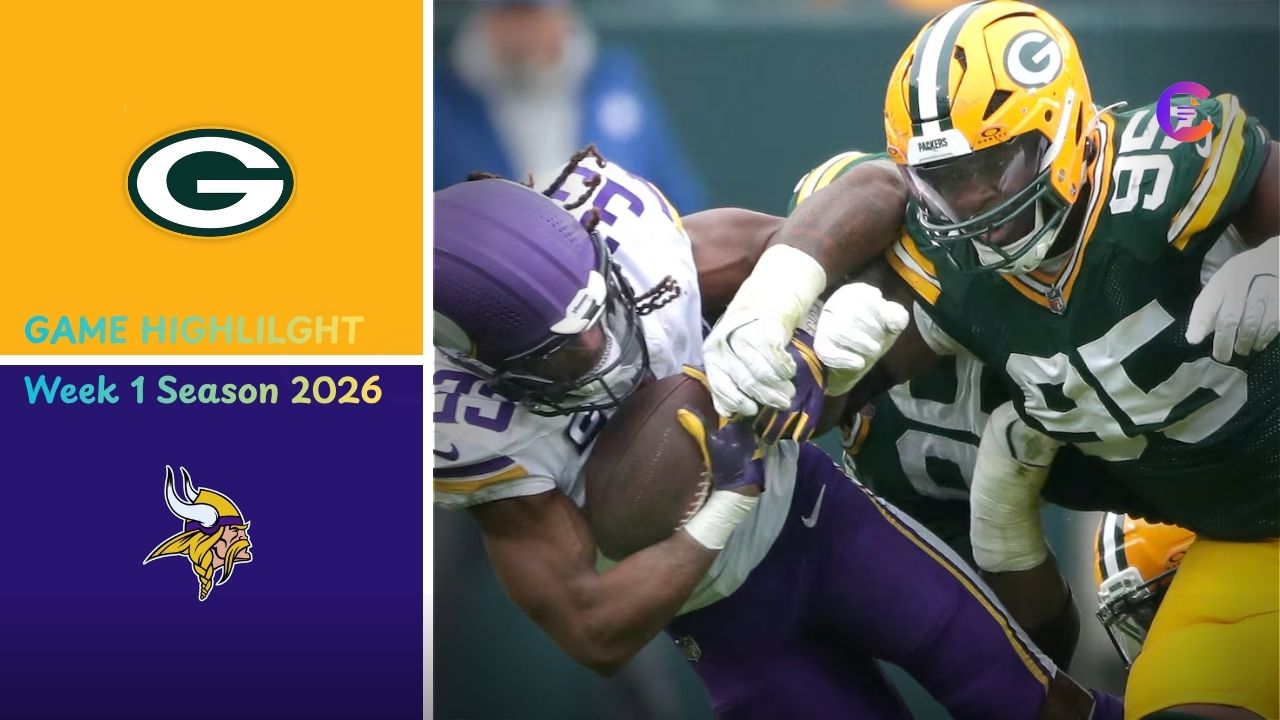
The Minnesota Vikings defeated the Green Bay Packers 39-22 in a dramatic Week 1 matchup on Sunday, September 13, 2026, at U.S. Bank Stadium in Minneapolis. Green Bay controlled much of the first three quarters and held a 22-10 advantage early in the second half. Minnesota then produced a stunning fourth-quarter comeback, scoring 22 unanswered points to turn the game around. The Vikings finished the afternoon with a 1-0 record, while the Packers opened the season at 0-1.
The final score did not reflect Green Bay’s statistical advantage in total yardage. The Packers gained 419 total yards, compared with only 239 for Minnesota. Green Bay also averaged 6.3 yards per play. However, turnovers, penalties, time of possession and Minnesota’s fourth-quarter execution changed the result. The Vikings committed only three penalties and one turnover, while Green Bay committed 12 penalties and two turnovers. NFL analysis highlighted Minnesota’s aggressive defensive approach as a major reason for the comeback.
Quarter-by-Quarter Scoring
| Quarter | Green Bay Packers | Minnesota Vikings |
|---|---|---|
| Q1 | 9 | 3 |
| Q2 | 10 | 7 |
| Q3 | 3 | 7 |
| Q4 | 0 | 22 |
| Final | 22 | 39 |
Green Bay opened the scoring with a 59-yard field goal from Trey Smack before Jordan Love connected with Christian Watson for an explosive 81-yard touchdown. Minnesota responded with a field goal, but the Packers continued to control the scoreboard. Green Bay led 9-3 after the first quarter and extended its advantage during the second period. Watson caught another touchdown from Love with only seconds remaining before halftime.
The third quarter still appeared to favor Green Bay when Smack added another field goal, giving the Packers a 22-10 lead. Minnesota answered through T.J. Hockenson’s touchdown reception, cutting the deficit to five points. The fourth quarter completely changed the contest. Minnesota scored 22 points without allowing Green Bay to answer, including touchdowns from Aaron Jones Sr., Jordan Mason and Justin Jefferson.
Match Details
The official NFL game center confirms the 39-22 final score, the U.S. Bank Stadium location and the quarter-by-quarter scoring breakdown. NFL’s schedule also lists the matchup as Minnesota’s Week 1 victory and Green Bay’s opening loss of the 2026 regular season.
The biggest takeaway from the Green Bay Packers vs Minnesota Vikings match player stats is that yardage alone did not determine the winner. Green Bay moved the ball better overall, but Minnesota made the critical plays when the game mattered most. The Vikings’ fourth-quarter defense, Carson Wentz’s efficient passing and Justin Jefferson’s touchdown production ultimately produced a memorable 39-22 comeback victory.
Jordan Love Passing Stats
Jordan Love delivered strong statistical production despite the Packers’ defeat. He completed 21 of 42 passes for 387 yards, two touchdowns and one interception. His 387 passing yards represented the biggest passing total in the game and helped Green Bay finish with 419 total yards. Love showed his ability to attack downfield, especially when he connected with Watson for the 81-yard touchdown in the first quarter.
However, Love struggled when Minnesota’s pressure became more aggressive late in the game. The Vikings defense repeatedly created pressure and eventually forced Love into critical mistakes. NFL analysis noted that Brian Flores sent pressure on a very high percentage of defensive plays, creating problems for Green Bay’s offensive line. Love’s late fumble and interception helped Minnesota turn its comeback into a comfortable 17-point victory.
Carson Wentz Leads Minnesota’s Comeback
Carson Wentz became one of the biggest stories of the game after replacing Kyler Murray. Wentz completed 12 of 19 passes for 133 yards and three touchdowns without an interception. His passing numbers were not enormous, but his efficiency and ability to deliver touchdowns in important situations helped Minnesota erase its deficit. His three touchdown passes went to T.J. Hockenson and Justin Jefferson.
Wentz also handled the pressure of entering the game unexpectedly. Murray had suffered a concussion during the first quarter and did not return. Wentz stepped in and helped the Vikings maintain their offensive structure. His touchdown connection with Jefferson during the fourth quarter was especially important because it came after Minnesota had already taken control. The Vikings ultimately scored 29 unanswered points during their comeback.
Christian Watson’s Huge Receiving Performance
Christian Watson was the Packers’ most explosive offensive player. He finished with six receptions for 147 yards and two touchdowns, averaging 24.5 yards per catch. His 81-yard touchdown was one of the game’s biggest individual plays and immediately gave Green Bay an early advantage. Watson later added a two-yard touchdown reception just before halftime.
Watson’s performance showed how dangerous Green Bay’s passing game could become when Love found time to throw. Matthew Golden also contributed six catches for 95 yards, while Tucker Kraft added three receptions for 65 yards. Despite those numbers, Green Bay could not maintain its offensive rhythm during the fourth quarter. Minnesota’s pressure prevented Love from consistently finding the same explosive opportunities late in the game.
Justin Jefferson’s Two-Touchdown Performance
Justin Jefferson remained a central part of Minnesota’s comeback. He caught eight passes for 92 yards and two touchdowns. His first touchdown came on a 39-yard reception from Wentz during the second quarter. That score kept Minnesota close while Green Bay appeared to be controlling the contest. Jefferson later produced another touchdown during the decisive fourth-quarter surge.
Jefferson also caught the successful two-point conversion following Aaron Jones Sr.’s fourth-quarter touchdown. That play gave Minnesota a 25-22 advantage and represented a major turning point. Instead of allowing Green Bay to regain control, the Vikings continued attacking and added additional touchdowns. Jefferson finished the game as Minnesota’s leading receiver and one of its most important offensive players.
Green Bay Packers Rushing Stats
Green Bay’s rushing attack could not match its passing production. MarShawn Lloyd led the Packers with 13 carries for 37 yards, while Chris Brooks added seven carries for 29 yards. Jordan Love recorded one rushing attempt for no gain. Overall, Green Bay produced only 21 rushing attempts, which placed significant pressure on Love and the passing game.
The lack of a consistent ground attack became increasingly important as Minnesota’s defense began attacking the quarterback. Green Bay had to rely heavily on Love’s arm, especially when the Packers were trying to protect their lead. Minnesota’s defense recognized that situation and increased its pressure. The result was a late collapse despite Green Bay gaining far more total yards than the Vikings.
Minnesota Vikings Rushing Stats
Minnesota relied more heavily on its running game. Jordan Mason led the Vikings with 15 carries for 59 yards and one touchdown, while Aaron Jones Sr. finished with 12 carries for 40 yards and one touchdown. Kyler Murray added nine rushing yards on two attempts before leaving the game. The Vikings finished with 34 rushing attempts, significantly more than Green Bay.
Mason and Jones became particularly important during the fourth quarter. Jones scored the go-ahead touchdown on a three-yard run, while Mason later added a one-yard touchdown. Those rushing scores helped Minnesota control the game after the defense had generated momentum. The Vikings’ balanced approach also helped them hold the ball for 32:58, compared with 27:02 for Green Bay.
Packers vs Vikings Player Stats
| Player | Team | Passing | Rushing | Receiving |
|---|---|---|---|---|
| Jordan Love | GB | 21/42, 387 yds, 2 TD, 1 INT | 1-0 | — |
| Carson Wentz | MIN | 12/19, 133 yds, 3 TD, 0 INT | 5–1 | — |
| Kyler Murray | MIN | 3/5, 18 yds, 0 TD, 1 INT | 2-9 | — |
| Christian Watson | GB | — | — | 6-147, 2 TD |
| Matthew Golden | GB | — | — | 6-95 |
| Tucker Kraft | GB | — | — | 3-65 |
| Justin Jefferson | MIN | — | — | 8-92, 2 TD |
| T.J. Hockenson | MIN | — | — | 4-36, 1 TD |
| Josh Oliver | MIN | — | — | 2-22 |
The player statistics show a clear contrast between the two teams. Green Bay produced the game’s biggest passing yardage through Love and Watson, while Minnesota relied on timely touchdowns and a more balanced offensive approach. Watson’s 147 receiving yards stood out, but Jefferson’s two touchdowns had a greater impact on the final result because they arrived during crucial moments. Wentz also avoided turnovers after taking over at quarterback.
Minnesota’s production was particularly impressive given Murray’s early departure. Wentz did not need to throw for 300 yards because the Vikings repeatedly converted important opportunities into touchdowns. Jefferson, Hockenson, Jones and Mason all contributed during the comeback. Green Bay’s players produced stronger raw yardage numbers, but Minnesota’s players delivered more effectively when the game reached its decisive stage.
Team Statistics Comparison
| Statistic | Green Bay | Minnesota |
|---|---|---|
| Total Yards | 419 | 239 |
| Yards Per Play | 6.3 | 3.9 |
| Plays | 67 | 61 |
| Rushing Attempts | 21 | 34 |
| Turnovers | 2 | 1 |
| Time of Possession | 27:02 | 32:58 |
| Penalties | 12 | 3 |
| Penalty Yards | 98 | 15 |
| Final Score | 22 | 39 |
These numbers explain why the game became such an unusual result. Green Bay gained 419 yards and averaged 6.3 yards per play, yet Minnesota won by 17 points. The biggest statistical disadvantages for Green Bay came from turnovers and penalties. The Packers committed 12 penalties for 98 yards, while Minnesota committed only three penalties for 15 yards. Those extra mistakes repeatedly gave the Vikings opportunities to extend drives.
Time of possession also favored Minnesota. The Vikings held the ball for 32:58, compared with 27:02 for Green Bay. Although the Packers produced more yards, Minnesota was more efficient when it mattered. The Vikings also finished with only one turnover. That combination allowed Minnesota to survive Green Bay’s statistical advantage and dominate the final quarter.
Kyler Murray’s Injury Changed the Game
Kyler Murray’s Vikings debut ended early after he suffered a concussion in the first quarter. He had completed 3 of 5 passes for 18 yards and thrown one interception before leaving. NFL reported that Murray suffered the injury after taking a hard hit while scrambling on third down. He did not return to the game and entered the concussion protocol.
The injury could have completely changed Minnesota’s chances, especially because Green Bay had already established control. Instead, Wentz stepped in and delivered three touchdown passes. His performance gave Minnesota stability and allowed the defense to continue attacking Love. The Vikings therefore overcame not only a double-digit deficit but also the loss of their starting quarterback during the game.
Brian Flores’ Defense Turns the Game Around
Minnesota defensive coordinator Brian Flores played an aggressive role in the comeback. NFL’s Week 1 analysis reported that the Vikings blitzed on 78.3% of defensive plays and generated a 50% pressure rate. That aggressive approach created serious problems for Green Bay’s offensive line, particularly during the second half.
The pressure became decisive in the fourth quarter. Green Bay’s offense could no longer create the same explosive plays it produced earlier. Love faced increasing pressure, and the Vikings forced turnovers during the closing minutes. The defensive strategy allowed Minnesota to erase the Packers’ statistical advantage and finish the game with a huge scoring run.
Fourth-Quarter Comeback Decides the Result
The fourth quarter began with Minnesota trailing 22-17, but the Vikings quickly changed the game. Aaron Jones Sr. scored a three-yard touchdown, and Wentz connected with Jefferson on the following two-point conversion. That gave Minnesota a 25-22 lead. Jordan Mason then added a one-yard rushing touchdown before Wentz found Jefferson again for another score.
Green Bay could not produce a response. The Packers failed to score during the fourth quarter while Minnesota added 22 points. NFL’s official analysis described the comeback as a result of Minnesota’s defensive pressure and Green Bay’s inability to overcome mistakes. The Vikings finished the game with 29 unanswered points, turning a 22-10 deficit into a 39-22 victory.
Final Match Summary
The Minnesota Vikings defeated the Green Bay Packers 39-22 in one of Week 1’s biggest comebacks. Green Bay appeared to have control for most of the afternoon and finished with 419 total yards. Jordan Love threw for 387 yards and two touchdowns, while Christian Watson recorded 147 receiving yards and two scores. However, the Packers’ 12 penalties, two turnovers and fourth-quarter offensive collapse prevented them from protecting their lead.
Minnesota showed remarkable resilience after losing Kyler Murray to a concussion. Carson Wentz stepped in and threw three touchdown passes, while Justin Jefferson caught two scoring passes. Aaron Jones Sr. and Jordan Mason added rushing touchdowns during the comeback. The Vikings’ defense then finished the job by applying relentless pressure to Love. The result gave Minnesota a 1-0 start and left Green Bay searching for answers after another late-game collapse.
Get More Update CONTENTORY