
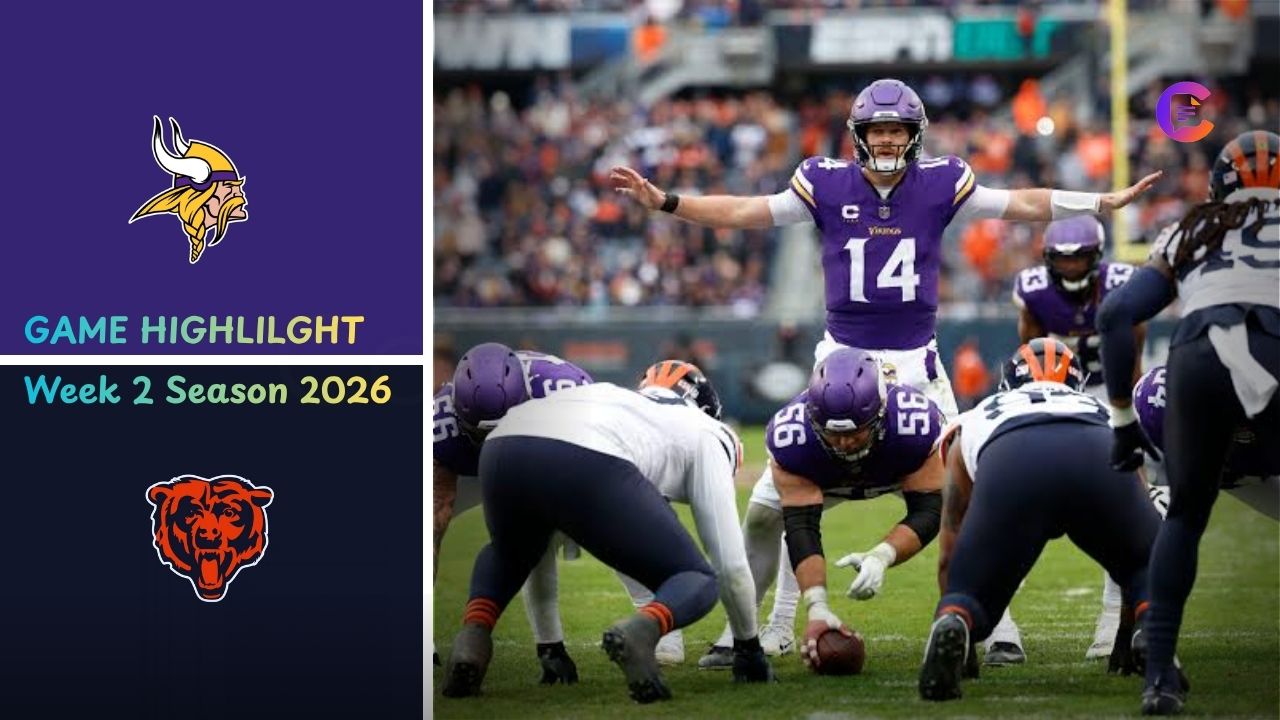
The Minnesota Vikings defeated the Chicago Bears 9-3 on September 20, 2026, in a defensive battle at rainy Soldier Field. Minnesota improved to 2-0 with the road victory, while Chicago dropped to 1-1. Neither team scored a touchdown, and all 12 points came from field goals. Will Reichard made all three of his attempts for Minnesota, while Cairo Santos converted one field goal for Chicago. The Vikings controlled the most important moments despite being outgained 297-246 by the Bears.
The game also featured major individual performances on both sides. Aaron Jones Sr. rushed for 105 yards on 23 carries, while Carson Wentz completed 11 of 20 passes for 143 yards. Justin Jefferson led Minnesota’s receiving group with 55 yards. Chicago quarterback Caleb Williams completed 15 of 26 passes for 138 yards and added 42 rushing yards before leaving with a hamstring injury. Tyson Bagent replaced him and helped the Bears reach the Minnesota 12-yard line late in the fourth quarter, but Dallas Turner ended the threat with a game-ending sack.
Final Score Table
| Team | Q1 | Q2 | Q3 | Q4 | Final |
|---|---|---|---|---|---|
| Minnesota Vikings | 3 | 3 | 0 | 3 | 9 |
| Chicago Bears | 3 | 0 | 0 | 0 | 3 |
Final Score and Match Details
Minnesota opened the scoring with a 35-yard field goal from Reichard in the first quarter. Chicago answered with Santos’ 50-yard kick, creating a 3-3 score after the opening period. Reichard added another field goal in the second quarter, giving the Vikings a 6-3 halftime advantage. Neither offense found the end zone during the third quarter, and the score remained 6-3 heading into the final period.
Reichard completed his third field goal early in the fourth quarter, connecting from 39 yards to give Minnesota a 9-3 lead. Chicago then mounted a late drive but could not finish it. Bagent connected with Rome Odunze for 21 yards and Luther Burden III for eight yards before the Bears reached the Vikings’ 12-yard line. Two incompletions followed, and Turner sacked Bagent on the final play to preserve Minnesota’s six-point victory.
Carson Wentz Player Stats
Carson Wentz started at quarterback for Minnesota with Kyler Murray working through the NFL concussion protocol. Wentz completed 11 of 20 passes for 143 yards and did not throw a touchdown or interception. He finished with a 77.7 passer rating and was sacked three times for 16 lost yards. His numbers were modest, but the veteran quarterback avoided turnovers and made several important throws during a difficult rainy afternoon.
Wentz also contributed six rushing yards on three attempts. His most important throw came during Minnesota’s final scoring drive, when he connected with Jordan Addison for a 15-yard gain on third down. That conversion helped keep the possession alive before Reichard eventually kicked the 39-yard field goal. Wentz did not produce a touchdown, but his ball security and late third-down completion helped Minnesota finish the game successfully.
Carson Wentz Passing Stats
| Stat | Carson Wentz |
|---|---|
| Completions | 11 |
| Attempts | 20 |
| Passing Yards | 143 |
| Passing TDs | 0 |
| Interceptions | 0 |
| Rating | 77.7 |
| Sacks | 3 |
Caleb Williams Player Stats
Caleb Williams completed 15 of 26 passes for 138 yards and one interception before leaving the game with a right hamstring injury. He also rushed five times for 42 yards, including a 17-yard run. Williams helped Chicago move the football at times, but Minnesota’s defense repeatedly prevented the Bears from finishing drives. His interception came during the first quarter when Byron Murphy Jr. picked off an ill-advised throw.
Williams remained involved after halftime and helped drive Chicago into scoring position during the third quarter. The Bears reached first-and-goal at the Minnesota 1-yard line, but D’Andre Swift lost a fumble after a hit from Jalen Redmond. Isaiah Rodgers recovered for Minnesota. Williams later suffered his hamstring injury on a scramble in the fourth quarter, forcing Bagent to take over for the final portion of the game.
Caleb Williams Passing Stats
| Stat | Caleb Williams |
|---|---|
| Completions | 15 |
| Attempts | 26 |
| Passing Yards | 138 |
| Passing TDs | 0 |
| Interceptions | 1 |
| Rating | 56.3 |
| Sacks | 3 |
Aaron Jones Leads the Vikings Rushing Attack
Aaron Jones Sr. was Minnesota’s leading offensive player, rushing 23 times for 105 yards. He averaged 4.6 yards per carry and recorded a long run of 20 yards. Jones provided stability for an offense that struggled to pass consistently in the wet conditions. His ability to gain steady yardage allowed Minnesota to control field position and avoid putting the entire burden on Wentz.
The Vikings finished with 119 net rushing yards on 28 attempts, averaging 4.2 yards per carry. Jones accounted for the majority of that production. Minnesota’s running game became particularly important because the Vikings converted only three of 13 third-down opportunities. The offense therefore relied heavily on Jones, field position and Reichard’s accuracy while the defense handled most of the pressure created by the low-scoring contest.
Vikings Rushing Leaders
| Player | Carries | Rushing Yards | Average | TD |
|---|---|---|---|---|
| Aaron Jones Sr. | 23 | 105 | 4.6 | 0 |
| DeeJay Dallas | 2 | 8 | 4.0 | 0 |
| Carson Wentz | 3 | 6 | 2.0 | 0 |
Justin Jefferson and Vikings Receiving Stats
Justin Jefferson led Minnesota’s receiving production with three receptions for 55 yards. His longest catch went for 30 yards, and that explosive reception helped set up the Vikings’ opening field goal. Jefferson also remained one of Wentz’s most important targets during an afternoon when the passing attack struggled to establish a consistent rhythm.
T.J. Hockenson added three receptions for 29 yards, while Josh Oliver recorded one catch for 24 yards. Minnesota’s receiving group did not produce a touchdown, but the team avoided turnovers through the air. The Vikings finished with 127 net passing yards, and Wentz’s 143 gross passing yards were reduced by the three sacks he absorbed.
Vikings Receiving Leaders
| Player | Receptions | Receiving Yards | TD | Long |
|---|---|---|---|---|
| Justin Jefferson | 3 | 55 | 0 | 30 |
| T.J. Hockenson | 3 | 29 | 0 | 19 |
| Josh Oliver | 1 | 24 | 0 | 24 |
D’Andre Swift Leads Chicago Skill Players
D’Andre Swift produced 99 total yards for Chicago, combining 45 rushing yards with 54 receiving yards. He carried the ball 16 times and caught five passes. His 32-yard reception was Chicago’s longest catch of the game, and his receiving work helped compensate for the Bears’ limited passing production. Swift also played a central role in one of the game’s most important moments.
Swift’s fumble in the third quarter became a major turning point. Chicago had driven to the Minnesota 1-yard line, creating an excellent opportunity to tie or take the lead. Jalen Redmond forced the fumble, and Isaiah Rodgers recovered for the Vikings. Chicago failed to score on the possession, and Minnesota eventually extended its lead with Reichard’s third field goal.
Bears Rushing and Receiving Leaders
| Player | Rushing | Rushing Yards | Receptions | Receiving Yards |
|---|---|---|---|---|
| D’Andre Swift | 16 | 45 | 5 | 54 |
| Kyle Monangai | 10 | 47 | 2 | 11 |
| Caleb Williams | 5 | 42 | — | — |
| Rome Odunze | — | — | 3 | 43 |
| Kalif Raymond | — | — | 5 | 40 |
| Luther Burden III | — | — | 3 | 32 |
Dallas Turner and Vikings Defense
Dallas Turner delivered one of Minnesota’s biggest defensive performances. He recorded two sacks and five tackles, including the game-ending sack of Tyson Bagent. Turner also recorded a sack during the Vikings’ Week 1 victory over Green Bay, continuing his early-season impact as a pass rusher. His pressure became especially important when Chicago attempted its final comeback.
Blake Cashman also made a significant contribution with 10 tackles and a sack. Byron Murphy Jr. intercepted Williams during the first quarter, while Isaiah Rodgers recovered Swift’s fumble and later blocked a late Bears field-goal attempt. Minnesota recorded four sacks overall and forced two Chicago turnovers. Those defensive plays compensated for the Vikings’ offensive struggles and helped them protect the narrow lead.
Chicago Bears Defensive Performance
Chicago’s defense kept the team within striking distance throughout the game. The Bears held Minnesota to only 246 total yards and limited Wentz to 143 passing yards. Minnesota managed only 11 first downs and converted three of 13 third-down attempts. Those numbers demonstrate how effectively Chicago’s defense prevented sustained offensive drives.
The Bears’ defense also benefited from Minnesota’s problems in the passing game. Wentz was sacked three times, and the Vikings repeatedly faced difficult down-and-distance situations. However, Chicago’s offense could not capitalize on the defensive effort. The Bears generated 297 total yards but committed two turnovers and went 0-for-3 in the red zone, leaving points on the field throughout the afternoon.
Team Statistics Comparison
The Bears actually produced more total offense than Minnesota. Chicago finished with 297 total yards compared with Minnesota’s 246, while also holding a possession advantage of 32:41 to 27:19. Chicago recorded 17 first downs, six more than Minnesota. However, the Bears’ two turnovers and inability to score a touchdown proved costly.
Minnesota gained 119 rushing yards and 127 net passing yards. Chicago produced 134 rushing yards and 163 net passing yards. The Vikings made fewer mistakes, committing only three penalties for 25 yards and no turnovers. Chicago committed eight penalties for 58 yards and lost one of its two fumbles. The statistical profile shows why the final score remained close despite Minnesota controlling the decisive plays.
Team Comparison Table
| Statistic | Minnesota Vikings | Chicago Bears |
|---|---|---|
| Total Yards | 246 | 297 |
| Passing Yards | 127 | 163 |
| Rushing Yards | 119 | 134 |
| First Downs | 11 | 17 |
| Total Plays | 51 | 70 |
| Yards Per Play | 4.8 | 4.2 |
| Possession | 27:19 | 32:41 |
| Turnovers | 0 | 2 |
| Third Down | 3/13 | 5/15 |
| Red Zone | 0/1 | 0/3 |
| Penalties | 3-25 | 8-58 |
Key Turning Points of the Game
The first major turning point came in the third quarter when Chicago reached the Minnesota 1-yard line. Swift appeared positioned to give the Bears a chance to score, but Redmond forced a fumble and Rodgers recovered. Instead of potentially taking the lead, Chicago left the possession without points. That turnover became especially important because the game ultimately ended with only a six-point margin.
The final turning point came during the fourth quarter. Reichard extended Minnesota’s advantage to 9-3 with his 39-yard field goal, but Chicago still had enough time for a final drive. Bagent moved the Bears deep into Vikings territory with completions to Odunze and Burden. Chicago reached the Minnesota 12, but two incomplete passes stopped the momentum. Turner then sacked Bagent on fourth down, ending the game.
Final Match Summary
The Minnesota Vikings defeated the Chicago Bears 9-3 in a defensive Week 2 contest at Soldier Field. Aaron Jones led Minnesota with 105 rushing yards, Carson Wentz passed for 143 yards without an interception, and Justin Jefferson produced 55 receiving yards. Will Reichard converted all three of his field-goal attempts. The Vikings also forced two turnovers and recorded four sacks, allowing them to win despite producing fewer total yards than Chicago.
For Chicago, Caleb Williams finished with 138 passing yards and 42 rushing yards before leaving with a hamstring injury. Tyson Bagent then completed five of nine passes for 54 yards and nearly led a late scoring drive. D’Andre Swift finished with 99 total yards, while Rome Odunze recorded 43 receiving yards. However, the Bears went 0-for-3 in the red zone and could not overcome their turnovers. Minnesota therefore moved to 2-0, while Chicago fell to 1-1.
Get More Update CONTENTORY