

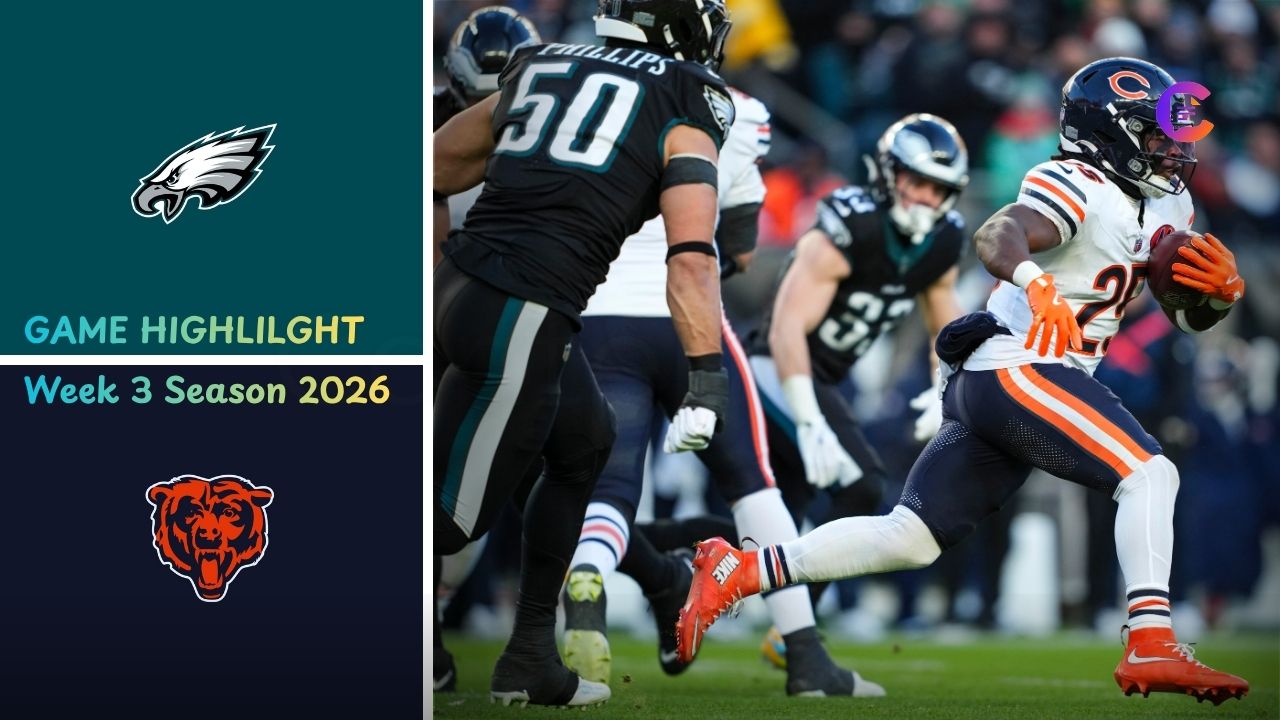
The Philadelphia Eagles vs Chicago Bears matchup on September 28, 2026, produced a decisive 27–7 victory for Chicago at Soldier Field. The Bears entered the game without starting quarterback Caleb Williams, who was sidelined with a hamstring injury. Backup Tyson Bagent also remained unavailable for the starting role after his concussion situation. That left veteran Case Keenum to make his first regular-season start since 2023. Keenum responded with an efficient performance that helped Chicago control the game from the first quarter.
Philadelphia entered the Monday Night Football contest with a 2–0 record. The Eagles struggled to maintain offensive rhythm, however, and committed three turnovers while collecting 248 total yards. Jalen Hurts completed 16 of 25 passes for 153 yards, while also rushing for a touchdown. Chicago created three takeaways and controlled possession for 36:53, allowing the Bears to turn a close halftime score into a comfortable second-half victory.
Match Details
| Match Detail | Information |
|---|---|
| Match | Philadelphia Eagles vs Chicago Bears |
| Date | September 28, 2026 |
| Week | Week 3 |
| Venue | Soldier Field |
| Location | Chicago, Illinois |
| Final Score | Bears 27, Eagles 7 |
| Eagles Record | 2–1 |
| Bears Record | 2–1 |
| Halftime Score | Bears 10, Eagles 7 |
The game took place at Soldier Field in Chicago during Week 3 of the 2026 NFL regular season. Philadelphia scored all seven of its points before halftime, while Chicago added points in every quarter. The Bears led 7–0 after the opening period and carried a 10–7 advantage into halftime. Chicago then produced 17 unanswered points after the break to complete the 27–7 victory.
The result moved both teams to 2–1 after three games. Chicago finished with 375 total yards compared with Philadelphia’s 248. The Bears also ran 69 offensive plays to Philadelphia’s 47 and held the ball for nearly 37 minutes. The Eagles committed 10 penalties for 61 yards, while Chicago had five penalties for 45 yards.
Final Score and Quarter-by-Quarter Breakdown
Chicago started quickly when Case Keenum connected with Luther Burden III for an eight-yard touchdown. Cairo Santos added the extra point, giving the Bears a 7–0 lead. Philadelphia reached the red zone later in the half but could not finish the drive with a touchdown. Santos added a 29-yard field goal, pushing Chicago ahead 10–0 before Philadelphia finally answered just before halftime.
Jalen Hurts scored on a one-yard quarterback sneak with one second remaining in the second quarter. The touchdown cut Chicago’s advantage to 10–7 and gave Philadelphia a chance entering halftime. That opportunity disappeared quickly after the break. Chicago scored 10 points in the third quarter and another seven in the fourth, while Philadelphia failed to score again.
| Quarter | Philadelphia Eagles | Chicago Bears |
|---|---|---|
| Q1 | 0 | 7 |
| Q2 | 7 | 3 |
| Q3 | 0 | 10 |
| Q4 | 0 | 7 |
| Final | 7 | 27 |
Case Keenum Delivers a Standout Performance
Case Keenum became the central story of the game after stepping into Chicago’s starting lineup under difficult circumstances. The veteran quarterback completed 24 of 34 passes for 247 yards and two touchdowns without throwing an interception. He also rushed four times for six yards and scored a one-yard touchdown in the fourth quarter. His 110.8 passer rating reflected an efficient night against the Eagles defense.
Keenum also managed the offense effectively during several important possessions. His first scoring drive covered 66 yards and ended with his touchdown pass to Burden. In the third quarter, he found Kalif Raymond for a 41-yard touchdown that expanded Chicago’s lead to 20–7. His rushing touchdown later in the game completed the Bears’ scoring and effectively removed any remaining doubt.
Jalen Hurts and the Eagles Offense
Jalen Hurts completed 16 of 25 passes for 153 yards, with no passing touchdowns and one interception. He added 25 rushing yards on four attempts and scored Philadelphia’s only touchdown. His passing performance was below his production through the first two weeks, as Chicago consistently disrupted Philadelphia’s offensive rhythm after halftime.
Hurts briefly left the game during a Philadelphia drive in the second quarter for a concussion evaluation. Andy Dalton entered and threw an interception in the end zone on third-and-goal from the Chicago two-yard line. Hurts returned later and helped Philadelphia score before halftime, but the Eagles could not generate another scoring drive after the break.
Saquon Barkley Leads Philadelphia’s Rushing Attack
Saquon Barkley was Philadelphia’s leading rusher, finishing with 15 carries for 82 yards. He averaged 5.5 yards per attempt and recorded a 17-yard run as his longest gain. Barkley also caught one pass for minus-two yards. His rushing production provided Philadelphia with some consistency, but the Eagles struggled to turn those yards into points.
Jalen Hurts added 25 rushing yards and the team’s lone rushing touchdown. Philadelphia finished with 107 rushing yards on 19 attempts, according to the game data. Despite averaging 5.6 yards per rushing attempt, the Eagles had too few offensive possessions to build sustained momentum. Chicago’s defense also forced three takeaways, limiting Philadelphia’s opportunities to capitalize on its rushing production.
Philadelphia Eagles Receiving Stats
DeVonta Smith led Philadelphia’s receiving group with six catches for 65 yards on eight targets. His longest reception covered 30 yards. Dontayvion Wicks added two receptions for 32 yards, while Makai Lemon caught three passes for 29 yards. The Eagles did not record a receiving touchdown during the game.
Philadelphia completed 16 passes for 153 yards, but the passing game struggled to consistently move the chains. The Bears defense limited explosive plays and generated two interceptions, including one from T.J. Edwards against Hurts and one from Dillon Thieneman against Dalton. Those turnovers became important factors in Chicago’s ability to control the contest.
| Eagles Player | Receiving Stats |
|---|---|
| DeVonta Smith | 6 receptions, 65 yards |
| Dontayvion Wicks | 2 receptions, 32 yards |
| Makai Lemon | 3 receptions, 29 yards |
| Will Shipley | 1 reception, 11 yards |
| Zach Ertz | 1 reception, 9 yards |
| Johnny Mundt | 1 reception, 4 yards |
| Tank Bigsby | 1 reception, 5 yards |
Chicago Bears Receiving Stats
Kalif Raymond produced one of the biggest offensive plays of the night for Chicago. He caught six passes for 90 yards and a touchdown, including a 41-yard scoring reception from Keenum in the third quarter. That play extended the Bears’ lead and shifted the game firmly in Chicago’s favor.
Luther Burden III also delivered an important performance. He caught seven passes for 61 yards and a touchdown while adding seven rushing yards. His eight-yard touchdown reception opened the scoring, giving Chicago early confidence. Rome Odunze contributed three catches for 44 yards, while Colston Loveland caught four passes for 31 yards.
| Bears Player | Receiving Stats |
|---|---|
| Kalif Raymond | 6 receptions, 90 yards, 1 TD |
| Luther Burden III | 7 receptions, 61 yards, 1 TD |
| Rome Odunze | 3 receptions, 44 yards |
| Colston Loveland | 4 receptions, 31 yards |
| Sam Roush | 1 reception, 16 yards |
| Zavion Thomas | 1 reception, 1 yard |
D’Andre Swift Provides Ground Production
D’Andre Swift led Chicago’s rushing attack with 20 carries for 84 yards. He averaged 4.2 yards per carry and produced a 15-yard run. Swift also caught two passes for four yards. His work helped Chicago maintain balance while Keenum handled the passing responsibilities.
Kyle Monangai added 31 rushing yards on 10 attempts, while Burden contributed seven yards on his single rushing attempt. As a team, Chicago recorded 128 rushing yards on 35 attempts. The Bears did not need a huge rushing total because Keenum’s passing efficiency and the defense’s takeaways gave the offense favorable situations throughout the game.
Bears Defense Creates the Turning Points
Chicago’s defense played a major role in the 20-point victory. The Bears generated three takeaways and held Philadelphia to 248 total yards. They also forced the Eagles into three straight three-and-out possessions to begin the second half, immediately putting pressure on Philadelphia’s offense.
Two interceptions became especially important. Dillon Thieneman intercepted Andy Dalton in the end zone during the second quarter, ending a promising Eagles drive. T.J. Edwards later intercepted Hurts on fourth down in the third quarter. That second interception came with Philadelphia trying to respond after Chicago had opened a 20–7 advantage.
Team Comparison and Key Statistics
The statistical profile shows why Chicago controlled the game. The Bears ran 69 plays compared with Philadelphia’s 47 and finished with 375 total yards against 248 for the Eagles. Chicago also controlled possession for 36:53, leaving Philadelphia with only 23:07. That difference gave Keenum and the Bears offense considerably more time to operate.
Philadelphia’s 10 penalties also hurt its chances. NFL.com reported that the Eagles were penalized twice as often as Chicago, with 10 infractions for 61 yards compared with five penalties for 45 yards. The Eagles also committed three turnovers, while Chicago finished without a turnover. Those differences helped Chicago sustain drives and prevent Philadelphia from recovering after halftime.
| Team Statistic | Eagles | Bears |
|---|---|---|
| Total Yards | 248 | 375 |
| Passing Yards | 141 | 247 |
| Rushing Yards | 107 | 128 |
| Offensive Plays | 47 | 69 |
| Yards per Play | 5.3 | 5.4 |
| Possession | 23:07 | 36:53 |
| Turnovers | 3 | 0 |
| Penalties | 10 | 5 |
| Penalty Yards | 61 | 45 |
Match Highlights and Turning Points
The first major turning point came when Chicago’s defense recovered a fumble after Austin Booker forced a short reception by Tank Bigsby to come loose. The Bears recovered at the Philadelphia 15-yard line, creating a valuable scoring opportunity. Although Chicago failed to score a touchdown on that possession, the defensive pressure continued to make Philadelphia work for every opportunity.
The second half became the decisive phase. Chicago opened the third quarter with another field goal and then Keenum connected with Raymond for a 41-yard touchdown. Philadelphia’s offense could not respond, and Edwards intercepted Hurts late in the third quarter. Keenum’s one-yard touchdown run in the fourth quarter completed a 17-point second-half effort and gave Chicago its final 27–7 margin.
Philadelphia Eagles vs Chicago Bears Player Stats Summary
The player statistics show contrasting performances at quarterback. Keenum completed 24 of 34 attempts for 247 yards, two touchdowns and no interceptions. Hurts completed 16 of 25 attempts for 153 yards, no passing touchdowns and one interception. Hurts did contribute a rushing touchdown, but Chicago’s defense limited his overall passing impact.
The skill-position numbers also underline Chicago’s balanced approach. Swift led the Bears in rushing, while Raymond and Burden produced the team’s two receiving touchdowns. For Philadelphia, Barkley supplied 82 rushing yards and Smith led the receiving group with 65 yards. However, Philadelphia could not turn those individual contributions into sustained scoring drives.
| Category | Philadelphia Eagles | Chicago Bears |
|---|---|---|
| Passing Leader | Jalen Hurts — 153 yards | Case Keenum — 247 yards |
| Rushing Leader | Saquon Barkley — 82 yards | D’Andre Swift — 84 yards |
| Receiving Leader | DeVonta Smith — 65 yards | Kalif Raymond — 90 yards |
| Passing TDs | 0 | 2 |
| Rushing TDs | 1 | 1 |
| Interceptions Thrown | 2 team | 0 |
| Final Score | 7 | 27 |
Conclusion
The Philadelphia Eagles vs Chicago Bears matchup became a statement performance for Chicago’s defense and Case Keenum. The veteran quarterback stepped into the lineup and produced 247 passing yards, two passing touchdowns and one rushing touchdown without a turnover. The Bears defense added three takeaways while limiting Philadelphia to seven points. Chicago also controlled possession and offensive volume, creating the conditions for a 27–7 victory at Soldier Field.
Philadelphia will need to correct several areas after its first loss of the season. The Eagles managed only 248 total yards, committed three turnovers and finished with 10 penalties. Chicago, meanwhile, moved to 2–1 behind an efficient passing game and a defense that produced timely takeaways. The final score reflected a second half in which the Bears outscored Philadelphia 17–0 and closed the game with control on both sides of the ball.
Get More Update CONTENTORY