
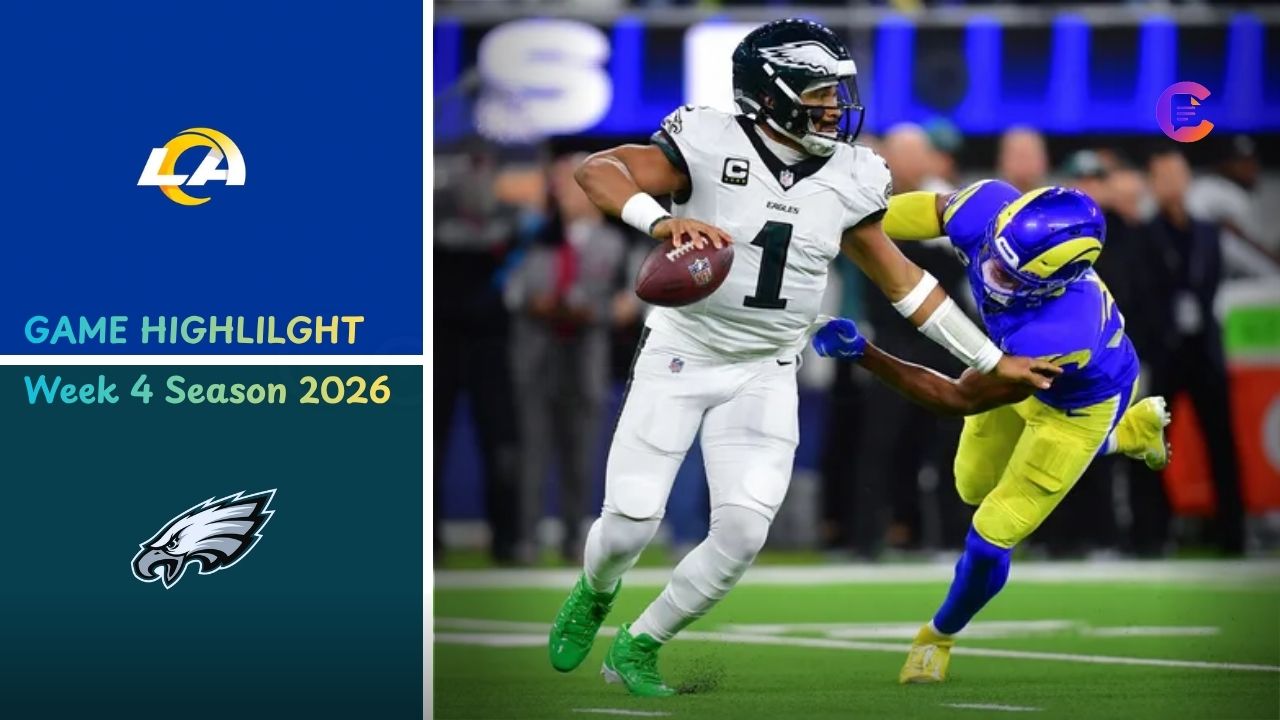
The Los Angeles Rams vs Philadelphia Eagles Match Player Stats 24-20 on October 4, 2026, at Lincoln Financial Field. The Rams overcame a 10-point halftime deficit with 14 unanswered points in the fourth quarter. Philadelphia led 20-10 entering the final period, but Los Angeles produced two Kyren Williams rushing touchdowns to complete the comeback. The victory moved the Rams to 2-2, while the Eagles also dropped to 2-2 after failing to score in the second half.
The game featured a major contrast between the two offenses. Matthew Stafford threw for 317 yards, while Puka Nacua recorded 125 receiving yards in his return from injury. Jalen Hurts threw two touchdown passes to Darius Cooper, but Philadelphia managed only 172 total yards. The Eagles also went 0-for-12 on third down, while the Rams controlled 32 minutes of possession and produced 415 total yards.
Final Score
| Team | Q1 | Q2 | Q3 | Q4 | Final |
|---|---|---|---|---|---|
| Los Angeles Rams | 3 | 7 | 0 | 14 | 24 |
| Philadelphia Eagles | 3 | 17 | 0 | 0 | 20 |
Los Angeles and Philadelphia exchanged field goals during an evenly matched first quarter. Jake Elliott opened the scoring with a 29-yard field goal before Harrison Mevis answered with a 40-yard kick. Elliott then connected from 56 yards in the second quarter, giving Philadelphia a 6-3 lead. The Eagles later created separation when Darius Cooper caught an 18-yard touchdown from Hurts.
The Rams answered with a Puka Nacua two-yard rushing touchdown, but Cooper caught another touchdown pass before halftime. His second score came on a 10-yard reception with only three seconds left in the second quarter. That play gave Philadelphia a 20-10 advantage and appeared to put the Eagles in a strong position entering the second half.
Kyren Williams Leads the Rams Comeback
Kyren Williams became the central figure in the Rams’ fourth-quarter comeback. He finished with 16 carries for 80 rushing yards and two touchdowns. He also caught 10 passes for 67 yards, giving him 147 yards from scrimmage. His combination of rushing and receiving production allowed Los Angeles to maintain pressure on Philadelphia throughout the final period.
Williams’ first fourth-quarter touchdown came on a one-yard run that cut Philadelphia’s lead to 20-17. After the Rams defense forced another stop, Williams finished the next scoring drive with a seven-yard touchdown run. That score gave Los Angeles a 24-20 advantage with 1:10 remaining and completed the Rams‘ comeback.
Matthew Stafford Delivers Through the Air
Matthew Stafford completed 32 of 51 passes for 317 yards. He did not throw a touchdown pass and was intercepted twice, but his passing production helped the Rams generate 415 total yards. Stafford continued attacking downfield even after Philadelphia’s defense intercepted him twice during the first half.
Stafford’s biggest contribution came during the fourth-quarter comeback. The quarterback directed the Rams on two long scoring drives after Philadelphia had built its 20-10 lead. His ability to move the offense late helped create opportunities for Williams near the goal line. Stafford eventually took a knee after the Rams secured possession in the final seconds.
Puka Nacua Makes Strong Return
Puka Nacua returned from injury and immediately made an impact. He caught nine passes for 125 yards, with a long reception of 32 yards. His performance gave Stafford a reliable target throughout the afternoon and helped the Rams generate consistent passing yardage against Philadelphia’s defense.
Nacua also scored on the ground during the second quarter. He took a two-yard run into the end zone after a lengthy Rams drive. Although his rushing touchdown was the only touchdown he scored, his 125 receiving yards made him one of the game’s most productive offensive players. His return added an important dimension to the Rams’ attack.
Read Jacksonville Jaguars vs Cincinnati Bengals Match Player Stats, Score and Highlights
Jalen Hurts and Darius Cooper Connect Twice
Jalen Hurts completed 12 of 27 passes for 93 yards and two touchdowns. Both touchdown passes went to Darius Cooper, who emerged as Philadelphia’s most productive scoring threat. Cooper caught three passes for 33 yards, with his two touchdowns coming on receptions of 18 and 10 yards.
Cooper’s first touchdown came in the second quarter when he made an 18-yard reception from Hurts. His second touchdown arrived just before halftime and extended Philadelphia’s lead to 20-10. Despite those two scores, the Eagles’ offense struggled after halftime and failed to score on its final six possessions.
Eagles Offense Struggles in Second Half
Philadelphia entered halftime with a 20-10 lead, but its offense completely stalled after the break. The Eagles failed to score in the third and fourth quarters. They also converted none of their 12 third-down opportunities, making it extremely difficult to sustain drives against the Rams defense.
The Eagles finished with only 172 total yards, including 68 net passing yards. Hurts completed just 12 passes, while the Rams repeatedly pressured him during the decisive fourth quarter. Philadelphia’s inability to extend drives gave Los Angeles enough opportunities to erase the deficit and take control late.
Rams Defense Makes the Difference Late
The Rams defense allowed Philadelphia to build a 20-10 lead but responded when the game mattered most. The unit forced the Eagles to punt after the Rams’ first fourth-quarter touchdown. That stop gave Stafford another opportunity, and Los Angeles converted it into the go-ahead score.
Byron Young played a major role on the final Philadelphia possession. He recorded two sacks of Hurts during the Eagles’ last drive, including a strip-sack that pushed Philadelphia backward. On fourth-and-25, Hurts could not complete his pass to Cooper, allowing the Rams to secure the victory.
Rams vs Eagles Key Player Stats
The player statistics highlight how dramatically the game changed after halftime. Stafford produced 317 passing yards and Nacua gained 125 receiving yards. Williams added 80 rushing yards, 67 receiving yards and two rushing touchdowns. Together, those performances helped Los Angeles generate 415 total yards.
Philadelphia’s statistical leaders produced a very different picture. Hurts finished with 93 passing yards and two touchdowns, while Tank Bigsby led the Eagles with 55 rushing yards. Cooper supplied both receiving touchdowns, but Philadelphia could not maintain its first-half momentum. The contrast between the teams’ fourth-quarter production ultimately determined the result.
| Player | Team | Key Statistics |
|---|---|---|
| Matthew Stafford | Rams | 32/51, 317 passing yards, 2 INT |
| Kyren Williams | Rams | 16 carries, 80 yards, 2 TD; 10 receptions, 67 yards |
| Puka Nacua | Rams | 9 receptions, 125 yards; 1 rushing TD |
| Tyler Higbee | Rams | 5 receptions, 67 yards |
| Jalen Hurts | Eagles | 12/27, 93 passing yards, 2 TD |
| Darius Cooper | Eagles | 3 receptions, 33 yards, 2 TD |
| Tank Bigsby | Eagles | 14 carries, 55 yards |
| Makai Lemon | Eagles | 3 receptions, 27 yards |
Rams Dominate the Overall Yardage Battle
The Rams finished with 415 total yards compared with only 172 for Philadelphia. Los Angeles also recorded 26 first downs against the Eagles’ 12. The Rams ran 77 offensive plays, while Philadelphia ran only 58. Those numbers show how much more consistently Los Angeles moved the football.
Los Angeles controlled possession for 32 minutes and converted 7 of 16 third downs. Philadelphia converted none of its 12 third-down attempts. The Rams did turn the ball over twice, both on Stafford interceptions, but Philadelphia could not capitalize enough to preserve its lead.
| Team Statistic | Rams | Eagles |
|---|---|---|
| Final Score | 24 | 20 |
| Total Yards | 415 | 172 |
| First Downs | 26 | 12 |
| Rushing Yards | 106 | 104 |
| Net Passing Yards | 309 | 68 |
| Offensive Plays | 77 | 58 |
| Third Down | 7/16 | 0/12 |
| Turnovers | 2 | 0 |
| Time of Possession | 32:00 | 28:00 |
| Penalties | 8-100 | 10-57 |
Final Drive Seals the Rams Victory
Philadelphia still had an opportunity after the Rams took a 24-20 lead. However, the final possession quickly turned into a defensive showcase for Los Angeles. Young sacked Hurts on first down and later produced another sack that included a forced fumble. The Eagles recovered the ball, but the resulting fourth-down situation became nearly impossible to convert.
Hurts’ final pass attempt targeted Cooper, but the Rams defense prevented the completion on fourth-and-25. Los Angeles took possession and Stafford kneeled to end the game. The final sequence completed one of the biggest comebacks of the Week 4 schedule and gave the Rams a 2-2 record.
What the Result Means for Both Teams
The victory gave the Rams a 2-2 record and demonstrated their ability to recover from a major halftime deficit. Los Angeles produced 14 unanswered fourth-quarter points and finished with more than twice Philadelphia’s total yardage. The comeback also showed the value of Williams, Nacua and the Rams defensive front during high-pressure moments.
Philadelphia also moved to 2-2 after the defeat. The Eagles can point to a strong first half, but their second-half offensive collapse proved decisive. They produced no points after halftime and went 0-for-12 on third down. The inability to sustain possession allowed Los Angeles to control the final period and complete the comeback.
Conclusion
The Los Angeles Rams defeated the Philadelphia Eagles 24-20 on October 4, 2026, after overcoming a 20-10 halftime deficit. Kyren Williams scored twice in the fourth quarter, while Puka Nacua produced 125 receiving yards in his return from injury. Matthew Stafford threw for 317 yards, and the Rams finished with 415 total yards. The defense then held Philadelphia scoreless throughout the second half.
The Eagles’ first-half performance showed their offensive potential, but their second-half struggles changed the game. Hurts finished with two touchdown passes, both to Darius Cooper, yet Philadelphia failed to convert any third downs. Byron Young’s two late sacks helped close the game, and the Rams completed a dramatic road comeback to improve to 2-2.
Get More Update CONTENTORY