
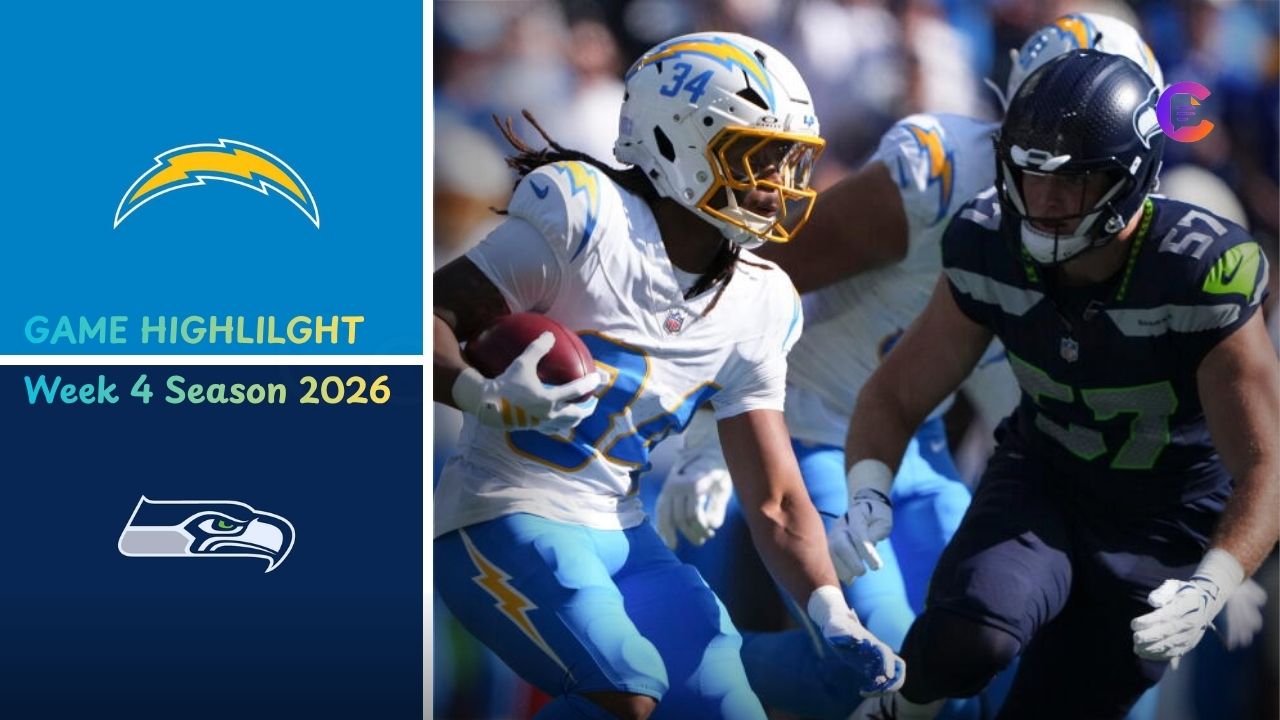
The Los Angeles Chargers vs Seattle Seahawks Match Player Stats 30–23 in a dramatic Week 4 matchup at Lumen Field on October 4, 2026. Seattle controlled much of the game early and built a 27–6 advantage before Los Angeles launched a strong second-half comeback. The Seahawks eventually held on to improve to 3–1, while the Chargers fell to 0–4. The result reflected Seattle’s early dominance, timely defensive plays, and ability to capitalize on several costly Los Angeles mistakes.
Sam Darnold delivered two touchdown passes for Seattle, while running back Emanuel Wilson produced 81 rushing yards and scored twice through different methods. Jaxon Smith-Njigba also led the Seahawks in receiving with 76 yards. Justin Herbert finished with 189 passing yards, one touchdown, and two interceptions. He also rushed for 40 yards. The Chargers improved after halftime, but Seattle’s early 21-point advantage proved too difficult to overcome.
Final Score
Seattle established control during the first half and entered halftime with a 20–6 lead. The Chargers opened the scoring with Cameron Dicker’s 40-yard field goal, but the Seahawks quickly answered with an Emanuel Wilson touchdown reception. Rasheed Shaheed later scored on a 28-yard rushing play, and Wilson added an 88-yard rushing touchdown just before halftime.
The Seahawks added another touchdown early in the third quarter to stretch their advantage to 27–6. Los Angeles then responded with 17 consecutive points across the remainder of the game, including touchdowns from Kimani Vidal and Omarion Hampton. Dicker’s 35-yard field goal brought the Chargers within seven points with just over two minutes left, but Seattle’s defense forced a late fumble from Herbert to end the comeback attempt.
| Quarter | Los Angeles Chargers | Seattle Seahawks |
|---|---|---|
| 1st | 3 | 7 |
| 2nd | 3 | 13 |
| 3rd | 7 | 10 |
| 4th | 10 | 0 |
| Final | 23 | 30 |
Justin Herbert Player Stats
Justin Herbert completed 19 of 31 passes for 189 yards and one touchdown. He also threw two interceptions and finished with a 62.4 passer rating. The first half was especially difficult, as Herbert completed only five of 15 passes for 36 yards while throwing both interceptions. His first-half passer rating stood at only 4.8.
Herbert improved after halftime and helped Los Angeles turn a 21-point deficit into a one-score game. He also contributed 40 rushing yards on six attempts, including a 26-yard run. However, his final possession ended with a strip-sack that Seattle recovered. That turnover prevented the Chargers from getting another opportunity to tie the game.
Sam Darnold Leads Seattle’s Offense
Sam Darnold completed 13 of 22 passes for 168 yards and two touchdowns. He also threw one interception and finished with a 94.5 passer rating. His passing performance was efficient rather than volume-heavy, as Seattle leaned on its rushing attack and explosive plays to maintain control.
Darnold’s first touchdown came on a 23-yard connection with Emanuel Wilson in the opening quarter. He later found Tory Horton for a six-yard touchdown in the third quarter. Those scoring passes helped Seattle build its large early lead and gave the Seahawks enough breathing room to survive Los Angeles’ second-half surge.
Emanuel Wilson Becomes a Key Difference Maker
Emanuel Wilson was one of the most important players in the game. He carried the ball 21 times for 81 yards and one rushing touchdown. His longest run covered 15 yards. Wilson also caught three passes for 39 yards and another touchdown, giving him two total scores.
His 88-yard touchdown run was the biggest play of the first half and completely changed the momentum heading into halftime. Wilson also opened Seattle’s scoring with his 23-yard touchdown reception from Darnold. His ability to contribute as both a runner and receiver gave the Seahawks an effective offensive balance throughout the contest.
Explore Tennessee Titans vs Baltimore Ravens Match Player Stats Full Game Breakdown
Jaxon Smith-Njigba Leads Seahawks Receivers
Jaxon Smith-Njigba led Seattle’s receiving corps with five catches for 76 yards. He averaged 15.2 yards per reception and recorded a long gain of 28 yards. Although he did not score, his production helped Seattle maintain offensive efficiency during a game where the passing volume remained moderate.
Wilson was the Seahawks’ second-leading receiver with three receptions for 39 yards and a touchdown. Rasheed Shaheed added 20 receiving yards, while Cooper Kupp contributed 13 yards. Tory Horton caught one pass for six yards, but that reception became significant because it produced Seattle’s third-quarter touchdown.
Chargers Offensive Player Statistics
The Chargers received useful contributions from several players despite the difficult opening half. Tre Harris led Los Angeles with three receptions for 60 yards, while Quentin Johnston recorded one catch for 44 yards. Oronde Gadsden Jr. added five receptions for 36 yards.
On the ground, rookie Omarion Hampton led the Chargers with nine carries for 45 yards and a touchdown. Justin Herbert followed with 40 rushing yards, while Keaton Mitchell added 39 yards on 10 carries. Kimani Vidal rushed five times for 25 yards and also caught a nine-yard touchdown pass from Herbert.
| Player | Team | Statistics |
|---|---|---|
| Justin Herbert | Chargers | 19/31, 189 yards, 1 TD, 2 INT |
| Omarion Hampton | Chargers | 9 carries, 45 yards, 1 TD |
| Tre Harris | Chargers | 3 receptions, 60 yards |
| Quentin Johnston | Chargers | 1 reception, 44 yards |
| Kimani Vidal | Chargers | 5 carries, 25 yards; 2 receptions, 11 yards, 1 TD |
| Sam Darnold | Seahawks | 13/22, 168 yards, 2 TD, 1 INT |
| Emanuel Wilson | Seahawks | 21 carries, 81 yards, 1 TD; 3 receptions, 39 yards, 1 TD |
| Jaxon Smith-Njigba | Seahawks | 5 receptions, 76 yards |
| Rasheed Shaheed | Seahawks | 2 carries, 33 yards, 1 TD |
Los Angeles Chargers vs Seattle Seahawks Team Stats
Seattle finished with 301 total yards compared with 286 for Los Angeles. The Seahawks produced 154 passing yards and 147 rushing yards, while the Chargers recorded 148 passing yards and 138 rushing yards. Seattle also controlled possession for 30:59, compared with 29:01 for Los Angeles.
The biggest statistical difference came in turnovers. The Chargers committed four turnovers, while Seattle turned the ball over only once. Los Angeles also struggled on third down, converting five of 15 attempts. Seattle converted three of 12, but its ability to create turnovers and score after mistakes helped overcome its own third-down struggles.
| Team Statistic | Chargers | Seahawks |
|---|---|---|
| Total Yards | 286 | 301 |
| Passing Yards | 148 | 154 |
| Rushing Yards | 138 | 147 |
| Total Plays | 58 | 68 |
| First Downs | 19 | 20 |
| Possession | 29:01 | 30:59 |
| Third Down | 5/15 | 3/12 |
| Red Zone | 2/4 | 2/3 |
| Turnovers | 4 | 1 |
| Yards Per Play | 4.9 | 4.4 |
Seattle’s Defense Creates the Difference
The Seahawks defense produced several important plays against Herbert. Ernest Jones IV led the team with 12 tackles and also recorded an interception. Devon Witherspoon finished with nine tackles, while Nick Emmanwori added nine tackles and a sack.
Uchenna Nwosu also made the decisive defensive play late in the game. He recorded a sack and forced the fumble that ended the Chargers’ final possession. Seattle’s defense also benefited from pressure throughout the contest, while Los Angeles’ four turnovers created short-field opportunities and helped the Seahawks build their early advantage.
Key Scoring Plays and Highlights
The Chargers opened the scoring when Cameron Dicker converted a 40-yard field goal. Seattle responded quickly when Darnold found Wilson for a 23-yard touchdown. Shaheed then extended the lead with a 28-yard rushing touchdown, and Wilson delivered the game’s biggest offensive play with an 88-yard touchdown run before halftime.
Seattle reached a 27–6 lead after Darnold’s touchdown pass to Horton in the third quarter. Los Angeles then began its comeback. Herbert connected with Vidal for a nine-yard touchdown, Hampton scored on a two-yard run, and Dicker added another field goal. The final Chargers field goal made it 30–23, but Seattle’s late defensive stand prevented overtime.
Penalties and Mistakes Shape the Game
The matchup became unusually penalty-heavy. Seattle committed 14 penalties for 150 yards, while Los Angeles was flagged 16 times for 130 yards. The combined 30 penalties made the game difficult to manage for both coaching staffs and contributed to an uneven offensive rhythm.
Turnovers created an even greater impact. Los Angeles lost four possessions through turnovers, including Herbert’s two interceptions and his late fumble. Derius Davis also lost a muffed punt that directly contributed to Seattle’s first touchdown drive. The Chargers’ official recap highlighted these early mistakes as a major reason Seattle established its 20–6 halftime advantage.
Second-Half Comeback Falls Short
The Chargers deserve credit for refusing to surrender after falling behind 27–6. Los Angeles outscored Seattle 17–10 in the second half and repeatedly moved the ball with more confidence. Herbert became more effective as the game progressed, while Hampton and Vidal provided important rushing and receiving contributions.
The comeback ultimately ended because the Chargers could not complete the final drive. After Dicker’s field goal made the score 30–23, Seattle used a personal-foul penalty to help extend its possession and drain valuable time. Herbert eventually got another chance, but Nwosu’s strip-sack produced the final turnover and sealed Seattle’s victory.
What the Result Means for Both Teams
Seattle improved to 3–1 with the victory and continued its strong start to the 2026 season. The Seahawks showed they could withstand a major second-half challenge after building a substantial lead. Their combination of rushing production, timely passing, and opportunistic defense proved enough to secure the win at Lumen Field.
For Los Angeles, the defeat dropped the Chargers to 0–4. The team showed fight after halftime, but its early turnovers and mistakes created too large a deficit. Herbert’s four total turnovers were particularly costly, while Seattle’s defense consistently produced important plays when the Chargers threatened to close the gap.
Conclusion
The Los Angeles Chargers vs Seattle Seahawks matchup produced a 30–23 Seattle victory after two very different halves. The Seahawks dominated the opening stages, built a 27–6 advantage, and used Wilson’s explosive performance to control the game. Darnold added two touchdown passes, while Smith-Njigba provided 76 receiving yards. Seattle’s defense then made enough plays late to prevent the Chargers from completing their comeback.
Los Angeles showed encouraging resilience by scoring 17 second-half points and cutting the deficit to seven. Herbert finished with 189 passing yards and one touchdown, while Hampton and Vidal contributed on the ground. However, four turnovers proved too damaging to overcome. Seattle’s 3–1 record contrasted sharply with Los Angeles’ 0–4 start, making the Week 4 result an important early-season statement for both teams.
Get More Update CONTENTORY