
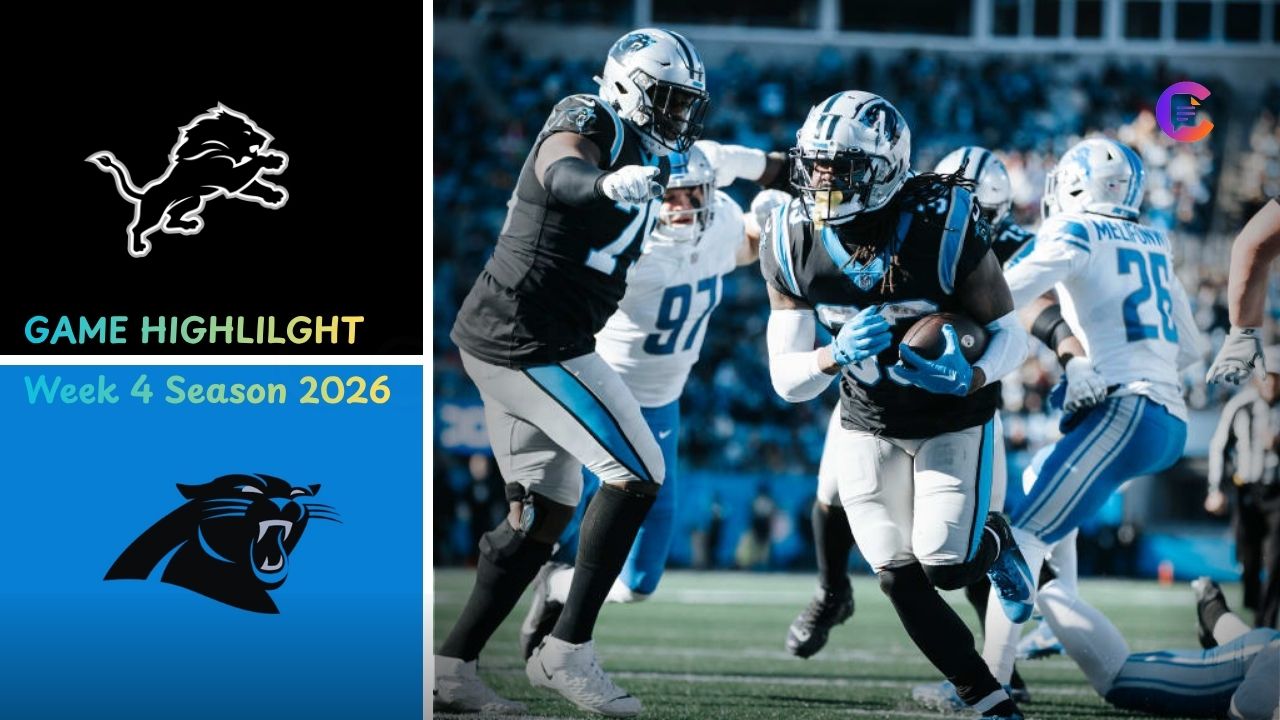
The Carolina Panthers defeated the Detroit Lions 32–26 in a high-scoring Sunday Night Football matchup at Bank of America Stadium in Charlotte on October 4, 2026. Both teams entered the game at 2–1, but Carolina produced the bigger plays when the game mattered most. Bryce Young delivered one of his strongest performances of the season, while second-year wide receiver Tetairoa McMillan created constant problems for Detroit’s secondary.
Detroit’s offense generated 452 total yards and kept the game competitive throughout the night. Jared Goff threw for 412 yards and a touchdown, while Jameson Williams surpassed 100 receiving yards. However, the Lions struggled to establish a consistent running game and could not slow Carolina’s passing attack enough. The Panthers finished with 445 total yards and controlled the final stages of the contest.
Final Score
| Team | Q1 | Q2 | Q3 | Q4 | Final |
|---|---|---|---|---|---|
| Detroit Lions | 3 | 13 | 3 | 7 | 26 |
| Carolina Panthers | 7 | 9 | 13 | 3 | 32 |
Carolina started strongly and took a 7–3 lead after Chuba Hubbard scored on a 15-yard touchdown run. Detroit answered with field goals from Jake Bates, who remained perfect throughout the game. The second quarter became much more competitive, with both teams trading touchdowns and field goals before the Panthers carried a 16–16 tie into halftime.
The Panthers then created separation during the third quarter. McMillan caught another touchdown from Young, while Hubbard added his second rushing score. Detroit continued to fight and eventually reduced the deficit with a Sam LaPorta touchdown in the fourth quarter. Carolina’s defense stopped Detroit on fourth down late in the game to secure the six-point victory.
Jared Goff Delivers 412 Passing Yards
Jared Goff was one of Detroit’s biggest statistical positives. He completed 32 of 52 attempts for 412 yards, one touchdown, and no interceptions. His 92.8 passer rating reflected a productive passing performance, even though the Lions could not turn enough of those yards into points.
Goff repeatedly moved the ball through the air and helped Detroit produce 406 net passing yards. He connected with several receivers for explosive gains, including a 49-yard completion to Jameson Williams and a 57-yard reception by Isaac TeSlaa. The Lions ultimately needed one more successful possession late in the fourth quarter, but Carolina’s pass rush ended the final comeback attempt.
Bryce Young Leads Carolina’s Passing Attack
Bryce Young completed 29 of 41 passes for 329 yards and two touchdowns without throwing an interception. He finished with a 110.7 passer rating and completed 70.7 percent of his attempts. The performance marked his fifth career 300-yard passing game and his second such game of the 2026 season.
Young established an early rhythm and completed his first 11 passes. His connection with McMillan became the centerpiece of Carolina’s offense, especially when Detroit struggled to contain deep and intermediate routes. Young also avoided the turnovers that could have allowed Detroit to steal momentum during the second half.
Explore Miami Dolphins vs Minnesota Vikings Match Player Stats Complete Game Analysis
Tetairoa McMillan Produces a Career Night
Tetairoa McMillan delivered the standout individual performance of the game. He caught 14 passes for 192 yards and two touchdowns, setting career highs in receptions and receiving yards. His production gave the Panthers a reliable target whenever they needed a major play.
McMillan scored on receptions of 32 and 10 yards. His first touchdown came during the second quarter and helped Carolina regain the lead after Detroit had moved the ball effectively. His second touchdown arrived early in the second half and extended Carolina’s advantage. The Lions never found a consistent answer for him throughout the contest.
Chuba Hubbard Powers the Ground Game
Chuba Hubbard provided the balance that Carolina needed. He rushed 20 times for 122 yards and two touchdowns, averaging 6.1 yards per carry. His longest run covered 32 yards, and his production helped Carolina control the clock while keeping Detroit’s defense from focusing exclusively on Young and McMillan.
Hubbard scored Carolina’s first touchdown on a 15-yard run in the opening quarter. He added another two-yard touchdown during the third quarter. His two-touchdown performance was especially important because Detroit’s passing offense continued to produce large chunks of yardage.
Detroit’s Receiving Leaders
Jameson Williams produced his first 100-yard receiving performance of the season. He finished with six receptions for 102 yards, including a 49-yard catch that helped set up a Detroit scoring opportunity. His speed gave Carolina’s secondary another difficult assignment throughout the night.
Isaac TeSlaa also delivered an important performance with four receptions for 95 yards. Sam LaPorta caught eight passes for 84 yards and scored Detroit’s fourth-quarter touchdown. Amon-Ra St. Brown added eight receptions for 75 yards, giving Goff several productive options despite Carolina’s defensive pressure late in the game.
Detroit Lions vs Carolina Panthers Match Player Stats
Passing
| Player | Comp/Att | Yards | TD | INT | Rating |
|---|---|---|---|---|---|
| Jared Goff, DET | 32/52 | 412 | 1 | 0 | 92.8 |
| Bryce Young, CAR | 29/41 | 329 | 2 | 0 | 110.7 |
Rushing
| Player | Carries | Yards | TD | Long |
|---|---|---|---|---|
| Jahmyr Gibbs, DET | 15 | 46 | 1 | 13 |
| Chuba Hubbard, CAR | 20 | 122 | 2 | 32 |
| Bryce Young, CAR | 3 | 3 | 0 | 7 |
| AJ Dillon, CAR | 5 | 2 | 0 | 2 |
Receiving
| Player | Receptions | Yards | TD | Long |
|---|---|---|---|---|
| Jameson Williams, DET | 6 | 102 | 0 | 49 |
| Isaac TeSlaa, DET | 4 | 95 | 0 | 57 |
| Sam LaPorta, DET | 8 | 84 | 1 | 25 |
| Amon-Ra St. Brown, DET | 8 | 75 | 0 | 19 |
| Tetairoa McMillan, CAR | 14 | 192 | 2 | 32 |
| John Metchie III, CAR | 3 | 37 | 0 | 18 |
| Darren Waller, CAR | 3 | 36 | 0 | 16 |
The player statistics show how differently the two offenses generated their production. Detroit relied heavily on Goff’s passing volume, while Carolina combined Young’s efficient passing with Hubbard’s 122 rushing yards. McMillan’s 192 receiving yards remained the most influential individual total of the night.
Team Statistics and Offensive Comparison
| Statistic | Detroit Lions | Carolina Panthers |
|---|---|---|
| Total Yards | 452 | 445 |
| Passing Yards | 406 | 318 |
| Rushing Yards | 46 | 127 |
| First Downs | 24 | 28 |
| Plays | 68 | 72 |
| Possession | 26:45 | 33:15 |
| Third Down | 4/12 | 5/12 |
| Turnovers | 0 | 0 |
| Penalties | 9 | 8 |
| Penalty Yards | 67 | 60 |
The overall yardage was surprisingly close, with Detroit holding a seven-yard advantage. The difference came from how those yards were distributed. Carolina ran the ball far more effectively and held possession for more than 33 minutes. Detroit gained 406 passing yards but managed only 46 rushing yards.
Carolina also converted slightly better on third down and produced four more first downs. Neither team committed a turnover, so the outcome came down to execution, efficiency, and Carolina’s ability to create touchdowns from its offensive opportunities.
Jake Bates Keeps Detroit in the Game
Jake Bates was a major bright spot for Detroit. He made all four of his field-goal attempts, including kicks from 54, 43, 41, and 26 yards. His consistency allowed the Lions to remain within striking distance even when Carolina generated touchdowns.
Bates opened the scoring with a 54-yard field goal and later tied the game at halftime with his 41-yard kick. His fourth field goal brought Detroit within three points during the third quarter. However, Carolina’s subsequent touchdown drive gave the Panthers enough breathing room to withstand Detroit’s late rally.
Fourth-Quarter Comeback Falls Short
Detroit entered the final quarter needing a strong finish. After Carolina added a field goal, Goff led the Lions down the field and found Sam LaPorta for an eight-yard touchdown. The score reduced Carolina’s advantage to a single possession and gave Detroit another opportunity to force a late comeback.
The Lions defense then stopped Carolina and returned possession to the offense with a little more than two minutes remaining. Detroit started at its own 13-yard line, but Carolina’s defense delivered the decisive play. A sack on fourth-and-13 ended the Lions’ final drive, allowing Young to take a pair of kneel-downs and close out the victory.
Key Highlights From the Match
The game featured several memorable performances and momentum-changing moments. McMillan’s two touchdown receptions stood out, while Hubbard’s 122 rushing yards gave Carolina a balanced offensive attack. Young also played a clean game with 329 passing yards and no interceptions. Detroit responded with strong passing numbers from Goff and a 100-yard receiving performance from Williams.
One of the most important moments came on Detroit’s final possession. The Lions needed to convert fourth-and-13 to keep their comeback alive, but Carolina’s defense generated a sack and forced a turnover on downs. That defensive stop preserved the Panthers’ 32–26 lead and completed their first Sunday Night Football victory since 2015.
What the Result Means for Both Teams
The victory moved Carolina to 2–2 and gave the Panthers an important home win against a Detroit team that entered the contest with playoff expectations. Carolina also became the first team in franchise history to score more than 30 points in three of its first four games of a season.
Detroit also moved to 2–2 after the loss. The Lions’ offense produced enough yardage to win many games, but their inability to slow Carolina’s attack proved costly. Detroit allowed 30 or more points for the third time in its first four contests, highlighting an area that will need significant attention moving forward.
Conclusion
The Detroit Lions vs Carolina Panthers matchup delivered a competitive 32–26 contest, but Carolina controlled the key moments. Bryce Young played efficiently, Chuba Hubbard supplied a strong rushing attack, and Tetairoa McMillan produced a career performance with 192 receiving yards and two touchdowns. Together, those contributions allowed the Panthers to overcome Detroit’s 452-yard offensive effort.
Detroit can take positives from Goff’s 412 passing yards, Williams’ 102 receiving yards, LaPorta’s touchdown, and Bates’ perfect field-goal night. Still, the Lions could not overcome their defensive struggles or their limited rushing production. Carolina’s final defensive stand completed a memorable home victory and gave the Panthers momentum heading into their bye week.
Get More Update CONTENTORY