
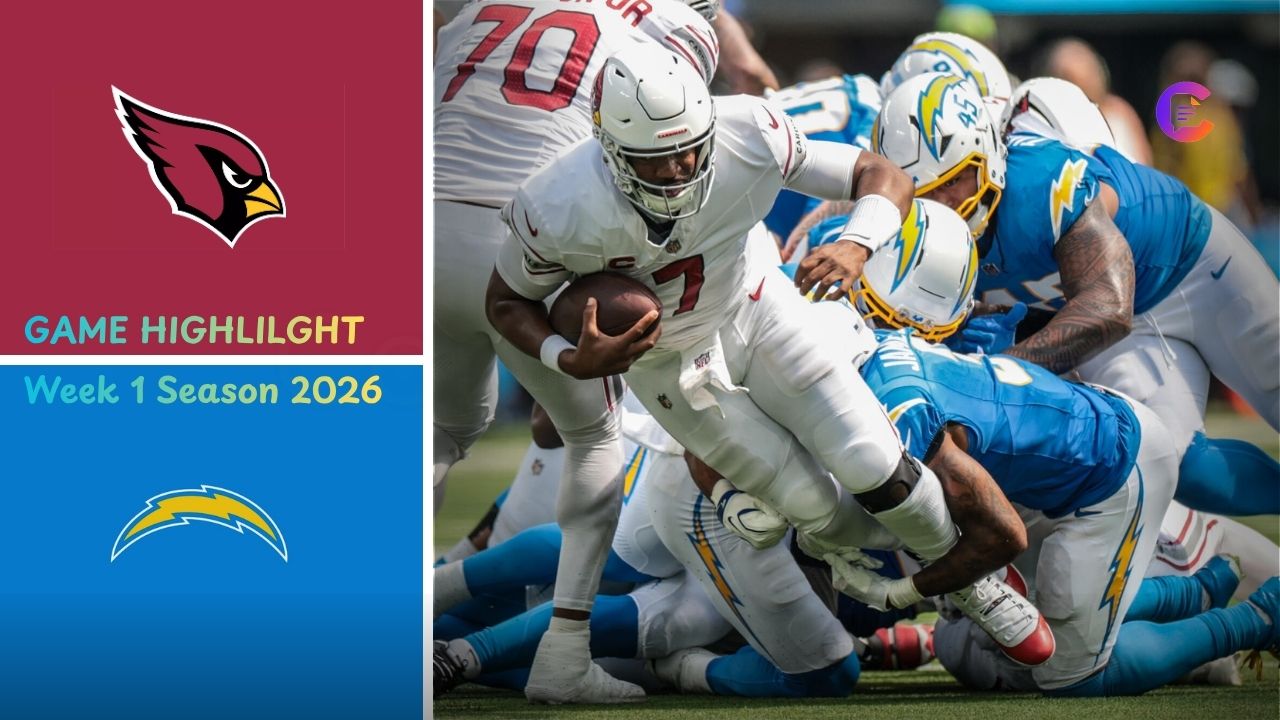
The Arizona Cardinals opened the 2026 NFL regular season with a convincing 26-14 victory over the Los Angeles Chargers on September 13, 2026, at SoFi Stadium. Arizona controlled the game with a balanced offense, strong third-down execution, and a defense that forced two Chargers turnovers. Jacoby Brissett delivered an efficient performance in his Cardinals debut, while Trey McBride became the focal point of the passing attack. ESPN’s official box score confirms Arizona finished with 393 total yards compared with 268 for Los Angeles.
The result also gave new Cardinals head coach Mike LaFleur a winning debut. Arizona entered Week 1 as a significant underdog but consistently pressured Los Angeles after halftime. The Chargers scored their final points in the third quarter, then struggled to create another scoring drive. Arizona added a fourth-quarter touchdown and field goal to close out the upset. ESPN and Reuters both reported the 26-14 final, while the official game data confirms the Cardinals finished with zero turnovers and controlled possession for 37:31.
Final Score and Match Overview
| Team | Q1 | Q2 | Q3 | Q4 | Final |
|---|---|---|---|---|---|
| Arizona Cardinals | 7 | 6 | 3 | 10 | 26 |
| Los Angeles Chargers | 7 | 0 | 7 | 0 | 14 |
Arizona and Los Angeles traded touchdowns during an entertaining first quarter. Rookie Jeremiyah Love gave the Cardinals an early lead with a five-yard rushing touchdown, but Omarion Hampton answered for Los Angeles. Arizona then took control with three field goals across the second and third quarters. The Chargers briefly pulled within two points after Justin Herbert connected with Ladd McConkey in the third quarter, but Arizona responded with a decisive fourth-quarter touchdown and another field goal.
The final margin reflected Arizona’s superior consistency rather than one overwhelming statistical category. The Cardinals ran 72 offensive plays compared with only 51 for the Chargers. Arizona also produced 23 first downs and converted six of 14 third downs. Los Angeles managed 17 first downs and converted only two of eight third-down attempts. Those differences allowed Arizona to sustain drives and keep Herbert’s offense off the field for long stretches.
Jacoby Brissett’s Passing Performance
Jacoby Brissett was one of the biggest reasons Arizona secured the upset. He completed 27 of 37 passes for 277 yards and one touchdown without an interception. His 103.1 passer rating showed how efficiently he operated the Cardinals’ offense. Brissett also added 14 rushing yards on six attempts. Most importantly, he avoided the costly mistakes that affected Los Angeles and gave Arizona a reliable presence throughout the game.
Brissett distributed the football effectively instead of relying on one receiver on every possession. Trey McBride led the team with nine receptions, while Kendrick Bourne added eight catches. Michael Wilson contributed five receptions for 56 yards. Brissett’s touchdown pass to McBride in the fourth quarter provided the Cardinals with the separation they needed. His clean passing line was particularly important because the Chargers managed only one interception while Arizona committed none.
Justin Herbert’s Chargers Stats
Justin Herbert completed 17 of 27 passes for 209 yards, one touchdown, and one interception. His 83.7 passer rating was respectable, but Los Angeles could not maintain enough offensive momentum to keep pace with Arizona. Herbert also rushed five times for 29 yards. The Chargers quarterback faced pressure late, including a fourth-quarter sack that ended one important possession.
Herbert’s best connection came with Ladd McConkey, who caught five passes for 82 yards and a touchdown. David Njoku also caught five passes for 58 yards, while Oronde Gadsden added two receptions for 32 yards. However, Los Angeles struggled to convert opportunities into points. The Chargers finished with only 268 total yards and went 0-for-3 on fourth down, leaving several chances unused.
Arizona Cardinals Rushing Stats
Arizona produced 116 rushing yards on 34 attempts, giving the passing game useful support. Tyler Allgeier led the Cardinals with 17 carries for 61 yards. Rookie Jeremiyah Love added 41 yards on 11 carries and scored the opening touchdown of the game. Brissett contributed another 14 rushing yards. Love’s early touchdown also marked an encouraging moment for the rookie in his first regular-season action.
The Cardinals did not need a huge individual rushing performance because their offensive balance kept Los Angeles from concentrating entirely on Brissett. Arizona consistently mixed runs with short and intermediate passes, helping the offense sustain drives. Love averaged 3.7 yards per carry, while Allgeier averaged 3.6. Together, the running backs helped Arizona control tempo and keep its offense on the field for much of the afternoon.
Los Angeles Chargers Rushing Stats
The Chargers finished with 81 rushing yards on 21 attempts, well below Arizona’s 116 rushing yards. Omarion Hampton led Los Angeles with 12 carries for 43 yards and scored an eight-yard touchdown in the first quarter. Herbert added 29 rushing yards on five attempts, while Keaton Mitchell gained nine yards on four carries. The Chargers averaged only 3.9 yards per rushing attempt as a team.
Hampton’s touchdown temporarily answered Arizona’s opening score and showed the potential of the Chargers’ running game. However, Los Angeles could not maintain that efficiency after the opening period. Arizona’s defense increasingly controlled the line of scrimmage and limited the Chargers’ rushing opportunities. With only 21 rushing attempts, Los Angeles also became more dependent on Herbert as the game progressed, which allowed Arizona’s defense to focus more attention on the passing game.
Trey McBride Leads Arizona Receivers
Trey McBride delivered the Cardinals’ most productive receiving performance. He caught nine passes for 95 yards and one touchdown, leading Arizona in both receptions and receiving yards. His 27-yard reception was his longest of the afternoon. McBride’s fourth-quarter three-yard touchdown reception gave Arizona a 23-14 advantage and helped turn a competitive game into a more comfortable victory.
Kendrick Bourne also played an important role with eight receptions for 75 yards. Michael Wilson added five catches for 56 yards, giving Brissett multiple dependable targets. Arizona’s receiving distribution helped prevent Los Angeles from shutting down one particular route or player. McBride’s performance stood out, but the broader receiving production demonstrated how effectively Brissett used the Cardinals’ offensive personnel throughout the game.
Chargers Receiving Leaders
Ladd McConkey led the Chargers with five receptions for 82 yards and one touchdown. He scored on an eight-yard reception from Herbert in the third quarter, briefly reducing Arizona’s lead to 16-14. McConkey’s performance ended early after he suffered an injury and left the game. Reuters reported that he was undergoing testing after the game and that Chargers coach Jim Harbaugh described his status as day-to-day.
David Njoku also caught five passes, finishing with 58 yards, while Oronde Gadsden recorded two receptions for 32 yards. McConkey’s departure reduced the Chargers’ options during the latter stages of the game. Los Angeles still moved the ball at times, but it could not consistently finish drives. The Cardinals’ defense tightened in the fourth quarter and prevented Herbert from producing another touchdown after McConkey’s third-quarter score.
Team Statistics Comparison
| Statistic | Cardinals | Chargers |
|---|---|---|
| Total Yards | 393 | 268 |
| Passing Yards | 277 | 187 |
| Rushing Yards | 116 | 81 |
| Total Plays | 72 | 51 |
| First Downs | 23 | 17 |
| Third Down | 6/14 | 2/8 |
| Fourth Down | 0/0 | 0/3 |
| Turnovers | 0 | 2 |
| Time of Possession | 37:31 | 22:29 |
| Yards per Play | 5.5 | 5.3 |
The team statistics clearly explain Arizona’s victory. The Cardinals gained 393 total yards and ran 21 more plays than Los Angeles. They also held a significant possession advantage, keeping the ball for 37 minutes and 31 seconds. The Chargers had only 22 minutes and 29 seconds of possession. Arizona’s six third-down conversions compared with Los Angeles’ two also allowed the Cardinals to repeatedly extend drives.
Turnovers provided another major advantage. Arizona finished without a turnover, while the Chargers committed two. Los Angeles also failed on all three fourth-down attempts. Although Arizona committed eight penalties for 111 yards, the Cardinals overcame those mistakes through stronger offensive efficiency and better possession control. The Chargers had fewer penalty yards but could not compensate for their inability to sustain drives and protect scoring opportunities.
Key Plays That Decided the Game
One of the biggest turning points came when Arizona continued adding points while the Chargers struggled to answer. Chad Ryland made field goals from 27, 44, 34, and 49 yards, giving the Cardinals 12 points from his kicking performance. That consistency mattered because Arizona did not need to convert every red-zone opportunity into a touchdown. The Cardinals instead kept building their advantage while their defense limited Los Angeles’ scoring chances.
The decisive sequence came in the fourth quarter. After Arizona’s defense helped stop Los Angeles, Brissett found McBride for a three-yard touchdown that pushed the Cardinals ahead 23-14. Ryland then added a 49-yard field goal with 2:37 remaining. The Chargers could not mount a comeback, and Arizona closed the game by controlling the final possessions. The result completed a surprising road victory for LaFleur in his first game as Cardinals head coach.
Arizona Cardinals Defense and Turnovers
Arizona’s defense played an important role by limiting the Chargers to 268 total yards and forcing two turnovers. Andrew Wingard intercepted Herbert in the fourth quarter, while the Cardinals also benefited from a blocked punt by Simi Fehoko that helped create a scoring opportunity. The defense became increasingly effective as the game progressed, especially when Los Angeles needed quick points late.
The Cardinals also generated pressure when it mattered most. Jack Gibbens and Budda Baker combined for an eight-yard sack of Herbert late in the fourth quarter. That play helped prevent Los Angeles from extending a critical possession. Arizona’s defense did not need to dominate every snap. Instead, it produced timely stops, protected its lead, and forced Los Angeles into difficult fourth-down situations.
Chad Ryland’s Perfect Kicking Performance
Chad Ryland quietly became one of Arizona’s most important contributors. He made four field goals, including attempts from 27, 44, 34, and 49 yards. His kicking accounted for 12 points, giving the Cardinals valuable scoring production whenever drives stalled. Ryland’s accuracy allowed Arizona to turn several long possessions into points and maintain pressure on the Chargers throughout the second half.
His final field goal proved especially useful. The 49-yarder with 2:37 remaining increased Arizona’s advantage to 26-14 and effectively ended Los Angeles’ comeback hopes. Special teams also contributed through Fehoko’s blocked punt. Together, the kicking and special-teams plays gave Arizona an edge in a game where the Cardinals repeatedly capitalized on opportunities created by their defense and field position.
Final Match Summary
The Arizona Cardinals defeated the Los Angeles Chargers 26-14 in the September 13, 2026 NFL season opener. Brissett completed 27 of 37 passes for 277 yards and one touchdown, while McBride finished with nine catches for 95 yards and a score. Arizona also received 61 rushing yards from Allgeier and a touchdown from rookie Love. The Cardinals finished with 393 total yards, 23 first downs, and zero turnovers, establishing strong offensive and defensive balance in LaFleur’s debut.
For Los Angeles, Herbert finished with 209 passing yards, one touchdown, and one interception. Hampton rushed for 43 yards and a touchdown, while McConkey produced 82 receiving yards and one score before leaving with an injury. The Chargers struggled on third and fourth downs and committed two turnovers. Arizona’s ability to control possession, protect the football, and finish drives ultimately separated the teams. The 26-14 victory gave the Cardinals a memorable road start to the 2026 season.
Get More Update CONTENTORY