
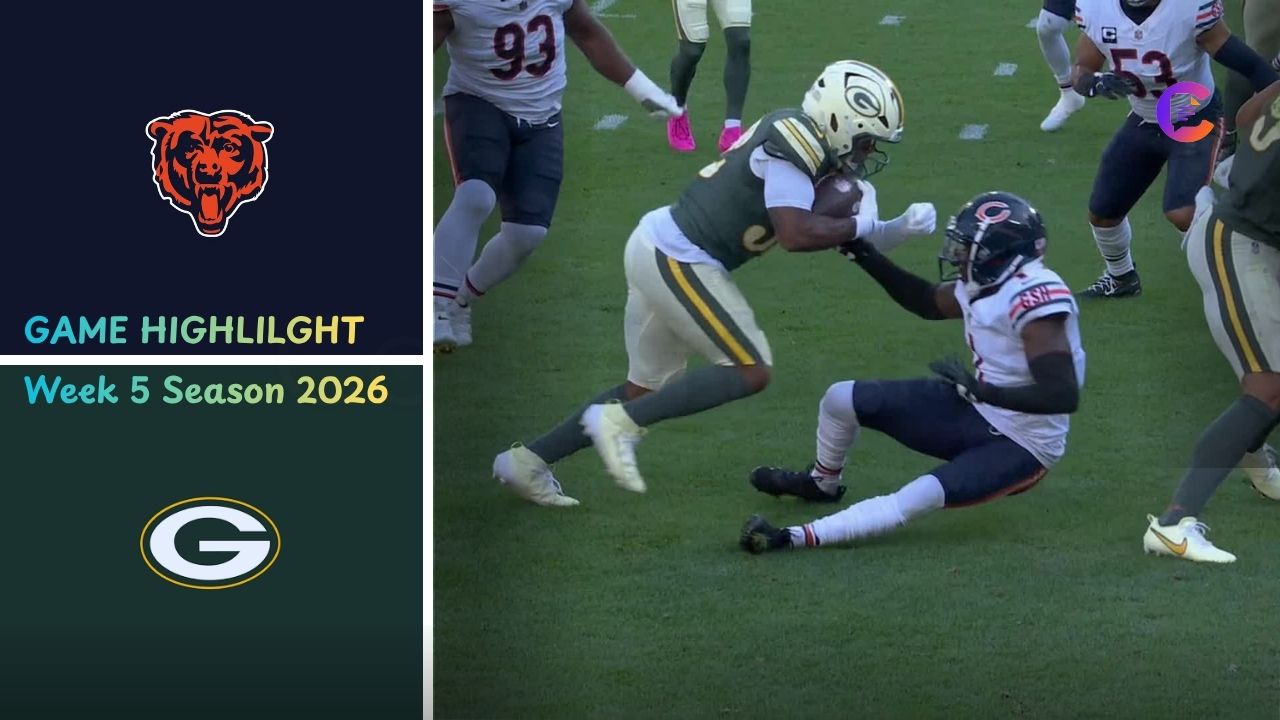
The Chicago Bears and Green Bay Packers renewed their NFC North rivalry on October 11, 2026, at Lambeau Field in Green Bay, Wisconsin. The Packers controlled the matchup and secured a 31–7 victory in Week 5 of the NFL regular season. Green Bay combined an explosive passing attack with an aggressive defensive performance to dominate the game. Chicago struggled to maintain offensive consistency and committed five turnovers, making a comeback increasingly difficult as the contest progressed.
Quarterback Jordan Love led Green Bay with 367 passing yards and two touchdown passes. Wide receiver Christian Watson delivered one of the game’s standout performances, recording six receptions for 143 yards and two touchdowns. Running back MarShawn Lloyd added two rushing touchdowns, while safety Xavier McKinney intercepted Chicago quarterback Tyson Bagent twice. The Bears managed just 246 total yards and scored their only touchdown before halftime. Here is the complete game recap, player statistics, scoring summary, and key moments.
Chicago Bears vs Green Bay Packers Final Score
| Team | Q1 | Q2 | Q3 | Q4 | Final |
|---|---|---|---|---|---|
| Chicago Bears | 0 | 7 | 0 | 0 | 7 |
| Green Bay Packers | 7 | 7 | 9 | 8 | 31 |
Green Bay established control early and maintained its advantage throughout the second half. The Packers scored touchdowns on their first two possessions, creating a 14–0 lead before Chicago found the end zone. Although the Bears reduced the deficit to seven points before halftime, Green Bay responded with another touchdown after the break and continued to pressure Chicago’s offense.
The Packers finished with 428 total net yards, significantly outperforming Chicago’s 246. Green Bay also protected possession more effectively and forced five turnovers. The Bears could not turn their limited scoring opportunities into enough points to challenge the home team. This combination of offensive production and defensive pressure proved decisive in the final result.
Jordan Love Leads the Packers Offense
Jordan Love delivered an efficient performance against Chicago’s defense. He completed 25 of 31 pass attempts for 367 yards, throwing two touchdowns without an interception. His 137.5 passer rating reflected his accuracy and ability to create explosive plays downfield. Love connected with multiple receivers, keeping the Bears’ secondary under pressure and helping Green Bay sustain drives throughout the afternoon.
Love’s connection with Christian Watson became the defining feature of the passing attack. The pair connected for touchdowns of 42 and 53 yards, giving the Packers crucial momentum. Love also found tight end Tucker Kraft for a 46-yard gain that helped set up a field goal. His command of the offense allowed Green Bay to stretch Chicago’s defense and capitalize on opportunities created by its own defensive unit.
Christian Watson and Green Bay’s Receiving Leaders
Christian Watson was Green Bay’s leading receiver and one of the biggest difference-makers in the game. He caught six passes for 143 yards and two touchdowns. His first scoring reception covered 42 yards, while his second traveled 53 yards. Both plays demonstrated his ability to get open downfield and convert Love’s accurate throws into major scoring opportunities.
Matthew Golden also made a significant contribution, recording six receptions for 123 yards. His catches helped Green Bay move the chains and maintain offensive rhythm. Kraft added five receptions for 64 yards, including a key 46-yard catch during the third quarter. The Packers’ ability to spread the ball across several targets prevented Chicago from focusing exclusively on Watson and created space for the offense to operate.
Explore New York Giants vs Washington Commanders Match Player Stats, Score and Highlights
Chicago Bears Passing and Receiving Stats
Tyson Bagent started at quarterback for Chicago and completed 12 of 21 passes for 87 yards. He threw no touchdown passes and suffered two interceptions before leaving the game in the fourth quarter. The Packers’ defensive pressure and coverage made it difficult for Bagent to establish a passing rhythm. His turnovers also gave Green Bay opportunities to extend its lead.
Case Keenum replaced Bagent and completed 11 of 19 passes for 108 yards. He did not throw a touchdown and was intercepted once. Luther Burden III led the Bears in receiving yards, catching four passes for 47 yards. Rome Odunze added three receptions for 40 yards, while Roschon Johnson recorded five catches for 34 yards. Chicago’s receivers produced some useful gains, but the passing attack could not overcome the turnovers and limited overall production.
Rushing Stats: MarShawn Lloyd and D’Andre Swift
MarShawn Lloyd delivered an important contribution to Green Bay’s victory with two rushing touchdowns. He carried the ball 10 times for 31 yards, scoring on runs of six and four yards. His first touchdown came on the opening play of the second quarter, extending the Packers’ lead to 14–0. His second score arrived early in the fourth quarter and helped put the result beyond doubt.
Chicago’s D’Andre Swift supplied the Bears’ only touchdown. He finished with nine carries for 43 yards and scored from one yard out late in the first half. Chicago’s rushing offense totaled just 81 yards on 24 carries, limiting its ability to control possession through the ground game. Green Bay’s defense consistently restricted running lanes and forced the Bears to rely on a passing attack that struggled under pressure.
Full Player Passing Stats
The quarterback numbers highlight the difference between the two offenses. Love combined high efficiency with explosive passing plays, while Chicago used two quarterbacks but failed to generate a touchdown through the air.
| Player | Team | Completions/Attempts | Passing Yards | TD | INT |
|---|---|---|---|---|---|
| Jordan Love | Packers | 25/31 | 367 | 2 | 0 |
| Tyson Bagent | Bears | 12/21 | 87 | 0 | 2 |
| Case Keenum | Bears | 11/19 | 108 | 0 | 1 |
Love’s 25 completions produced more than three times Bagent’s passing-yard total. Keenum added 108 yards after entering the game, but Chicago still finished without a passing touchdown. The three Bears interceptions were particularly costly because they ended drives and gave Green Bay additional opportunities to score.
Full Receiving Stats
The receiving statistics show how effectively Green Bay created explosive plays. Watson and Golden combined for 266 receiving yards, giving Love two reliable targets throughout the game. Chicago’s leaders made shorter gains, but the Bears could not consistently generate the big plays needed to close the scoring gap.
| Player | Team | Receptions | Receiving Yards | TD |
|---|---|---|---|---|
| Christian Watson | Packers | 6 | 143 | 2 |
| Matthew Golden | Packers | 6 | 123 | 0 |
| Tucker Kraft | Packers | 5 | 64 | 0 |
| Luther Burden III | Bears | 4 | 47 | 0 |
| Rome Odunze | Bears | 3 | 40 | 0 |
| Roschon Johnson | Bears | 5 | 34 | 0 |
| D’Andre Swift | Bears | 4 | 30 | 0 |
Watson’s two touchdowns separated him from the other receivers in the matchup. Golden’s 123 yards also gave Green Bay another dangerous option, while Kraft contributed important intermediate and deep receptions. Burden led Chicago’s receivers in yardage, but no Bears receiver scored a touchdown.
Defensive Performance and Five Turnovers
Green Bay’s defense played a central role in the victory. Xavier McKinney intercepted Bagent twice, including an early takeaway that gave the Packers possession near Chicago’s 45-yard line. Green Bay converted that opportunity into a touchdown and moved ahead 14–0. McKinney’s second interception set up another scoring drive early in the fourth quarter.
The Packers finished with five takeaways, including three interceptions across Chicago’s two quarterbacks and two fumbles. Those turnovers disrupted the Bears’ momentum and prevented them from building sustained drives. Green Bay also limited Chicago’s rushing attack to 81 yards. The defense repeatedly forced difficult situations, turning a competitive first half into a comfortable victory during the final two quarters.
Quarter-by-Quarter Game Recap
First quarter: Green Bay opened the scoring with a 42-yard touchdown pass from Love to Watson. The play capped a 10-play, 91-yard drive. Chicago’s next possession ended when a deflected Bagent pass was intercepted by McKinney, giving the Packers another short field.
Second quarter: Lloyd scored a six-yard rushing touchdown to make it 14–0. Chicago responded with a 16-play, 78-yard drive that consumed 9:10 and ended with Swift’s one-yard touchdown run. The Bears entered halftime trailing 14–7, giving themselves a chance to make the second half competitive.
Third quarter: Watson caught a 53-yard touchdown pass from Love, although Green Bay missed the extra point. A 35-yard field goal extended the lead to 23–7. Chicago reached the Packers’ 20-yard line on its response, but Cairo Santos missed a 43-yard field goal attempt.
Fourth quarter: Lloyd scored his second touchdown on a four-yard run, and Matthew Golden caught the two-point conversion to make it 31–7. Chicago’s attempt to respond ended with Keenum throwing an interception at the goal line. Green Bay’s defense closed out the game without allowing another score.
Team Statistics and Key Numbers
The overall statistics underline Green Bay’s advantage in offensive production and defensive execution. The Packers generated more yards, completed more explosive passes, and made better use of Chicago’s mistakes. The Bears had moments of progress, especially on their long scoring drive in the second quarter, but could not sustain that performance.
| Team Statistic | Chicago Bears | Green Bay Packers |
|---|---|---|
| Total net yards | 246 | 428 |
| Passing yards | 195 | 367 |
| Rushing yards | 81 | 70 |
| First downs | 17 | — |
| Turnovers lost | 5 | 0 |
| Penalties | 3 | 4 |
| Penalty yards | 20 | 25 |
| Time of possession | 29:36 | 30:24 |
Green Bay’s offense produced 182 more total net yards than Chicago. The Packers’ passing game was the main source of that advantage, while the defense created repeated opportunities through turnovers. Chicago’s five giveaways proved especially damaging because they limited its chances to respond after Green Bay extended the lead.
What the Result Means for Both Teams
The win improved Green Bay’s record to 3–2 and gave the Packers a valuable divisional victory. Their performance offered encouraging signs on both sides of the ball, particularly Love’s passing efficiency and the defense’s ability to create takeaways. Watson’s production also showed how dangerous the Packers can become when their downfield passing game connects consistently.
Chicago also entered the game with a 3–1 record and left at 3–2 after its two-game winning streak ended. The Bears will need to improve ball security and find more consistency on offense. Their defense could not contain Green Bay’s deep passing attack, while the offense struggled to recover from turnovers. Reducing mistakes will be essential as Chicago prepares for its next matchup against Atlanta.
Conclusion
The Chicago Bears vs Green Bay Packers game on October 11, 2026, ended with a decisive 31–7 victory for Green Bay. Jordan Love completed 25 of 31 passes for 367 yards and two touchdowns, while Christian Watson recorded 143 receiving yards and two scores. MarShawn Lloyd added two rushing touchdowns, and Xavier McKinney’s two interceptions helped the Packers control the game.
Chicago’s five turnovers, limited passing production, and missed scoring opportunity prevented a serious comeback. The Packers combined explosive offense with a disciplined defensive performance to secure an important NFC North win. For the Bears, the result highlighted the need for better ball security and more reliable offensive execution in the weeks ahead.
Get More Update CONTENTORY