

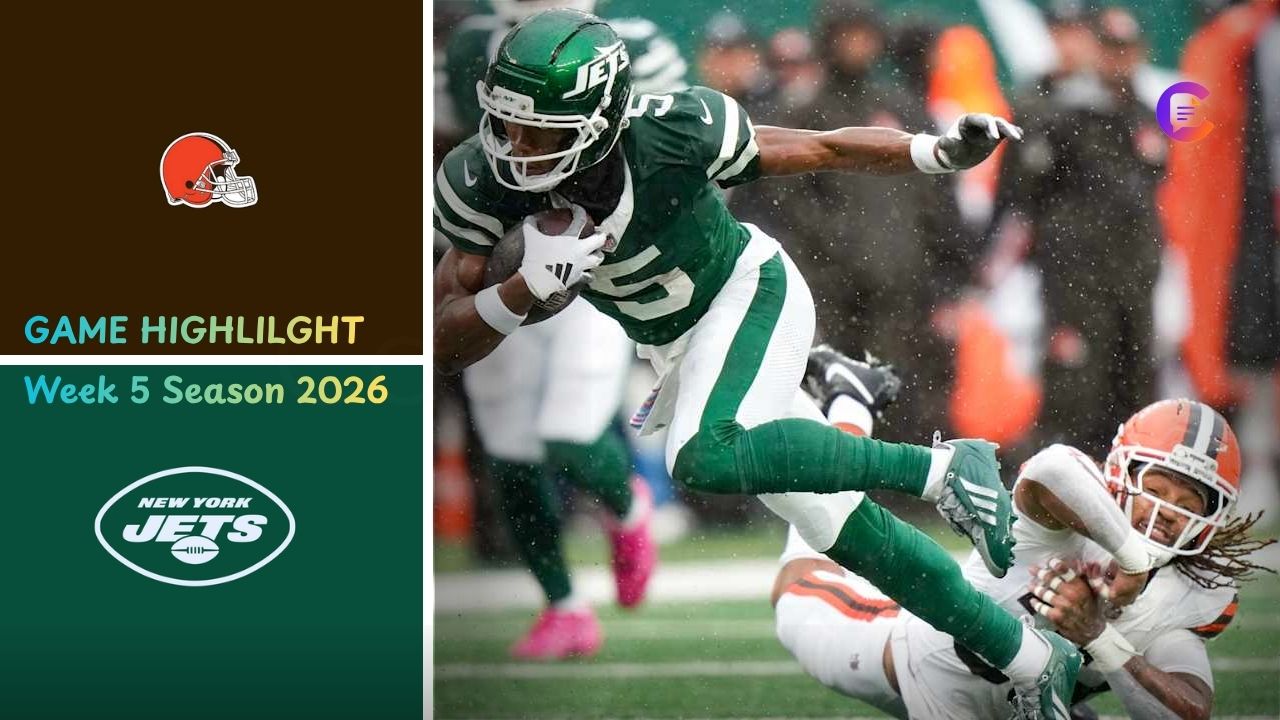
The Cleveland Browns vs New York Jets matchup on October 11, 2026, delivered a tense NFL contest at MetLife Stadium. New York secured a 17–12 victory in rainy conditions, ending Cleveland’s three-game winning streak. Both teams struggled to maintain offensive consistency, but the Jets made better use of their late scoring opportunity. Running back Braelon Allen delivered the decisive touchdown, while quarterback Geno Smith and receiver Garrett Wilson helped New York establish its early advantage.
Cleveland entered the game looking to extend its winning run, but dropped passes, pressure on quarterback Deshaun Watson, and a missed extra point hurt its chances. Watson connected with rookie receiver Denzel Boston for a fourth-quarter touchdown that briefly put the Browns ahead. However, a mishandled punt snap gave New York excellent field position, and Allen converted the opportunity into the winning score. The result moved the Jets to 2–3 and dropped the Browns to 3–2.
Cleveland Browns vs New York Jets Final Score
| Team | Q1 | Q2 | Q3 | Q4 | Final |
|---|---|---|---|---|---|
| Cleveland Browns | 3 | 3 | 0 | 6 | 12 |
| New York Jets | 7 | 0 | 0 | 10 | 17 |
The Jets won by five points after a strong opening quarter and a decisive fourth-quarter finish. Cleveland scored six points in the first half through two field goals, then added a touchdown in the final quarter. New York remained scoreless in the second and third quarters before producing ten points in the fourth.
Garrett Wilson opened the scoring with a 32-yard touchdown reception from Smith. Browns kicker Andre Szmyt answered with field goals from 25 and 41 yards. Jason Sanders then extended New York’s lead with a 54-yard field goal in the fourth quarter. Boston’s touchdown gave Cleveland a 12–10 lead, but Allen’s 22-yard rushing score put the Jets back in front for good.
Braelon Allen Leads the Jets to Victory
Braelon Allen was New York’s most influential offensive player. He rushed 24 times for 116 yards and scored the game-winning touchdown with 3:01 remaining. His powerful running helped the Jets maintain their offensive rhythm despite difficult weather conditions and inconsistent passing production.
Allen’s decisive run came after Cleveland punter Corey Bojorquez mishandled the snap, giving New York possession near the Browns’ 23-yard line. The Jets needed only a few plays to take advantage. Allen found room for a 22-yard touchdown run, and Sanders converted the extra point. The score gave New York a 17–12 lead that its defense protected until the final whistle.
Read Cincinnati Bengals vs Miami Dolphins Match Player Stats and Game Highlights
Geno Smith’s Passing Performance
Geno Smith completed 17 of 30 passes for 182 yards and one touchdown, finishing without an interception. His most productive connection came with Garrett Wilson, who repeatedly found space in Cleveland’s secondary. Smith’s 32-yard touchdown pass to Wilson gave the Jets an early lead and set the tone for their first scoring drive.
Smith faced pressure throughout the game and was sacked four times for a combined loss of 40 yards. Cleveland’s defense also forced a fumble on a pass intended for tight end Kenyon Sadiq. Despite those challenges, Smith avoided costly interceptions and helped New York move into field-goal range in the fourth quarter. His steady performance supported Allen’s ground game and gave the Jets enough offense to win.
Deshaun Watson and the Browns’ Passing Attack
Deshaun Watson completed 15 of 33 passes for 155 yards and one touchdown. He did not throw an interception, but the Jets’ pass rush made it difficult for Cleveland to sustain drives. New York recorded eight sacks, repeatedly forcing Watson to make decisions under pressure and limiting the Browns’ ability to build momentum.
Watson’s biggest moment came late in the fourth quarter. He found Boston for a 29-yard touchdown that moved Cleveland ahead 12–10 with 6:15 remaining. However, Szmyt missed the extra point after the ball struck the upright. That missed kick left the Browns with only a two-point lead, making New York’s subsequent touchdown even more damaging. Watson finished with six rushing attempts for 40 yards, but Cleveland could not produce another scoring drive.
Browns Player Stats: Rushing and Receiving
Cleveland’s offense struggled to generate consistent production, but several players delivered important contributions. Running back Quinshon Judkins led the Browns with 44 rushing yards on 14 carries. Watson added 40 yards on the ground, helping Cleveland finish with 96 rushing yards overall.
| Browns player | Passing | Rushing | Receiving |
|---|---|---|---|
| Deshaun Watson | 15/33, 155 yards, 1 TD | 6 carries, 40 yards | — |
| Quinshon Judkins | — | 14 carries, 44 yards | 3 catches, 6 yards |
| Isaiah Bond | — | — | 3 catches, 74 yards |
| Denzel Boston | — | — | 3 catches, 46 yards, 1 TD |
| Jerry Jeudy | — | — | 3 catches, 19 yards |
Isaiah Bond was Cleveland’s leading receiver by yardage, finishing with 74 yards on three receptions. His ability to gain ground after the catch helped create opportunities for the offense. Boston also made a major contribution with his late touchdown, which briefly gave the Browns the lead. However, dropped passes and New York’s persistent pressure limited the overall effectiveness of Cleveland’s passing attack.
Jets Player Stats: Rushing and Receiving
The Jets relied on Allen’s rushing production and Wilson’s receiving ability to create their biggest offensive moments. Allen finished with 116 yards on 24 carries, while Smith added seven rushing yards. New York recorded 134 rushing yards as a team, giving its offense an important foundation in challenging weather.
| Jets player | Passing | Rushing | Receiving |
|---|---|---|---|
| Geno Smith | 17/30, 182 yards, 1 TD | 5 carries, 7 yards | — |
| Braelon Allen | — | 24 carries, 116 yards, 1 TD | 1 catch, 0 yards |
| Garrett Wilson | — | — | 7 catches, 104 yards, 1 TD |
| Tim Patrick | — | — | 2 catches, 26 yards |
| Mason Taylor | — | — | 3 catches, 24 yards |
| Kenyon Sadiq | — | — | 2 catches, 3 yards |
Wilson’s seven receptions for 104 yards made him the Jets’ leading receiver. His first-quarter touchdown came on a 32-yard catch that put New York ahead 7–0. The receiver’s ability to create separation gave Smith a dependable option when the passing game needed a spark. Allen then supplied the decisive finish, making the Jets’ two main offensive contributors central to the victory.
New York’s Defense Records Eight Sacks
The Jets’ pass rush played a major role in the result. New York recorded eight sacks, repeatedly disrupting Watson’s timing and forcing Cleveland into difficult down-and-distance situations. Rookie defender David Bailey stood out with three sacks, providing a significant contribution in a game where the Browns struggled to protect their quarterback.
The defense also forced Cleveland to settle for field goals in the first half. The Browns managed only 13 first downs and struggled to move the ball consistently. Although Boston’s fourth-quarter touchdown briefly changed the scoreboard, the Jets responded with Allen’s decisive run. New York then forced another turnover on downs late in the game, preventing Cleveland from mounting a final comeback.
Explore Tennessee Titans vs Baltimore Ravens Match Player Stats Full Game Breakdown
Fourth-Quarter Highlights That Decided the Game
The fourth quarter featured all the scoring drama. Sanders opened the period with a 54-yard field goal, putting the Jets ahead 10–6. Cleveland responded with Watson’s 29-yard touchdown pass to Boston, taking a 12–10 lead. The Browns failed to convert the extra point, leaving the door open for New York to reclaim the advantage.
Bojorquez’s mishandled snap on a punt gave the Jets an opportunity they quickly converted. Allen ran for 22 yards into the end zone, and Sanders added the extra point to make it 17–12. Cleveland attempted to respond, but New York’s defense shut down the final drive. Will McDonald IV strip-sacked Watson late in the game, helping secure the Jets’ first victory since Week 1.
Team Statistics and Overall Performance
New York finished with 316 total yards, compared with 251 for Cleveland. The Jets generated 182 passing yards and 134 rushing yards, while the Browns recorded 155 passing yards and 96 rushing yards. New York also held a slight advantage in first downs, recording 14 compared with Cleveland’s 13.
| Team statistic | Browns | Jets |
|---|---|---|
| Total yards | 251 | 316 |
| Passing yards | 155 | 182 |
| Rushing yards | 96 | 134 |
| First downs | 13 | 14 |
| Third-down conversions | 4/16 | 8/17 |
| Time of possession | 28:35 | 31:25 |
| Turnovers | 2 | 2 |
| Penalties | 6 for 30 yards | 10 for 102 yards |
The numbers show that New York produced more yardage and converted third downs more effectively. Both teams recorded two turnovers, but Cleveland’s costly punting error came at a particularly damaging moment. The Jets also benefited from stronger rushing production and a defense that consistently pressured Watson. Those advantages helped New York overcome its own penalties and uneven offensive stretches.
What the Result Means for Both Teams
The victory moved the Jets to 2–3 and ended their three-game losing streak. Allen’s strong rushing performance offered a positive sign for the offense, while Wilson continued to serve as Smith’s most productive receiving target. The defense also showed its ability to influence games through pressure, forcing Watson into a difficult afternoon and closing out the contest when Cleveland needed a final drive.
Cleveland fell to 3–2, ending a three-game winning streak. The Browns showed flashes of offensive potential through Bond’s receiving production and Boston’s touchdown, but they struggled to sustain drives. Their missed extra point and the botched punt snap proved especially costly. Cleveland will need better pass protection and cleaner execution to regain its winning form in the coming weeks.
Conclusion
The Cleveland Browns vs New York Jets game on October 11, 2026, ended in a 17–12 victory for New York. Braelon Allen’s 116 rushing yards and game-winning touchdown made him the standout performer, while Garrett Wilson contributed 104 receiving yards and an early touchdown. The Jets’ eight sacks also played a decisive role in limiting Cleveland’s offense.
For readers searching for Cleveland Browns vs New York Jets Match Player Stats and Final Score, the key takeaway is how late-game execution shaped the result. Watson and Boston briefly put Cleveland ahead, but the missed extra point and punting mistake changed the momentum. Allen capitalized, and New York’s defense sealed the victory. The Jets left MetLife Stadium with a much-needed win, while Cleveland was left to reflect on missed opportunities.
Get More Update CONTENTORY