

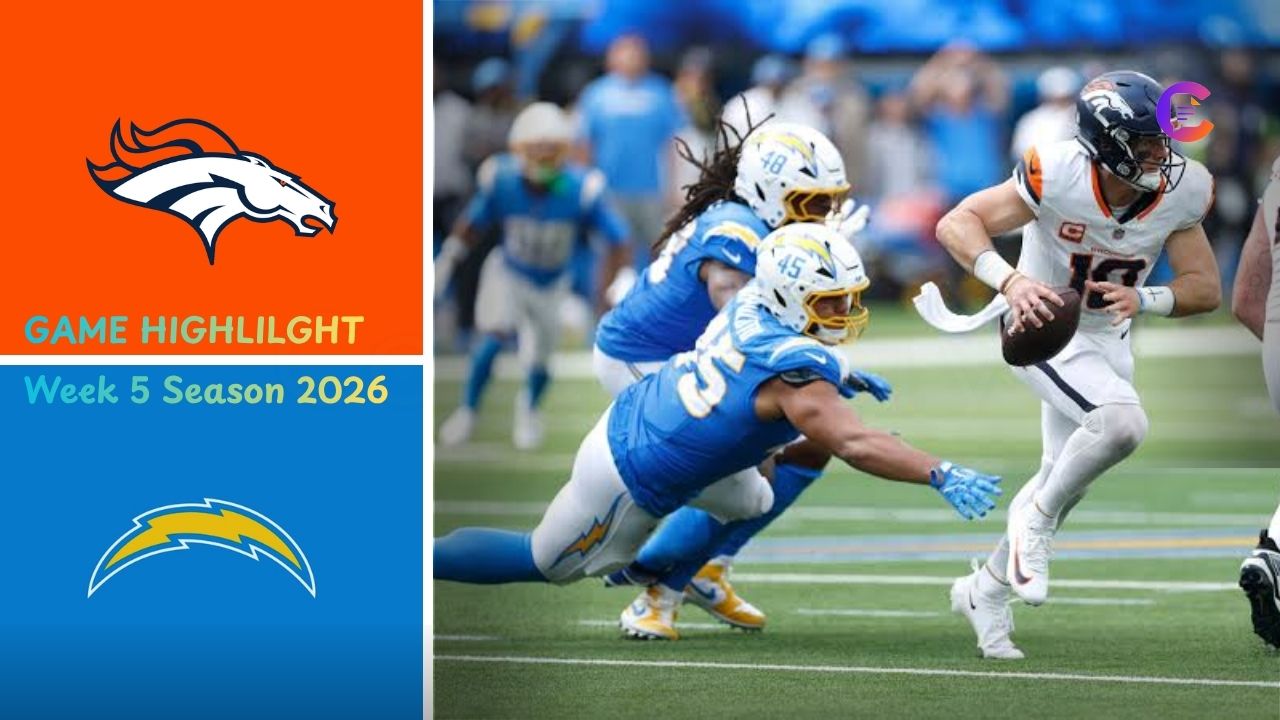
The Denver Broncos and Los Angeles Chargers met on October 11, 2026, in a crucial AFC West matchup at SoFi Stadium. Denver entered the contest looking to strengthen its position in the division, while Los Angeles hoped to secure its first victory of the season. The Chargers held a seven-point advantage entering the fourth quarter, but Denver responded with a determined comeback and closed the game with timely defensive plays.
The Broncos won 23–17 after scoring 13 unanswered fourth-quarter points. Quarterback Bo Nix connected with Courtland Sutton for the game-tying touchdown, while kicker Wil Lutz converted two late field goals. Running back J.K. Dobbins contributed a rushing touchdown and 68 rushing yards. Denver’s defense also forced crucial turnovers from Justin Herbert, helping the Broncos improve to 3–2. The Chargers fell to 0–5 despite taking control during the third quarter.
Final Score
| Team | Q1 | Q2 | Q3 | Q4 | Final |
|---|---|---|---|---|---|
| Denver Broncos | 7 | 3 | 0 | 13 | 23 |
| Los Angeles Chargers | 0 | 3 | 14 | 0 | 17 |
Denver started strongly but struggled to extend its lead during the first half. The Chargers gradually found their rhythm after halftime and scored 14 points in the third quarter. However, Denver’s defense regained control in the final period, and the Broncos’ offense made enough plays to complete the comeback.
Denver scored the opening touchdown through Dobbins before adding a second-quarter field goal. Los Angeles answered with a field goal and two third-quarter touchdowns, briefly moving ahead 17–10. Sutton’s fourth-quarter touchdown tied the score, and two successful Lutz field goals gave Denver the six-point victory.
Bo Nix Passing Stats and Performance
Bo Nix completed 16 of 27 passes for 123 yards and one touchdown. He did not throw an interception, although he lost a fumble during the third quarter. His passing numbers were modest, but he delivered the crucial touchdown when Denver needed it most. Nix connected with Sutton for a five-yard score early in the fourth quarter, tying the game at 17–17.
Nix also contributed 10 rushing yards on four attempts. Denver’s offense struggled to maintain consistency for much of the contest, but the quarterback remained composed during the decisive final period. His touchdown drive followed a failed fourth-down attempt by Los Angeles. That sequence changed the momentum and gave Denver the opportunity to reclaim control of the game.
Explore New York Giants vs Washington Commanders Match Player Stats, Score and Highlights
Justin Herbert Passing Stats and Chargers Offense
Justin Herbert completed 14 of 24 passes for 121 yards and one touchdown. He threw one interception and was sacked five times for a loss of 39 yards. Herbert also rushed six times for 54 yards, including a significant 23-yard scramble during the Chargers’ long third-quarter scoring drive. His mobility helped Los Angeles move the ball when the passing game struggled.
Herbert’s touchdown pass went to tight end Hayden Rucci, who caught a seven-yard scoring reception. However, the Chargers could not maintain their momentum after taking a 17–10 lead. Herbert lost a fumble in the fourth quarter, then threw an interception on the next Los Angeles possession. Those mistakes allowed Denver to take the lead and protect it until the final whistle.
J.K. Dobbins Leads Denver’s Rushing Attack
J.K. Dobbins led the Broncos with 68 rushing yards on 18 carries. He also scored Denver’s opening touchdown on a two-yard run in the first quarter. The score capped a short drive that followed an early Chargers turnover, giving Denver an important advantage before either offense established consistent production.
Dobbins’ contribution extended beyond his touchdown. His carries helped Denver maintain possession and manage the clock during the closing stages. Quarterback Nix added 10 rushing yards, while Jaylen Waddle recorded nine yards on one attempt. Denver’s rushing production helped support the late comeback even though the passing attack did not produce a high yardage total.
Kimani Vidal Sparks the Chargers
Kimani Vidal supplied one of the game’s biggest offensive plays for Los Angeles. He rushed eight times for 57 yards and scored on a spectacular 42-yard touchdown run late in the third quarter. The play came immediately after the Chargers recovered a fumble by Nix, turning a defensive takeaway into a quick offensive score.
Vidal’s touchdown put Los Angeles ahead 17–10 and appeared to give the home team control. However, the Chargers could not sustain that advantage. Denver’s defense tightened in the fourth quarter, and the offense took advantage of the opportunities created by turnovers. Vidal’s performance remained a bright spot in a difficult result for the Chargers.
Key Receiving Stats and Top Performers
Denver’s passing attack relied on several receivers to move the ball. Tight end Evan Engram led the Broncos with four receptions for 55 yards. Courtland Sutton delivered the most important catch of the game, securing the five-yard touchdown that tied the score at 17. Jaylen Waddle added two receptions for 19 yards, along with nine rushing yards.
For Los Angeles, Charlie Kolar recorded three receptions for 37 yards, while Hayden Rucci caught the seven-yard touchdown pass from Herbert. The Chargers struggled to generate consistent explosive passing plays. Denver’s defense limited Herbert to 121 passing yards and pressured him throughout the contest. That pressure became especially effective during the final quarter, when the Chargers’ turnovers proved decisive.
| Player | Team | Key Statistics |
|---|---|---|
| Evan Engram | Broncos | 4 receptions, 55 yards |
| Courtland Sutton | Broncos | 5-yard touchdown reception |
| Jaylen Waddle | Broncos | 2 receptions, 19 yards; 9 rushing yards |
| Charlie Kolar | Chargers | 3 receptions, 37 yards |
| Hayden Rucci | Chargers | 7-yard touchdown reception |
| Kimani Vidal | Chargers | 8 carries, 57 yards, 1 TD |
Denver Broncos vs Los Angeles Chargers Passing Stats
The quarterback comparison shows how closely matched the passing totals were. Nix finished with 123 yards and a touchdown, while Herbert recorded 121 yards and a touchdown. Denver gained the decisive advantage by protecting the ball through the air and forcing mistakes on the opposing side.
| Quarterback | Team | Completions/Attempts | Passing Yards | TD | INT |
|---|---|---|---|---|---|
| Bo Nix | Broncos | 16/27 | 123 | 1 | 0 |
| Justin Herbert | Chargers | 14/24 | 121 | 1 | 1 |
Nix’s passing performance was not statistically dominant, but his fourth-quarter touchdown was essential. Herbert’s interception and lost fumble proved more costly than the small difference in passing yards. Denver also sacked Herbert five times, repeatedly disrupting the Chargers’ offensive rhythm.
Team Statistics and Turnovers
The overall numbers show a competitive game, with neither offense producing overwhelming passing yardage. Denver recorded 18 first downs compared with Los Angeles’ 14. The Broncos converted one of 12 third-down attempts, while the Chargers converted five of 14. Denver also finished with one turnover, compared with three for Los Angeles.
| Team Statistic | Denver Broncos | Los Angeles Chargers |
|---|---|---|
| Total net yards | 224 | 237 |
| Passing yards | 123 | 121 |
| First downs | 18 | 14 |
| Third-down conversions | 1/12 | 5/14 |
| Red-zone efficiency | 2/5 | 1/1 |
| Turnovers | 1 | 3 |
| Penalties | 7 | 9 |
| Penalty yards | 40 | 93 |
| Time of possession | 29:07 | 30:53 |
Los Angeles had a slight edge in net yardage and possession time, but the team could not turn those advantages into a victory. The Chargers’ nine penalties cost 93 yards, and their three turnovers created costly situations. Denver’s defense made the most important plays when the game was on the line.
Quarter-by-Quarter Game Recap
First quarter: Denver opened the scoring with Dobbins’ two-yard touchdown run. The Broncos capitalized on an early Chargers fumble to take a 7–0 lead. Both defenses then limited the opposing offense, keeping the score unchanged through the remainder of the quarter.
Second quarter: Cameron Dicker converted a 42-yard field goal for Los Angeles. Wil Lutz answered with a 34-yard field goal, giving Denver a 10–3 halftime advantage. The Chargers managed only 74 yards of offense during the first half and struggled to establish consistent drives.
Third quarter: Los Angeles tied the game with a seven-yard touchdown pass from Herbert to Rucci. The Chargers then recovered Nix’s fumble, and Vidal scored on a 42-yard run. That explosive play put Los Angeles ahead 17–10 heading into the final quarter.
Fourth quarter: Denver answered with Nix’s five-yard touchdown pass to Sutton, tying the score. Herbert then fumbled, allowing Denver to take a 20–17 lead through Lutz’s 19-yard field goal. Brandon Jones intercepted Herbert on the next Chargers possession, and Lutz added a 36-yard field goal to complete the scoring.
Defensive Highlights and the Game-Changing Moments
Denver’s defense turned the contest around in the fourth quarter. The most important sequence began when the Chargers failed to convert a fourth-down attempt. Denver moved downfield and scored the touchdown that tied the game. The Broncos then forced Herbert’s fumble, which created the opportunity for Lutz to kick the go-ahead field goal.
Brandon Jones’ interception on the following Chargers possession gave Denver another crucial defensive stop. Los Angeles still had an opportunity to respond, but Herbert faced pressure and was sacked on the final play. The late defensive effort demonstrated how turnovers and quarterback pressure can decide a close NFL matchup, even when the winning offense has limited yardage.
What the Result Means for Both Teams
The victory moved Denver to 3–2 and gave the Broncos an important AFC West result. Their comeback demonstrated resilience, although the offense will need to improve its third-down efficiency. Nix and the receiving group produced enough at the end, while Dobbins supplied a dependable rushing contribution. The defense delivered the decisive plays that secured the win.
The Chargers dropped to 0–5, extending a difficult start to the 2026 season. Their third-quarter surge showed offensive potential, but costly fourth-quarter mistakes erased the advantage. Los Angeles will need better ball security, fewer penalties, and stronger late-game execution to turn competitive stretches into wins. The loss also highlighted the importance of protecting Herbert and maintaining offensive consistency.
Conclusion
The Denver Broncos vs Los Angeles Chargers matchup on October 11, 2026, ended in a 23–17 Denver victory. Bo Nix threw for 123 yards and a touchdown, J.K. Dobbins rushed for 68 yards and scored, and Courtland Sutton caught the game-tying touchdown. Wil Lutz then converted two field goals to secure the win.
The decisive difference came from Denver’s defense, which forced a late fumble and intercepted Herbert during the fourth quarter. Los Angeles had briefly taken a 17–10 lead but could not protect it. Denver improved to 3–2, while the Chargers fell to 0–5. The result showed how late defensive stops and ball security can determine the outcome of a tightly contested divisional game.
Get More Update CONTENTORY