
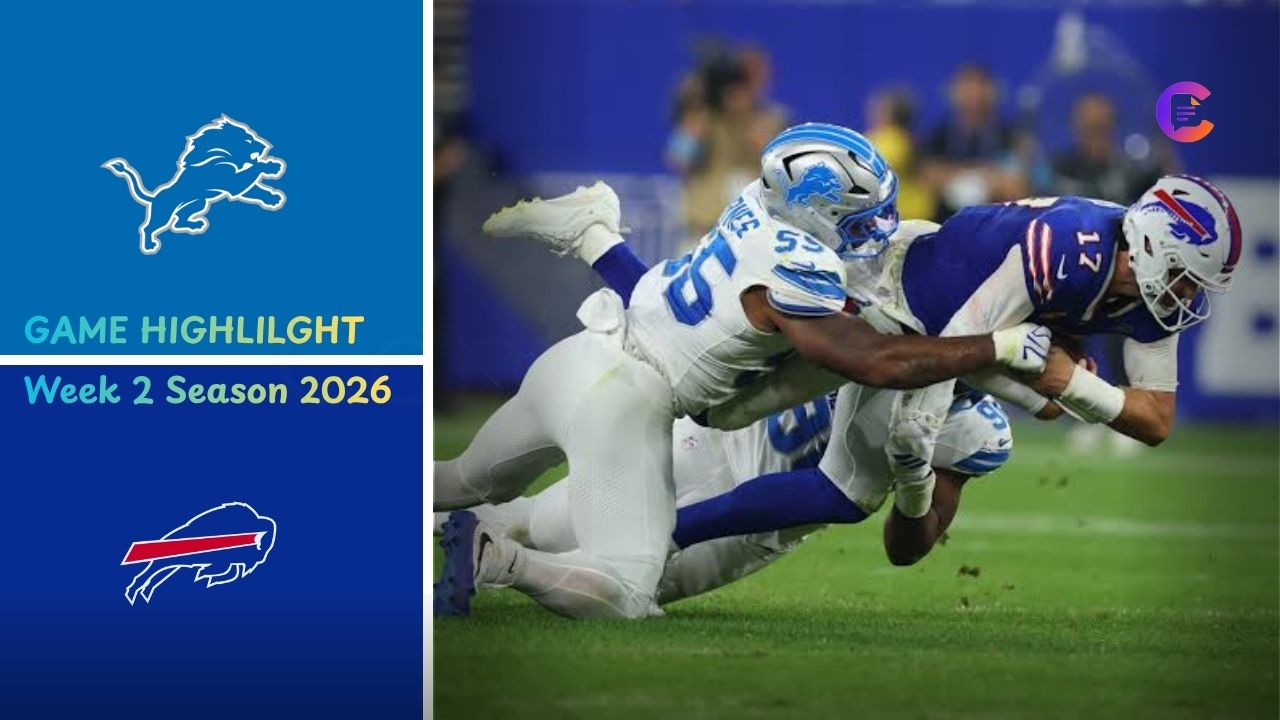
The Buffalo Bills defeated the Detroit Lions 41-31 on September 17, 2026, in a high-scoring Week 2 matchup at Highmark Stadium in Orchard Park, New York. The game marked the first regular-season contest at Buffalo’s new stadium, and Josh Allen delivered a five-touchdown performance in front of the home crowd. Detroit produced 355 total yards and scored 31 points, but Buffalo generated 446 yards and controlled the game for 33:45. The result moved Buffalo to 2-0 while Detroit fell to 1-1.
Josh Allen led Buffalo with 248 passing yards, three passing touchdowns, and two rushing touchdowns. James Cook added 135 rushing yards and a touchdown, while Dalton Kincaid caught seven passes for 95 yards and one touchdown. Detroit quarterback Jared Goff completed 26 of 38 attempts for 327 yards and four touchdowns without an interception. Amon-Ra St. Brown produced nine receptions for 142 yards and two touchdowns. Despite Detroit’s strong passing production, Buffalo’s early lead and balanced offensive attack kept the Bills ahead throughout the contest.
Final Score Table
| Team | Q1 | Q2 | Q3 | Q4 | Final |
|---|---|---|---|---|---|
| Detroit Lions | 0 | 10 | 7 | 14 | 31 |
| Buffalo Bills | 14 | 13 | 7 | 7 | 41 |
Final Score and Match Overview
Buffalo started quickly and built a 14-0 first-quarter advantage. Allen opened the scoring with a one-yard rushing touchdown before throwing a 43-yard touchdown pass to Joshua Palmer. The Bills added two more touchdowns through Allen during the second quarter, including a short pass to Dawson Knox and a 16-yard connection with Dalton Kincaid. Detroit responded with scores from Amon-Ra St. Brown and Jahmyr Gibbs, but Buffalo entered halftime with a 27-10 lead.
Detroit attempted to close the gap during the second half and eventually reduced Buffalo’s lead to seven points in the fourth quarter. However, James Cook scored on a one-yard touchdown run with 2:53 remaining, and Buffalo maintained control. St. Brown caught a late 27-yard touchdown from Goff with 1:48 left, but the Bills recovered the ensuing onside kick. Allen then took three knees to close the game and preserve Buffalo’s 41-31 victory.
Josh Allen’s Five-Touchdown Performance
Josh Allen produced the headline performance of the night for Buffalo. He completed 20 of 31 passes for 248 yards and three touchdowns without throwing an interception. Allen also carried the ball 14 times for 69 yards and two touchdowns. His five total touchdowns accounted for 30 of Buffalo’s 41 points. The Bills’ official recap described his performance as a major part of the historic home opener at Highmark Stadium.
Allen scored his first touchdown on a one-yard rushing play in the opening quarter. He later threw touchdown passes to Joshua Palmer, Dawson Knox, and Dalton Kincaid before adding another rushing touchdown in the third quarter. His ability to contribute through both passing and rushing prevented Detroit from focusing on one aspect of Buffalo’s offense. Allen finished the night without a turnover, helping Buffalo maintain its advantage despite Detroit’s late offensive surge.
Josh Allen Passing and Rushing Stats
| Category | Statistics |
|---|---|
| Completions/Attempts | 20/31 |
| Passing Yards | 248 |
| Passing TDs | 3 |
| Interceptions | 0 |
| Rushing Attempts | 14 |
| Rushing Yards | 69 |
| Rushing TDs | 2 |
| Total TDs | 5 |
Jared Goff Leads Detroit’s Passing Attack
Jared Goff produced an impressive statistical performance despite Detroit’s 10-point loss. He completed 26 of 38 passes for 327 yards and four touchdowns while avoiding an interception. His passing production accounted for nearly all of Detroit’s offensive yardage through the air. Goff repeatedly connected with Amon-Ra St. Brown, Jahmyr Gibbs, and Sam LaPorta as the Lions attempted to remain within reach during the second half.
Goff’s four touchdown passes went to three different players. He connected with Gibbs for an 11-yard touchdown in the second quarter, St. Brown for two scores, and LaPorta for another touchdown in the fourth quarter. His final touchdown pass came to St. Brown for 27 yards with 1:48 remaining. Detroit’s passing attack therefore remained productive even while Buffalo controlled possession and produced more total offensive plays.
Jared Goff Passing Stats
| Player | C/ATT | Passing Yards | TD | INT |
|---|---|---|---|---|
| Jared Goff | 26/38 | 327 | 4 | 0 |
Amon-Ra St. Brown Dominates Receiving
Amon-Ra St. Brown was Detroit’s leading receiver and one of the most productive players on the field. He finished with nine receptions for 142 yards and two touchdowns. His average gain was 15.78 yards per reception, and his longest catch covered 34 yards. St. Brown became an important part of Detroit’s comeback effort, scoring touchdowns in both the third and fourth quarters.
St. Brown’s first touchdown came on a two-yard reception from Goff with 9:31 remaining in the third quarter. His second arrived late in the fourth quarter on a 27-yard pass. That final touchdown reduced Buffalo’s lead to 10 points, but Detroit could not recover the onside kick. St. Brown’s nine catches also gave Goff a consistent target throughout the game as the Lions relied heavily on their passing attack.
Explore more Baltimore Ravens vs Indianapolis Colts Match Player
Detroit Receiving Leaders
| Player | Receptions | Receiving Yards | TD |
|---|---|---|---|
| Amon-Ra St. Brown | 9 | 142 | 2 |
| Jahmyr Gibbs | 6 | 61 | 1 |
| Sam LaPorta | 6 | 52 | 1 |
James Cook Powers Buffalo’s Rushing Game
James Cook provided Buffalo with a strong ground-game foundation. He carried the ball 21 times for 135 yards and one touchdown, averaging 6.43 yards per attempt. His longest run covered 35 yards. Cook’s production helped Buffalo maintain balance between the running and passing games while also allowing the Bills to control the clock during important stretches.
Cook’s touchdown came late in the fourth quarter when he rushed one yard into the end zone with 2:53 remaining. The score pushed Buffalo’s advantage to 40-24 before the extra point. His 21 carries also represented the largest rushing workload for either team. Combined with Allen’s 69 rushing yards, Cook helped Buffalo finish with 36 rushing attempts compared with Detroit’s 20.
Buffalo Rushing Leaders
| Player | Carries | Rushing Yards | TD |
|---|---|---|---|
| James Cook | 21 | 135 | 1 |
| Josh Allen | 14 | 69 | 2 |
| DJ Moore | 1 | -1 | 0 |
Dalton Kincaid and Buffalo Receiving Stats
Dalton Kincaid led Buffalo’s receiving group with seven catches for 95 yards and one touchdown. He averaged 13.57 yards per reception and recorded a long gain of 25 yards. Kincaid’s touchdown came in the second quarter when Allen found him for a 16-yard score. His production gave Allen another dependable target while Detroit attempted to contain Buffalo’s outside receivers.
Keon Coleman also contributed six receptions for 63 yards, while Joshua Palmer caught one pass for 43 yards and a touchdown. Palmer’s reception came on Buffalo’s opening-quarter scoring drive and immediately created a major explosive play. The receiving distribution demonstrated Buffalo’s ability to create scoring opportunities through different players rather than depending entirely on one target.
Buffalo Receiving Leaders
| Player | Receptions | Receiving Yards | TD |
|---|---|---|---|
| Dalton Kincaid | 7 | 95 | 1 |
| Keon Coleman | 6 | 63 | 0 |
| Joshua Palmer | 1 | 43 | 1 |
Jahmyr Gibbs Provides a Dual-Threat Performance
Jahmyr Gibbs remained an important part of Detroit’s offense throughout the matchup. He rushed 16 times for 52 yards and added six receptions for 61 yards. His receiving touchdown came on an 11-yard pass from Goff in the second quarter. Gibbs finished with 113 combined rushing and receiving yards, giving Detroit another versatile option alongside St. Brown.
Gibbs’ receiving production became particularly important because Buffalo limited Detroit’s rushing efficiency. The Lions recorded only 20 rushing attempts compared with Buffalo’s 36. Gibbs still provided explosive potential as a receiver and helped extend the Lions’ passing attack. His six catches ranked second on Detroit behind St. Brown, while his 61 receiving yards complemented his 52 rushing yards.
Team Statistics Comparison
The team statistics show that Buffalo controlled the game through offensive volume and possession. The Bills produced 446 total yards compared with Detroit’s 355. Buffalo also ran 69 offensive plays, seven more than Detroit. The Bills possessed the ball for 33:45, while the Lions had it for 26:15. Buffalo’s 36 rushing attempts also created more opportunities to control the clock and protect its lead during the second half.
Detroit actually produced strong passing numbers, with 327 passing yards compared with Buffalo’s 248. The difference came largely from the ground game and overall offensive volume. Buffalo generated 198 rushing yards, while Detroit recorded only 28. The Bills also committed five penalties compared with Detroit’s 10, although Buffalo accumulated 46 penalty yards compared with Detroit’s 58. Both teams finished without a lost turnover.
Team Comparison Table
| Statistic | Detroit Lions | Buffalo Bills |
|---|---|---|
| Total Yards | 355 | 446 |
| Passing Yards | 327 | 248 |
| Rushing Yards | 28 | 198 |
| Total Plays | 62 | 69 |
| Yards per Play | 5.7 | 6.5 |
| Rushing Attempts | 20 | 36 |
| Possession | 26:15 | 33:45 |
| Turnovers | 0 | 0 |
| Penalties | 10 | 5 |
| Penalty Yards | 58 | 46 |
Key Plays That Shaped the Game
Buffalo’s opening quarter established the game’s early direction. Allen rushed for a one-yard touchdown on Buffalo’s first scoring drive, then connected with Palmer for a 43-yard touchdown later in the quarter. The Bills entered the second quarter with a 14-0 advantage and continued adding points. Detroit eventually responded, but Buffalo’s early offensive efficiency forced the Lions to spend much of the game playing from behind.
Detroit’s strongest stretch arrived in the second half. St. Brown scored twice, LaPorta added a touchdown, and the Lions continued finding room through Goff’s passing game. However, Buffalo repeatedly answered with scoring drives of its own. Cook’s fourth-quarter touchdown restored a significant cushion, and St. Brown’s final score came too late to change the outcome. Buffalo then recovered Detroit’s onside kick and ended the game with Allen’s kneel-downs.
Highmark Stadium Home Opener
The matchup carried additional significance because it was the first regular-season game at the Bills’ new Highmark Stadium. Buffalo’s official recap described the 41-31 victory as the stadium’s first game, while the home crowd watched Allen produce five touchdowns. The Bills entered the contest with a 1-0 record after their Week 1 victory and used the home opener to move to 2-0.
The victory also gave Joe Brady a 2-0 start as Buffalo’s head coach. The Bills’ official account noted that Brady became the first head coach in franchise history to begin his tenure with two victories. The Lions, meanwhile, moved to 1-1 after splitting their first two games. Buffalo’s combination of offensive balance and Allen’s five-touchdown performance made the stadium opener a notable early-season game.
Detroit Lions vs Buffalo Bills Player Stats
The individual numbers reveal strong performances on both sides. Goff threw four touchdown passes without an interception, while St. Brown exceeded 140 receiving yards. Gibbs added 113 combined yards, including a receiving touchdown. For Buffalo, Allen accounted for five touchdowns, Cook rushed for 135 yards, and Kincaid recorded 95 receiving yards with a score. These statistics explain how both offenses produced more than 30 points despite the final 10-point margin.
The biggest statistical contrast came from the rushing production. Buffalo gained 198 rushing yards, while Detroit managed only 28. That 170-yard difference helped Buffalo produce more offensive plays and maintain possession. At the same time, Detroit’s 327 passing yards showed that the Lions remained dangerous through the air. The overall numbers therefore presented a game in which Buffalo’s rushing balance complemented Allen’s passing and rushing contributions.
Complete Player Stats Table
| Team | Player | Category | Statistics |
|---|---|---|---|
| Detroit | Jared Goff | Passing | 26/38, 327 yards, 4 TD, 0 INT |
| Detroit | Jahmyr Gibbs | Rushing | 16 carries, 52 yards |
| Detroit | Amon-Ra St. Brown | Receiving | 9 receptions, 142 yards, 2 TD |
| Detroit | Jahmyr Gibbs | Receiving | 6 receptions, 61 yards, 1 TD |
| Detroit | Sam LaPorta | Receiving | 6 receptions, 52 yards, 1 TD |
| Buffalo | Josh Allen | Passing | 20/31, 248 yards, 3 TD, 0 INT |
| Buffalo | James Cook | Rushing | 21 carries, 135 yards, 1 TD |
| Buffalo | Josh Allen | Rushing | 14 carries, 69 yards, 2 TD |
| Buffalo | Dalton Kincaid | Receiving | 7 receptions, 95 yards, 1 TD |
| Buffalo | Keon Coleman | Receiving | 6 receptions, 63 yards |
| Buffalo | Joshua Palmer | Receiving | 1 reception, 43 yards, 1 TD |
Final Match Summary
The Buffalo Bills defeated the Detroit Lions 41-31 in a memorable Week 2 contest at Highmark Stadium. Josh Allen accounted for five touchdowns, including three through the air and two on the ground. James Cook added 135 rushing yards and one touchdown, while Dalton Kincaid produced 95 receiving yards and a score. Buffalo finished with 446 total yards, 198 rushing yards, and 33:45 of possession. The Bills also remained turnover-free during the contest.
Detroit’s offense produced enough passing success to keep the game competitive. Jared Goff threw for 327 yards and four touchdowns, while Amon-Ra St. Brown finished with 142 receiving yards and two scores. Jahmyr Gibbs contributed as both a runner and receiver. However, Buffalo’s rushing advantage, greater offensive volume, and early 14-0 lead ultimately shaped the final result. The Bills recovered Detroit’s late onside kick and finished the game at 41-31, moving to 2-0 on the season.
Get More Update CONTENTORY