

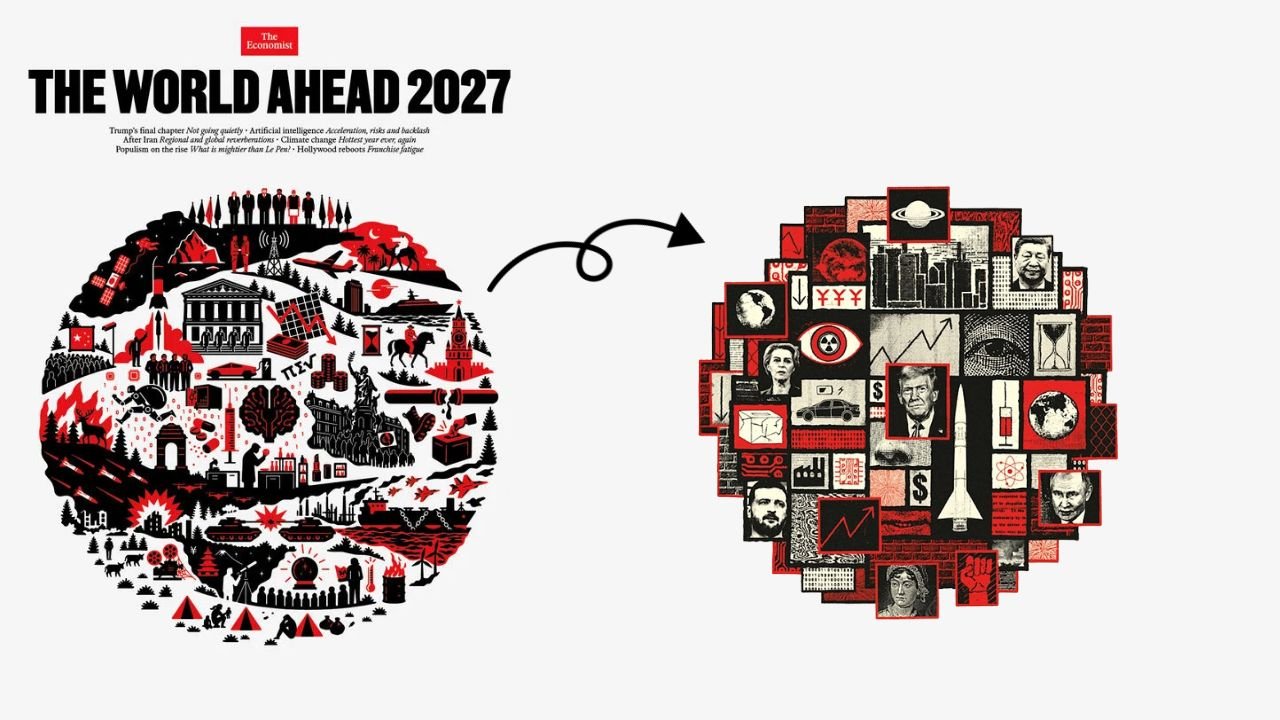
The outlook for 2027 points toward moderate global economic growth, easing inflation, and continued uncertainty. Major institutions disagree on the exact pace of expansion, but their projections suggest that the world economy could avoid a severe downturn if energy markets stabilize, trade improves, and businesses continue investing in technology.
One important distinction: these are forecasts from organizations such as the IMF, OECD, and World Bank—not a single prediction shared by all economists. Their estimates differ because they use different assumptions about geopolitical conflicts, energy prices, inflation, and economic policy.
What the Main Economic Forecasts Say About 2027
The International Monetary Fund’s October 2026 World Economic Outlook projects global growth of 3.4% in 2027, following estimated growth of 3.1% in 2026. The IMF also expects global headline inflation to ease from 4.7% in 2026 to 4.1% in 2027. Its outlook suggests that economic activity can strengthen, although risks remain tilted toward weaker-than-expected results. International Monetary Fund+1
The OECD takes a more cautious position, projecting global GDP growth of 3.0% in 2027. The World Bank’s June 2026 outlook projected growth of 2.8%, while the United Nations estimated 2.9% in its September update. These differences show why readers should treat any single 2027 figure as an estimate rather than a guaranteed outcome.
Global Growth Could Improve, but Remain Uneven
The global economy may expand in 2027 without delivering a strong recovery everywhere. Advanced economies face slower population growth, high public debt, and pressure on household budgets. Emerging markets could benefit from stronger demand, investment, and trade, but countries that rely heavily on imported energy may continue to face higher costs. The overall picture is one of uneven progress rather than a synchronized boom.
The IMF’s forecast is more optimistic than the OECD’s and the World Bank’s, but all three point toward continued expansion rather than a clear global recession in their central projections. However, a baseline forecast cannot rule out a downturn. A prolonged energy disruption, renewed trade restrictions, or financial stress could weaken growth across several regions at once.
Inflation May Ease, but Living Costs Could Stay High
Inflation could become less intense in 2027 if energy prices settle and supply chains operate more smoothly. The IMF expects global headline inflation to fall to 4.1% in 2027, down from its projected 4.7% for 2026. Lower inflation would give households and businesses some relief, particularly in countries where food, transport, housing, and utility costs have risen sharply.
However, lower inflation does not mean prices will return to earlier levels. It means prices are increasing more slowly. Families may still face expensive groceries, rent, healthcare, and electricity even if official inflation rates decline. Wage growth will matter too: households are more likely to feel an improvement when their earnings rise faster than the cost of everyday essentials.
Interest Rates and Central Bank Decisions
Central banks may have more room to reduce interest rates if inflation moves closer to their targets. Lower borrowing costs could encourage businesses to invest, help consumers finance major purchases, and reduce pressure on mortgage and loan payments. Yet policymakers will need to balance economic support against the risk that another energy or supply shock pushes prices higher.
Interest-rate cuts are therefore not guaranteed across every country. Economies with persistent inflation may keep monetary policy tight, while countries experiencing weaker demand could consider reductions sooner. Government borrowing also complicates the outlook. High public debt and concerns about fiscal sustainability may keep longer-term borrowing costs elevated, even if central banks lower their short-term rates.
The United States Economy in 2027
The United States could remain an important driver of global economic activity in 2027, supported by consumer spending, business investment, and technology development. The OECD projects US GDP growth of 2.1% in 2027, following its 2.2% estimate for 2026. It expects investment linked to artificial intelligence to provide support, although slower consumer spending and weaker real-income growth could limit momentum.
The main question is whether households and companies can maintain spending if borrowing remains expensive and living costs stay high. A stronger technology sector could lift productivity and investment, but gains may not reach every worker or industry equally. Employment conditions, consumer confidence, government policy, and financial-market stability will all influence how the US economy performs.
China’s Growth and Its Global Influence
China will remain central to the 2027 economic outlook because of its role in manufacturing, trade, technology, and global supply chains. The OECD projects Chinese economic growth of 4.2% in 2027, down from 4.5% in 2026. That points to continued expansion, but at a more moderate pace than in some earlier periods.
China’s performance will depend on domestic demand, industrial investment, property-market conditions, and international trade. Stronger consumer spending could support growth, while weak confidence or renewed trade tensions could create pressure. Changes in Chinese demand also matter beyond its borders: commodity exporters, manufacturers, shipping companies, and businesses supplying the country may all feel the effects.
Europe Could Face a Slow but Steady Recovery
Europe’s economic performance may improve gradually in 2027, although the region could continue to grow more slowly than some emerging markets. The OECD projects euro-area GDP growth of 1.0% in 2027, matching its estimate for 2026. It expects demand to strengthen if energy prices normalize and defence-related investment gains momentum.
Energy costs, industrial competitiveness, public spending, and consumer confidence will remain important issues. Countries with strong manufacturing sectors may benefit from lower input costs and renewed demand, but they could struggle if global trade weakens. Europe’s ability to attract investment and improve productivity will also shape its longer-term position in the global economy.
Artificial Intelligence Could Become a Major Growth Driver
Artificial intelligence may be one of the strongest forces shaping the global economy in 2027. Companies are investing in computing infrastructure, data centres, software, automation, and AI-enabled services. If these investments improve productivity, businesses could produce more with fewer resources, develop new services, and reduce operating costs. The IMF and OECD both identify technology-related activity as an important source of support for economic growth.
The benefits, however, may not appear evenly across industries or countries. Businesses that can afford advanced technology may gain an advantage, while smaller firms could struggle with implementation costs. Automation may also change job requirements and increase demand for technical skills. If investment expectations become excessive or productivity gains disappoint, a sharp correction in technology markets could create wider financial risks.
Read Also: The Story Behind Alberta Separatism Politics, History, and Key Issues
Oil Prices and Geopolitical Tensions Could Change the Outlook
Energy markets represent one of the biggest uncertainties for 2027. Conflict and disruption to oil and gas supplies can increase transport, manufacturing, electricity, and food-production costs. These pressures can weaken household purchasing power and force businesses to delay investment. The OECD has warned that prolonged disruption to Middle East energy exports could weigh on global growth and keep inflation higher. OECD+1
A more stable geopolitical environment could produce the opposite result. Reliable energy supplies and lower commodity prices would help reduce costs and support economic recovery. However, forecasts depend on assumptions about how conflicts and trade disruptions develop. Unexpected events can quickly change oil prices, investor confidence, and government spending priorities, making energy security a central issue for policymakers.
What the 2027 Forecast Could Mean for Pakistan
Pakistan’s economic outlook will depend partly on domestic reforms and partly on conditions in international markets. Lower global energy prices could reduce pressure on import costs and inflation, while stronger international demand could support exports. However, expensive fuel, currency pressure, debt repayments, and limited fiscal space could continue to restrict the government’s options.
The World Bank has identified the Middle East, North Africa, Afghanistan, and Pakistan region as particularly affected by the 2026 energy shock, while describing South Asia as the fastest-growing broad region. It expects regional recoveries as energy prices ease and global activity improves in 2027–28. For Pakistan, the strength of that recovery will depend on energy availability, export performance, investment, and economic policy.
Stock Markets and Investment Opportunities
Financial markets may respond positively if economic growth strengthens and inflation declines. Investors could look toward technology, infrastructure, energy, healthcare, and companies positioned to benefit from productivity improvements. Lower interest rates, where they occur, may also make some investments more attractive. Nevertheless, market performance will depend on company earnings, valuations, government policies, and investor expectations not just GDP growth.
A positive economic forecast does not guarantee rising stock prices. Markets can fall even when economies expand if investors believe companies are overvalued or future earnings will disappoint. Businesses and individual investors should therefore consider risk, diversification, and investment time horizons. The most useful approach is to prepare for different economic scenarios rather than assume that one forecast will prove correct.
Biggest Risks That Could Disrupt the 2027 Outlook
Several risks could make 2027 more difficult than current baseline projections suggest. These include prolonged geopolitical conflict, further energy-supply disruptions, renewed trade tensions, high government debt, and sudden changes in financial conditions. The IMF also highlights the possibility that a reassessment of AI-related expectations could weaken investment and market confidence.
The IMF’s October 2026 analysis estimates a roughly 10% probability that global growth could fall below 2% in 2027. That figure does not mean a severe slowdown is the most likely outcome; it illustrates that meaningful downside risks remain. Unexpected shocks can also interact, turning a regional problem into a broader economic challenge. International Monetary Fund
Conclusion
The 2027 global economic forecast suggests a year of moderate growth, potentially easing inflation, and continued technological investment. The IMF expects stronger global growth than the OECD and World Bank, but their projections all point to an economy facing significant uncertainty. The United States and China will remain influential, Europe may recover slowly, and emerging markets will experience different results depending on their energy exposure and economic policies.
Ultimately, the global economy’s direction will depend on whether energy markets stabilize, inflation continues to ease, trade remains resilient, and technology investment delivers real productivity gains. The outlook is cautiously positive, but it is not risk-free. Readers, businesses, and policymakers should follow updated forecasts throughout 2027 rather than treat today’s estimates as certain predictions.
Frequently Asked Questions
What is the global economic growth forecast for 2027?
The IMF projects global growth of 3.4% in 2027. The OECD estimates 3.0%, while the World Bank’s June 2026 outlook projected 2.8%. These differences reflect different models and assumptions.
Will inflation decrease in 2027?
The IMF expects global headline inflation to ease to 4.1% in 2027 from 4.7% in 2026. Actual inflation will depend on energy prices, supply conditions, and economic policy.
Will the world economy face a recession in 2027?
A global recession is not the central scenario in the major forecasts discussed here. However, geopolitical conflict, energy disruptions, and financial stress could weaken growth.
How could AI affect the global economy in 2027?
AI investment could support productivity, business efficiency, and economic growth. Its benefits may vary by industry, and excessive investment expectations could create financial risks.
What could the 2027 economic outlook mean for Pakistan?
Pakistan could benefit from lower energy prices and stronger regional activity. Its results will also depend on domestic reforms, exports, inflation, currency stability, and debt management.
Get More Update CONTENTORY