
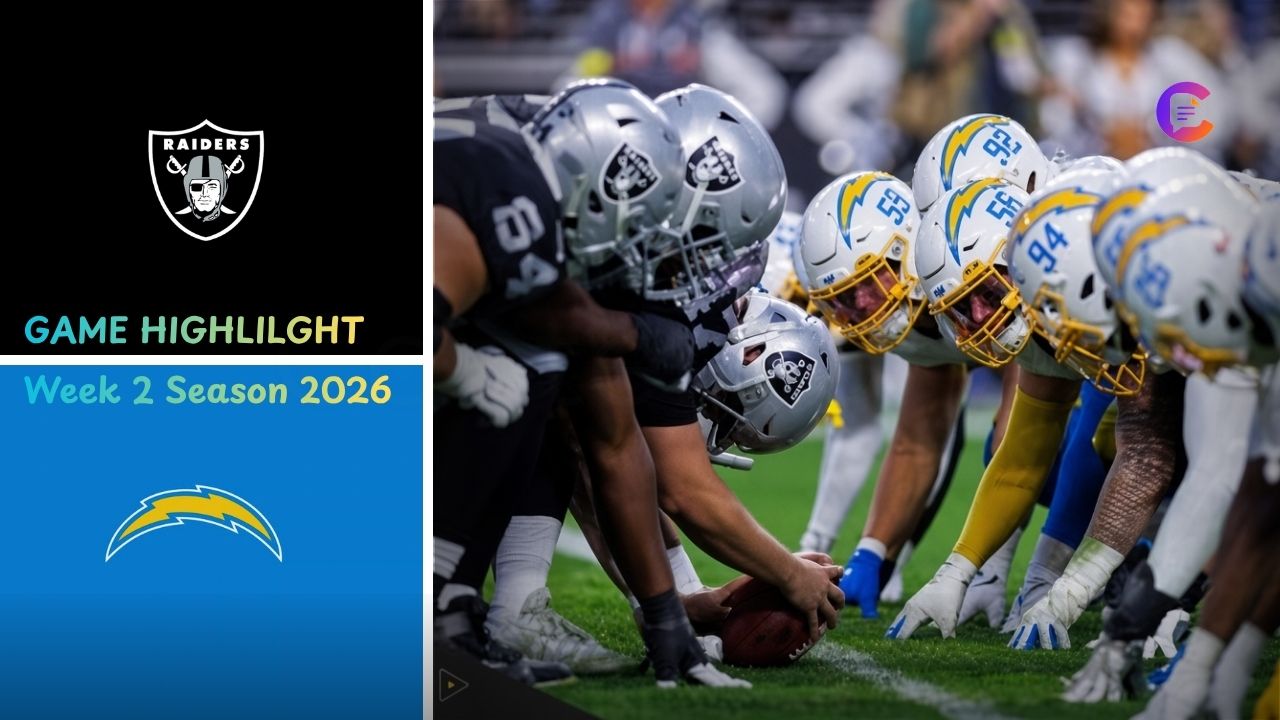
The Las Vegas Raiders defeated the Los Angeles Chargers 26–14 in their Week 2 matchup on September 20, 2026, at SoFi Stadium in Inglewood, California. The Raiders entered the game after winning their season opener and improved to 2–0 with another road victory. The Chargers dropped to 0–2 after suffering their second consecutive home defeat. Las Vegas produced 305 total yards, while Los Angeles finished with 310. The close yardage totals did not reflect the biggest statistical difference because the Chargers committed three turnovers compared with one by the Raiders.
Kirk Cousins led the Raiders offense with 253 passing yards and three touchdown passes on 19-of-29 passing. Tre Tucker caught five passes for 119 yards and one touchdown, while Cody White added two touchdown receptions. Justin Herbert completed 15 of 26 passes for 192 yards, one touchdown, and two interceptions for Los Angeles. Running back Omarion Hampton rushed 23 times for 94 yards and one touchdown. The Raiders also received a major defensive contribution from rookie cornerback Hezekiah Masses, who recorded two interceptions.
Final Score
| Team | Q1 | Q2 | Q3 | Q4 | Final |
|---|---|---|---|---|---|
| Las Vegas Raiders | 0 | 10 | 7 | 9 | 26 |
| Los Angeles Chargers | 0 | 7 | 7 | 0 | 14 |
Match Details
The final score was Las Vegas Raiders 26, Los Angeles Chargers 14. The game remained competitive through three quarters, with Los Angeles holding a 14–10 advantage before Las Vegas answered with a touchdown from Cody White. The Raiders then added another White touchdown in the fourth quarter before a late safety completed the scoring. The Chargers could not recover from their turnovers, and Las Vegas finished the game with a 2–0 record.
| Match Detail | Information |
|---|---|
| Teams | Las Vegas Raiders vs Los Angeles Chargers |
| Date | September 20, 2026 |
| Week | NFL Week 2 |
| Venue | SoFi Stadium |
| Location | Inglewood, California |
| Final Score | Raiders 26, Chargers 14 |
| Raiders Record | 2–0 |
| Chargers Record | 0–2 |
| Raiders Total Yards | 305 |
| Chargers Total Yards | 310 |
Quarter-by-Quarter Breakdown
The first quarter ended scoreless after both defenses prevented sustained scoring opportunities. Las Vegas opened the scoring in the second quarter when Cousins connected with Tre Tucker on a 40-yard touchdown pass. The Chargers answered with a one-yard rushing touchdown from Omarion Hampton. Matt Gay then converted a 59-yard field goal for Las Vegas just before halftime, giving the Raiders a 10–7 advantage at the break. The field goal represented the longest successful kick of Gay’s career.
Los Angeles moved ahead in the third quarter when Herbert found Oronde Gadsden for a 10-yard touchdown. The Raiders responded quickly as Cousins connected with Cody White for a 13-yard touchdown, putting Las Vegas back in front 17–14. The Raiders then added another White touchdown in the fourth quarter. A late safety increased the margin to 12 points and ended any realistic comeback opportunity for the Chargers. Las Vegas finished with nine fourth-quarter points and held Los Angeles scoreless in the final period.
Las Vegas Raiders Passing Stats
Kirk Cousins completed 19 of 29 passes for 253 yards, three touchdowns, and one interception. His 65.5 percent completion rate helped Las Vegas consistently create explosive passing plays despite the Chargers generating pressure. Cousins averaged 8.7 yards per attempt and finished with a reported passer rating of 113.1. His three touchdown passes also continued a notable early-season run, as Reuters reported that he became the first Raiders quarterback since Ken Stabler in 1976 to throw at least three touchdown passes in each of the team’s first two games of a season.
| Player | C/ATT | Passing Yards | TD | INT |
|---|---|---|---|---|
| Kirk Cousins | 19/29 | 253 | 3 | 1 |
Cousins distributed the ball effectively, with Tre Tucker providing the biggest receiving production. Tucker finished with five receptions for 119 yards and one touchdown, including a 40-yard scoring reception. Cody White also became an important red-zone target, catching two passes for 24 yards and two touchdowns. Michael Mayer added three receptions for 23 yards. The Raiders did not dominate total yardage, but their passing attack produced the decisive scoring plays when opportunities emerged.
Los Angeles Chargers Passing Stats
Justin Herbert completed 15 of 26 passes for 192 yards, one touchdown, and two interceptions. He connected with Oronde Gadsden for the Chargers’ third-quarter touchdown, which briefly gave Los Angeles a 14–10 lead. Herbert also dealt with pressure throughout the afternoon and finished with three sacks according to the Associated Press recap. His two interceptions became costly because Las Vegas converted the Chargers’ mistakes into important field-position opportunities.
| Player | C/ATT | Passing Yards | TD | INT |
|---|---|---|---|---|
| Justin Herbert | 15/26 | 192 | 1 | 2 |
Tre’ Harris produced the Chargers’ longest reception, gaining 53 yards on one catch. Ladd McConkey recorded three receptions for 35 yards, while Omarion Hampton contributed two catches for 21 yards. Oronde Gadsden’s 10-yard touchdown reception supplied Los Angeles with its final touchdown of the game. The Chargers generated 310 total yards, but their inability to protect the football limited the value of that offensive production.
Explore New Orleans Saints vs Baltimore Ravens Match Player Stats Complete Week 2 Analysis
Raiders Rushing and Receiving Stats
Ashton Jeanty led Las Vegas in rushing with 21 carries for 48 yards. He averaged 2.3 yards per carry and did not score a rushing touchdown. Mike Washington Jr. added seven yards on three carries, while Cousins gained one yard on four rushing attempts. The Raiders ran the ball 29 times and recorded 57 rushing yards, meaning their offense relied heavily on Cousins and the passing game to create scoring opportunities.
| Player | Rushing | Receiving |
|---|---|---|
| Ashton Jeanty | 21-48-0 | 4-15-0 |
| Mike Washington Jr. | 3-7-0 | 0-0-0 |
| Kirk Cousins | 4-1-0 | — |
| Tre Tucker | — | 5-119-1 |
| Cody White | — | 2-24-2 |
| Dareke Young | — | 1-27-0 |
| Jack Bech | — | 2-25-0 |
| Michael Mayer | — | 3-23-0 |
Tre Tucker’s performance was the standout receiving line for Las Vegas. He finished with five catches for 119 yards and a touchdown, giving the Raiders a reliable downfield threat. His 42-yard longest reception helped produce explosive yardage, while White supplied two touchdown catches in the second half. The combination allowed Las Vegas to overcome a modest rushing output and maintain scoring pressure despite possessing the ball for only 27:43.
Chargers Rushing and Receiving Stats
Omarion Hampton was the Chargers’ leading rusher and one of their most productive offensive players. He carried 23 times for 94 yards and scored a one-yard touchdown in the second quarter. He averaged 4.1 yards per carry and recorded a longest run of 17 yards. Keaton Mitchell added 24 yards on five carries, while Herbert’s rushing contribution was limited. Hampton also caught two passes for 21 yards, giving him 115 yards from scrimmage.
| Player | Rushing | Receiving |
|---|---|---|
| Omarion Hampton | 23-94-1 | 2-21-0 |
| Keaton Mitchell | 5-24-0 | — |
| Quentin Johnston | 1-7-0 | — |
| Tre’ Harris | — | 1-53-0 |
| Ladd McConkey | — | 3-35-0 |
| Omarion Hampton | — | 2-21-0 |
Tre’ Harris provided the Chargers’ biggest individual receiving gain with a 53-yard catch. McConkey added three receptions for 35 yards, while Hampton contributed both on the ground and through the air. However, the Chargers struggled to convert their offensive yardage into enough points. Their 310 total yards were slightly higher than Las Vegas’ 305, but three turnovers prevented Los Angeles from translating those yards into a winning result.
Team Statistics and Offensive Comparison
The team statistics show how closely matched the offenses were in total production. Las Vegas generated 305 yards, while Los Angeles recorded 310. The Raiders averaged 5.1 yards per play across 60 offensive plays, compared with 5.0 yards per play for the Chargers across 62 plays. Los Angeles held a slight advantage in possession at 32:17, while Las Vegas controlled the ball for 27:43. The major difference came from turnovers, with the Chargers committing three and the Raiders committing one.
| Team Statistic | Raiders | Chargers |
|---|---|---|
| Total Yards | 305 | 310 |
| Yards Per Play | 5.1 | 5.0 |
| Offensive Plays | 60 | 62 |
| Rush Attempts | 29 | 32 |
| Passing Yards | 248 | 183 |
| Rushing Yards | 57 | 127 |
| Turnovers | 1 | 3 |
| Possession | 27:43 | 32:17 |
| Penalties | 6 | 8 |
| Penalty Yards | 42 | 45 |
The statistical contrast between passing and rushing was notable. Las Vegas produced 248 passing yards and only 57 rushing yards, while Los Angeles recorded 183 passing yards and 127 rushing yards. The Chargers therefore produced more rushing yardage and slightly more total offense, yet the Raiders scored 12 more points. Las Vegas also avoided losing its lone fumble, while the Chargers lost one fumble and threw two interceptions. Those possession mistakes proved important during the second half.
Key Turning Points of the Game
The first major turning point came when Las Vegas scored immediately after Los Angeles took its first lead. Herbert’s 10-yard touchdown pass to Gadsden put the Chargers ahead 14–10 in the third quarter. The Raiders answered with Cousins’ 13-yard touchdown pass to Cody White. That response restored the Raiders’ lead and shifted momentum back toward the visitors. White later caught another touchdown in the fourth quarter, making his two catches particularly significant in the final scoring margin.
Another major sequence came with less than four minutes remaining. Omarion Hampton fumbled after a play, and Raiders linebacker Nakobe Dean forced the ball before Jeremy Chinn recovered it and returned it 43 yards to the Chargers’ 16-yard line. Cousins then directed a short touchdown drive that ended with White’s second touchdown catch. The Chargers attempted an onside kick afterward but did not regain possession. A late safety following an offensive holding penalty in the end zone completed the scoring.
Defensive Performances and Game Impact
Las Vegas’ defense created several of the game’s most important momentum-changing plays. Rookie cornerback Hezekiah Masses recorded two interceptions of Herbert, including one late in the fourth quarter. Jeremy Chinn also produced a crucial fumble recovery and 43-yard return. The Raiders’ defense finished with three sacks according to the game data, while Maxx Crosby helped generate pressure on Herbert. These plays limited the Chargers’ ability to turn their 310 total yards into additional points.
The Chargers defense also created pressure against Cousins, but the Raiders avoided the same level of turnover damage. Cousins was sacked twice, while the Chargers recorded three sacks according to the Associated Press recap. Los Angeles also forced one interception, but its three total turnovers gave Las Vegas more opportunities to control the scoreboard. Joe Alt committed three false-start penalties, and his late offensive holding penalty in the end zone resulted in the game’s final two points.
What the Week 2 Result Means
The Raiders moved to 2–0 after the victory and earned their first road win against the Chargers since 2020. The result also marked their first 2–0 start since 2021, according to the team’s official recap. Cousins’ three touchdown passes and Tucker’s 119 receiving yards were major offensive contributions. Defensively, Masses’ two interceptions and Chinn’s late fumble recovery helped Las Vegas protect its lead. The Raiders’ next scheduled opponent is the New Orleans Saints in Week 3.
The Chargers fell to 0–2 after opening the season with consecutive home losses. Herbert produced 192 passing yards and one touchdown, but his two interceptions contributed to the team’s turnover problems. Hampton provided 94 rushing yards and a touchdown, while Harris produced a 53-yard reception. Los Angeles will next travel to Buffalo for its first road game of the season. The Chargers will enter that matchup seeking to reduce turnovers and convert more of their offensive production into points.
Conclusion
The Las Vegas Raiders vs Los Angeles Chargers matchup showed how turnovers and scoring efficiency can outweigh a small difference in total yardage. Los Angeles finished with 310 yards compared with Las Vegas’ 305, but the Chargers committed three turnovers while the Raiders committed one. Cousins completed 19 of 29 passes for 253 yards and three touchdowns. Tucker added 119 receiving yards and a touchdown, while White caught two touchdown passes. The Raiders also made several important defensive plays during the second half.
For the Chargers, Hampton’s 94 rushing yards and touchdown represented an important offensive contribution, while Herbert finished with 192 passing yards, one touchdown, and two interceptions. However, Las Vegas made more of its critical opportunities count and scored nine points in the fourth quarter. The final 26–14 score moved the Raiders to 2–0 and left the Chargers at 0–2. The player statistics provide a clear picture of a game where both teams generated similar total yardage but experienced very different outcomes from their possessions.
Get More Update CONTENTORY