

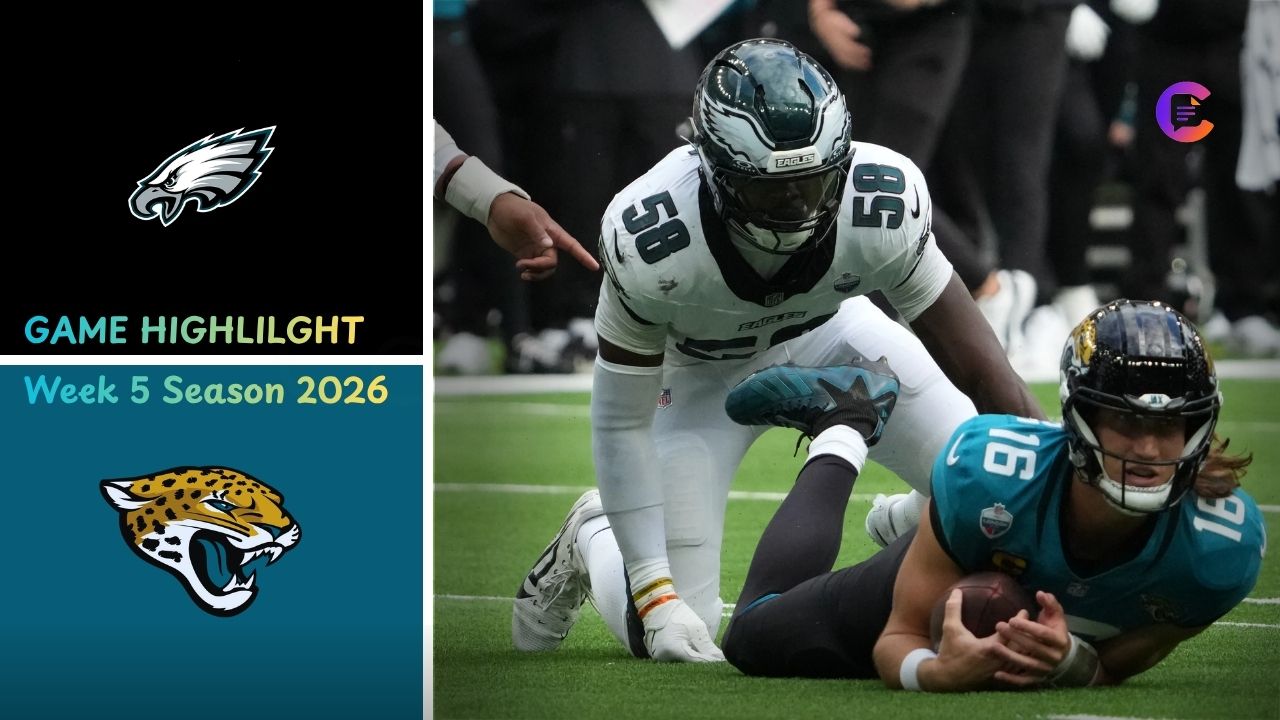
The Philadelphia Eagles vs Jacksonville Jaguars matchup delivered a dramatic finish on October 11, 2026, at Tottenham Hotspur Stadium in London. Jacksonville secured a 19–17 victory after Cam Little converted a 57-yard field goal on the final play. Philadelphia appeared to have escaped with a late win when Jake Elliott kicked a 48-yard field goal with eight seconds remaining. However, a long kickoff return gave Jacksonville one last opportunity, and Little made the most of it.
Trevor Lawrence led Jacksonville with 331 passing yards and two touchdown passes, both to Parker Washington. Jalen Hurts threw for 220 yards and one touchdown for Philadelphia, but the Eagles struggled to establish their running game. Injuries also affected their offensive options, leaving the team with only 22 rushing yards. Jacksonville gained 408 total yards and controlled possession for more than 35 minutes. The result improved the Jaguars to 4–1 and dropped Philadelphia to 2–3.
Philadelphia Eagles vs Jacksonville Jaguars Match Score
Jacksonville won 19–17 after a back-and-forth contest that featured a strong second quarter from Philadelphia and a dramatic final sequence. The Jaguars scored first, but the Eagles answered with two touchdowns before halftime. Jacksonville then chipped away at the deficit and produced the winning points in the closing seconds.
| Team | Q1 | Q2 | Q3 | Q4 | Final |
|---|---|---|---|---|---|
| Philadelphia Eagles | 0 | 14 | 0 | 3 | 17 |
| Jacksonville Jaguars | 7 | 0 | 3 | 9 | 19 |
Match details
- Date: October 11, 2026
- Competition: NFL regular season, Week 5
- Venue: Tottenham Hotspur Stadium, London, England
- Final score: Jacksonville Jaguars 19, Philadelphia Eagles 17
- Winning kick: Cam Little, 57 yards
The score reflects Jacksonville’s late comeback. Philadelphia led 14–7 at halftime, but the Jaguars scored 12 points in the fourth quarter to secure the win.
Quarterback Stats: Jalen Hurts vs Trevor Lawrence
Both quarterbacks made important plays, but Lawrence produced more passing yardage and touchdown passes. Hurts completed 21 of 40 attempts for 220 yards, one touchdown, and no interceptions. Lawrence completed 24 of 39 passes for 331 yards, two touchdowns, and one interception.
| Quarterback | Team | Completions/Attempts | Passing Yards | TD | INT |
|---|---|---|---|---|---|
| Jalen Hurts | Eagles | 21/40 | 220 | 1 | 0 |
| Trevor Lawrence | Jaguars | 24/39 | 331 | 2 | 1 |
Hurts connected with Darius Cooper for a 62-yard touchdown that helped Philadelphia build its halftime advantage. However, the Eagles struggled to sustain drives after the break. Lawrence delivered a more productive passing performance, repeatedly finding Washington and tight end Brenton Strange. His two touchdown passes kept Jacksonville in contention until Little completed the late comeback.
Explore Tampa Bay Buccaneers vs Dallas Cowboys Match Player Stats, Score and Recap
Parker Washington Leads Jacksonville’s Receiving Attack
Parker Washington was Jacksonville’s standout receiver. He caught six passes for 124 yards and two touchdowns, giving the Jaguars their most effective scoring connection. His 51-yard touchdown reception opened the scoring, while his 27-yard touchdown in the fourth quarter put Jacksonville ahead 16–14.
Washington’s ability to create separation and gain yards after the catch helped Jacksonville generate explosive plays. His second touchdown came on fourth-and-five, making it one of the game’s most important moments. Although Little missed the extra point following that score, Washington’s contribution gave the Jaguars a late lead and set up the tense final minutes.
Jacksonville Jaguars Receiving Stats
Jacksonville spread the ball across several targets, with Washington leading the way. Strange provided a reliable option over the middle, while Josh Cameron and Jakobi Meyers added useful yardage.
| Player | Receptions | Receiving Yards | TD |
|---|---|---|---|
| Parker Washington | 6 | 124 | 2 |
| Brenton Strange | 7 | 68 | 0 |
| Josh Cameron | 3 | 43 | 0 |
| Jakobi Meyers | 2 | 37 | 0 |
| Bhayshul Tuten | 2 | 24 | 0 |
| Nate Boerkircher | 2 | 20 | 0 |
| Travis Hunter | 1 | 9 | 0 |
| Chris Rodriguez Jr. | 1 | 6 | 0 |
Strange led Jacksonville in receptions with seven catches for 68 yards. Washington’s 124 yards, however, made him the most dangerous downfield target. Together, their production helped Lawrence finish with 331 passing yards. Jacksonville’s receiving group consistently generated larger gains than Philadelphia’s offense managed, helping explain the difference in total yardage.
Philadelphia Eagles Receiving Stats
Philadelphia’s receiving production centered on Darius Cooper, Dontayvion Wicks, and Makai Lemon. Cooper made the biggest individual play with a 62-yard touchdown reception, finishing with two catches for 71 yards.
| Player | Receptions | Receiving Yards | TD |
|---|---|---|---|
| Darius Cooper | 2 | 71 | 1 |
| Dontayvion Wicks | 5 | 63 | 0 |
| Makai Lemon | 5 | 43 | 0 |
| Dallas Goedert | 6 | 38 | 0 |
| Will Shipley | 1 | 7 | 0 |
| Dameon Pierce | 2 | -2 | 0 |
Goedert led the Eagles with six receptions, but his 38 yards did not provide the explosive impact Philadelphia needed. Wicks and Lemon combined for 106 yards, helping move the offense forward. Cooper’s touchdown gave Philadelphia a valuable lead before halftime. However, the Eagles could not produce another touchdown after the break, relying on Elliott’s late field goal for their only second-half points.
Rushing Stats: Eagles Struggle to Find Space
Philadelphia’s running game was a major weakness. The Eagles finished with just 22 rushing yards on 18 attempts. Dameon Pierce recorded 14 yards on 11 carries, while Will Shipley rushed five times for six yards and scored a touchdown. Hurts added two yards on two carries.
| Player | Team | Carries | Rushing Yards | TD |
|---|---|---|---|---|
| Dameon Pierce | Eagles | 11 | 14 | 0 |
| Will Shipley | Eagles | 5 | 6 | 1 |
| Jalen Hurts | Eagles | 2 | 2 | 0 |
| Bhayshul Tuten | Jaguars | 22 | 72 | 0 |
| Trevor Lawrence | Jaguars | 3 | 25 | 0 |
| Chris Rodriguez Jr. | Jaguars | 2 | 5 | 0 |
Tuten led Jacksonville with 72 rushing yards on 22 carries. Lawrence also contributed 25 yards on three attempts, helping the Jaguars reach 102 team rushing yards. Jacksonville did not score a rushing touchdown, but its ground game helped maintain possession and reduce pressure on Lawrence. Philadelphia’s limited rushing production made its offense easier to defend, especially during the second half.
Explore Detroit Lions vs Carolina Panthers Match Player Stats Full Match Recap
Key Scoring Plays and Game-Changing Moments
Jacksonville opened the scoring with a 51-yard touchdown pass from Lawrence to Washington. Philadelphia responded in the second quarter when Shipley scored on a two-yard run, tying the game at seven. Hurts then found Cooper for a 62-yard touchdown, giving the Eagles a 14–7 lead at halftime.
Little’s 34-yard field goal brought Jacksonville within four points in the third quarter. In the fourth, Lawrence connected with Washington for a 27-yard touchdown, but the missed extra point left Jacksonville ahead by only two. Elliott then converted a 48-yard field goal with eight seconds left, seemingly putting Philadelphia ahead for good. Abdullah returned the ensuing kickoff 53 yards, setting up Little’s decisive 57-yard kick.
Team Statistics: Jaguars Hold the Advantage
Jacksonville outgained Philadelphia by 176 yards and held the ball for more than ten additional minutes. The Jaguars also recorded more first downs and gained significantly more through the air and on the ground.
| Team Statistic | Eagles | Jaguars |
|---|---|---|
| Total net yards | 232 | 408 |
| Passing yards | 220 | 331 |
| Rushing yards | 22 | 102 |
| First downs | 13 | 18 |
| Third-down conversions | 6/15 | 5/16 |
| Penalties | 7 | 13 |
| Penalty yards | 43 | 100 |
| Time of possession | 24:58 | 35:02 |
| Turnovers lost | 0 | 1 |
Jacksonville’s 13 penalties for 100 yards threatened to undermine its performance. Philadelphia, however, could not fully exploit those mistakes. The Jaguars generated 408 yards and maintained longer possessions, while the Eagles’ 22 rushing yards limited their offensive balance. Jacksonville’s ability to create bigger gains proved crucial despite its penalty problems.
Defensive Performance and Final-Drive Drama
The defenses shaped the game in different ways. Philadelphia prevented Jacksonville from scoring on a fourth-and-goal attempt just before halftime, preserving its seven-point advantage. The Eagles also kept Lawrence from throwing an interception-free game, recording one takeaway through the passing defense.
Jacksonville’s defense held Philadelphia scoreless in the third quarter and allowed only a field goal in the fourth. That performance gave the Jaguars a chance to rally late. The final sequence then depended on special teams: Abdullah’s 53-yard kickoff return moved Jacksonville into field-goal range, and Little converted from 57 yards as time expired. His kick turned a likely Eagles victory into one of the season’s most dramatic finishes.
What the Result Means for Both Teams
The victory improved Jacksonville’s record to 4–1 and extended its winning streak to three games. Lawrence and Washington continued building their connection, while the team’s ability to respond after trailing at halftime demonstrated resilience. Little also delivered under pressure, converting both of his field-goal attempts, including the decisive kick.
Philadelphia dropped to 2–3 after its third consecutive loss. The Eagles showed promise in the second quarter, but injuries and a lack of rushing production affected their consistency. Their late field goal briefly put them in position to win, yet the kickoff return gave Jacksonville one final chance. Philadelphia will need a more balanced offense and stronger late-game execution to reverse its recent slide.
Conclusion
The Philadelphia Eagles vs Jacksonville Jaguars game ended with a thrilling 19–17 Jacksonville victory in London. Trevor Lawrence passed for 331 yards and two touchdowns, while Parker Washington recorded six receptions for 124 yards and both Jacksonville scores. Philadelphia took a 14–7 halftime lead, but the Jaguars stayed close and produced a late fourth-quarter rally.
The decisive moment came after Elliott’s 48-yard field goal gave Philadelphia a 17–16 lead with eight seconds remaining. Abdullah’s 53-yard kickoff return set up Little’s 57-yard game-winning kick. Jacksonville’s offensive yardage, stronger rushing production, and late special-teams execution made the difference. For Philadelphia, the defeat highlighted the cost of limited rushing output and the need to finish games more effectively.
Get More Update CONTENTORY