
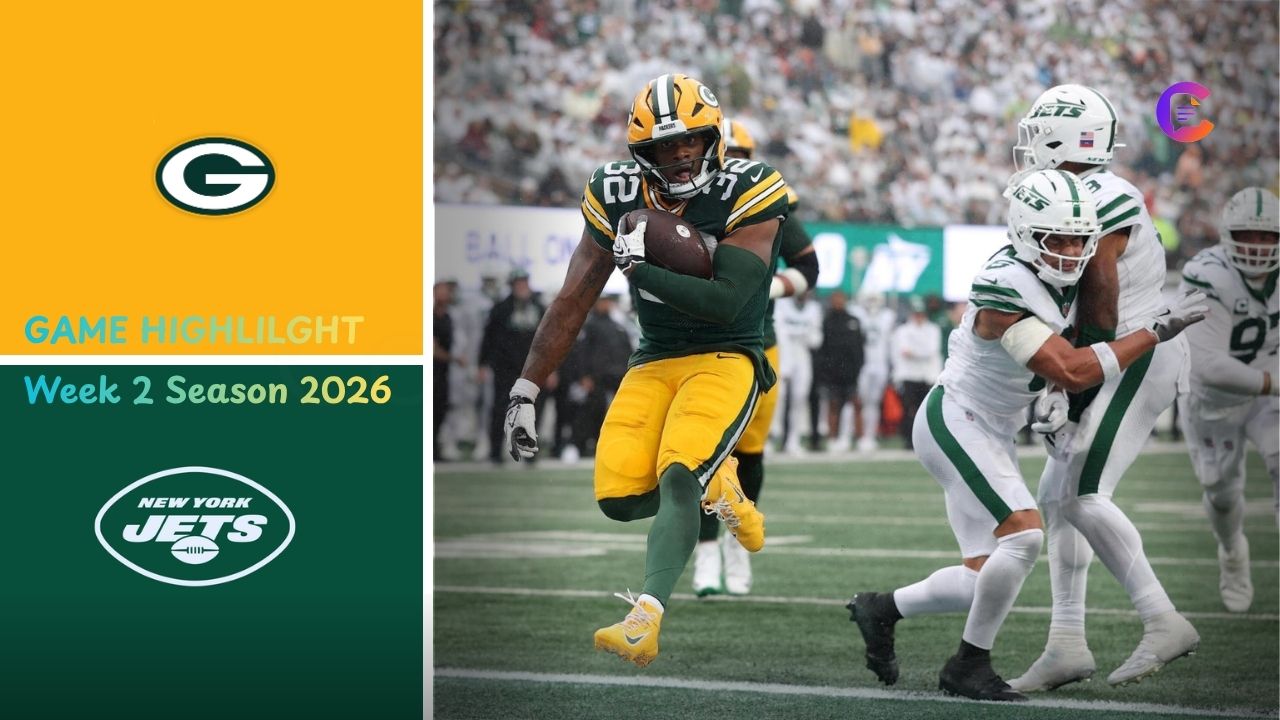
The Green Bay Packers defeated the New York Jets 20-17 in overtime on September 20, 2026, at MetLife Stadium in East Rutherford, New Jersey. The Week 2 matchup developed into a close defensive battle before Green Bay completed a fourth-quarter comeback and won in overtime. The Packers trailed 17-7 with just over 11 minutes remaining in regulation, but Jordan Love helped lead the offense back into the game. Rookie kicker Trey Smack then delivered the decisive 26-yard field goal in overtime.
The game produced contrasting individual performances. Geno Smith completed 27 of 41 passes for 247 yards and one touchdown for New York, while Jordan Love completed 16 of 29 attempts for 145 yards and two touchdowns. Garrett Wilson and Breece Hall provided important production for the Jets, while Christian Watson and Matthew Golden helped Green Bay during its late comeback. The Packers also received a major defensive performance from Lukas Van Ness, who finished with nine tackles, three tackles for loss, 1.5 sacks and four quarterback hits.
Final Score Table
| Team | Q1 | Q2 | Q3 | Q4 | OT | Final |
|---|---|---|---|---|---|---|
| Green Bay Packers | 0 | 7 | 0 | 10 | 3 | 20 |
| New York Jets | 0 | 7 | 7 | 3 | 0 | 17 |
Final Score and Game Overview
The Packers and Jets entered halftime tied at 7-7 after both teams produced one touchdown in the second quarter. Green Bay scored first when MarShawn Lloyd caught a six-yard touchdown pass from Love. New York responded with a six-yard rushing touchdown from Braelon Allen. The Jets then moved ahead in the third quarter when Smith connected with Wilson for a five-yard touchdown, giving New York a 14-7 advantage. The Jets extended that lead to 17-7 early in the fourth quarter with a 32-yard field goal.
Green Bay changed the game’s direction during the final quarter. Love found Christian Watson for a three-yard touchdown to cut the deficit to 17-14. Skyy Moore then returned a punt 63 yards, setting up Trey Smack’s 34-yard field goal that tied the game at 17. Neither team scored again in regulation. In overtime, Green Bay’s defense forced a three-and-out before Love guided the offense into field-goal range. Smack converted from 26 yards with 5:23 remaining in overtime to complete the comeback.
Jordan Love’s Passing Performance
Jordan Love finished the game with 16 completions on 29 attempts for 145 yards and two touchdowns. He did not throw an interception and posted a 91.9 passer rating. His passing numbers were modest compared with Geno Smith’s yardage total, but Love made several important throws during the fourth-quarter comeback. He also continued playing after taking a hard hit that temporarily caused numbness in his hand. Despite the difficult conditions and pressure from the Jets defense, he remained in the game and helped Green Bay finish the comeback.
Love’s biggest contribution came during the fourth quarter and overtime. He connected with Christian Watson for the touchdown that reduced New York’s lead to three points. Later, he found Matthew Golden for a key 14-yard gain during the overtime drive, helping move the Packers inside the Jets’ 10-yard line. Love also connected with Chris Brooks for a 15-yard swing pass before the winning field goal drive continued.
Jordan Love Passing Stats
| Player | Completions/Attempts | Passing Yards | TD | INT | Rating |
|---|---|---|---|---|---|
| Jordan Love | 16/29 | 145 | 2 | 0 | 91.9 |
Geno Smith Leads the Jets Passing Attack
Geno Smith produced the game’s highest passing total, completing 27 of 41 attempts for 247 yards and one touchdown. He finished with a 90.2 passer rating and did not throw an interception. Smith helped New York control large portions of the contest, particularly during the second and third quarters. His touchdown pass to Garrett Wilson gave the Jets their first lead of the game, and his connection with the receiving group helped New York maintain possession for much of the afternoon.
However, Green Bay’s pass rush became increasingly important late in the game. Smith was sacked twice on the opening two plays of overtime, forcing New York into a three-and-out. That defensive series gave the Packers favorable field position and allowed Love to lead the winning drive. Smith had produced more passing yards than Love, but the Jets could not turn their offensive production into the decisive points when the game reached its final stages.
Geno Smith Passing Stats
| Player | Completions/Attempts | Passing Yards | TD | INT | Rating |
|---|---|---|---|---|---|
| Geno Smith | 27/41 | 247 | 1 | 0 | 90.2 |
Christian Watson Makes a Crucial Impact
Christian Watson became one of Green Bay’s most important offensive players during the comeback. He finished with four receptions for 41 yards and one touchdown. His touchdown came with 7:58 remaining in the fourth quarter, when Love found him for a three-yard score. That play reduced New York’s lead from 17-7 to 17-14 and gave Green Bay a realistic opportunity to complete its comeback.
Watson also made two important receptions earlier in the game. During Green Bay’s first touchdown drive, Love connected with him for gains of 20 and 13 yards. Those completions helped the Packers reach the red zone before Love eventually found Lloyd for the touchdown. Watson’s production therefore contributed to both of Green Bay’s offensive touchdowns, making him an important part of the Packers’ scoring attack.
Packers Receiving Leaders
| Player | Receptions | Receiving Yards | TD |
|---|---|---|---|
| Matthew Golden | 4 | 58 | 0 |
| Christian Watson | 4 | 41 | 1 |
| Chris Brooks | 2 | 22 | 0 |
| Tucker Kraft | 2 | 16 | 0 |
| Skyy Moore | 2 | 8 | 0 |
Matthew Golden Provides Key Explosive Plays
Matthew Golden finished with four receptions for 58 yards, giving him Green Bay’s highest receiving-yard total. His production became especially important during the overtime possession. Golden caught a 14-yard pass that moved the Packers inside the Jets’ 10-yard line and placed Trey Smack in position for the game-winning field goal. He also drew a defensive pass interference penalty earlier in the fourth quarter that helped extend a Green Bay drive.
Golden’s performance showed how Green Bay’s passing game operated through multiple targets rather than relying on one receiver. Watson scored the touchdown, but Golden generated the highest receiving total. The Packers also used short passes to running backs during their comeback. Chris Brooks caught a 15-yard swing pass during overtime, while Green Bay used several quick throws to move against New York’s pressure packages. That variety helped the Packers produce enough offense despite finishing with only 199 total yards.
Breece Hall and the Jets Running Game
Breece Hall carried the ball 16 times for 29 yards, averaging less than two yards per attempt. His rushing production was limited for much of the afternoon, although he did produce a significant 14-yard run in the third quarter. Hall also contributed five receptions for 63 yards, including a 43-yard reception that helped the Jets create a scoring opportunity. His combined receiving production gave him an important role even though Green Bay largely contained him on the ground.
Braelon Allen provided New York’s rushing touchdown. He scored on a six-yard run during the second quarter to tie the game at 7-7. Allen also became involved in the decisive fourth-quarter sequence when the Jets attempted to convert a fourth-and-1 near midfield. Green Bay’s defense stopped the run short of the marker, giving the Packers possession. That defensive stand became one of the game’s key turning points because New York had an opportunity to protect its late lead.
Jets Rushing Leaders
| Player | Carries | Rushing Yards | TD |
|---|---|---|---|
| Breece Hall | 16 | 29 | 0 |
| Braelon Allen | 9 | 28 | 1 |
| Isaiah Williams | 2 | 11 | 0 |
Packers Rushing Performance
Green Bay’s rushing attack produced 63 yards, with rookie Kaleb Johnson leading the team with eight carries for 32 yards. MarShawn Lloyd added six carries for 20 yards and scored the Packers’ first touchdown of the game. Chris Brooks contributed four carries for 11 yards. The Packers did not generate a large rushing total, but Johnson became particularly valuable during overtime when his 11-yard run helped move Green Bay away from its own territory.
The Packers’ rushing production also helped complement Love’s passing attack during the comeback. Johnson’s overtime run was followed by a 15-yard reception from Brooks, and Golden then added another important reception. Those plays quickly moved Green Bay toward scoring range. Although the Packers averaged only 3.5 yards per rushing attempt, their late combination of running and short passing plays produced enough yardage to set up Smack’s winning field goal.
Packers Rushing Leaders
| Player | Carries | Rushing Yards | TD |
|---|---|---|---|
| Kaleb Johnson | 8 | 32 | 0 |
| MarShawn Lloyd | 6 | 20 | 0 |
| Chris Brooks | 4 | 11 | 0 |
Garrett Wilson Leads New York Receiving
Garrett Wilson finished with five receptions for 57 yards and one touchdown. His five-yard touchdown catch from Smith came late in the third quarter and gave New York a 14-7 lead. Wilson also made several important receptions during the Jets’ possession-based approach. He caught a 16-yard pass during the second quarter and added an 11-yard reception during the final drive of regulation.
Adonai Mitchell also played an important role for New York, recording six receptions for 63 yards. He produced 43 receiving yards in the first half alone, including a 15-yard gain that moved the Jets inside the Green Bay 10-yard line. Hall added 63 receiving yards, giving him 92 total yards from scrimmage. The Jets therefore received contributions from several skill players even though Green Bay ultimately stopped the offense during overtime.
Jets Receiving Leaders
| Player | Receptions | Receiving Yards | TD |
|---|---|---|---|
| Adonai Mitchell | 6 | 63 | 0 |
| Breece Hall | 5 | 63 | 0 |
| Garrett Wilson | 5 | 57 | 1 |
| Isaiah Williams | 3 | 32 | 0 |
| Jeremy Rucker | 3 | 19 | 0 |
Lukas Van Ness Leads the Packers Defense
Lukas Van Ness delivered one of his strongest performances for Green Bay. He recorded nine tackles, 1.5 sacks, three tackles for loss and four quarterback hits. His pressure became especially important during the fourth quarter and overtime. Van Ness helped stop the Jets on a crucial fourth-and-1 attempt near midfield, then remained involved in the pass rush when New York received the ball to start overtime.
The overtime sequence highlighted the Packers’ defensive improvement. Van Ness and Barryn Sorrell combined on a sack of Smith on the opening play, while another sack followed on the next snap. The Jets lost 15 yards across those two plays and eventually punted. Green Bay then needed only one offensive possession to reach field-goal range. The defensive stand therefore directly created the opportunity for Smack to kick the winning field goal.
Team Statistics Comparison
The Jets finished with more total yards and significantly more possession time. New York produced 285 total yards compared with Green Bay’s 199 and held the ball for 37:40. The Jets also recorded 21 first downs, while the Packers managed 16. However, Green Bay committed fewer turnovers and eventually produced the decisive points in overtime. The Packers finished with one turnover, while the Jets did not turn the ball over.
Penalty numbers also played a major role. Green Bay was penalized 14 times for 133 yards, while New York committed 13 penalties for 156 yards. That meant the teams combined for 27 penalties and 289 penalty yards. The Jets’ penalties repeatedly extended Green Bay possessions, while the Packers’ flags also stalled their own offense. Despite those mistakes, Green Bay made enough plays during the fourth quarter and overtime to overcome its statistical disadvantages.
Team Comparison Table
| Statistic | Green Bay Packers | New York Jets |
|---|---|---|
| Total Yards | 199 | 285 |
| Passing Yards | 136 | 218 |
| Rushing Yards | 63 | 67 |
| Total Plays | 50 | 72 |
| Yards Per Play | 4.0 | 4.0 |
| First Downs | 16 | 21 |
| Possession | 26:57 | 37:40 |
| Turnovers | 1 | 0 |
| Penalties | 14 | 13 |
| Penalty Yards | 133 | 156 |
| Third Down | 1/9 | 8/19 |
| Red Zone | 2/4 | 2/3 |
Fourth-Quarter Comeback Changes the Game
The Packers entered the fourth quarter trailing 14-7 before New York added a 32-yard field goal to make it a 10-point game. Green Bay responded with a touchdown pass from Love to Watson. The Packers then forced a Jets punt, and Skyy Moore delivered a 63-yard return that placed Green Bay deep in New York territory. Smack converted the resulting 34-yard field goal to tie the game at 17 with just over three minutes remaining.
The Jets still had a chance to win in regulation. Smith connected with Wilson during the final possession, but New York could not convert a fourth-and-1 near midfield. Green Bay took possession but failed to score before the end of regulation. Love was sacked on the final play, sending the game to overtime. The sequence demonstrated how quickly the game changed after the Jets appeared to have control with a 17-7 advantage.
Overtime Decides the Match
New York won the overtime coin toss and chose to receive, but the Packers immediately applied pressure. Smith was sacked on the first two plays, and the Jets eventually punted after a short completion. Green Bay took over at its own 34-yard line with a chance to end the game. Johnson opened the possession with an 11-yard run, moving the Packers into more favorable territory.
The Packers then used a combination of running and passing plays to move into the red zone. Brooks caught a 15-yard swing pass, and a late-hit penalty added another 15 yards. Golden followed with a 14-yard reception that moved Green Bay inside the Jets’ 10-yard line. Smack then entered the field and converted the 26-yard field goal with 5:23 remaining in overtime, giving Green Bay the 20-17 victory.
Key Plays That Shaped the Result
MarShawn Lloyd’s first NFL touchdown gave Green Bay an early 7-0 lead, but Braelon Allen’s rushing touchdown tied the game before halftime. Garrett Wilson’s touchdown catch then put the Jets ahead in the third quarter. New York appeared to have control after extending the lead to 17-7 in the fourth quarter, but Watson’s touchdown reception gave Green Bay renewed momentum.
Skyy Moore’s 63-yard punt return was another decisive moment. It immediately placed Green Bay in scoring territory and allowed Smack to tie the game at 17. The Jets then had an opportunity to win in regulation but failed on fourth down. In overtime, Green Bay’s two sacks on Smith created the field-position advantage that eventually produced the winning field goal.
Final Match Summary
The Green Bay Packers defeated the New York Jets 20-17 in overtime after overcoming a 17-7 fourth-quarter deficit. Jordan Love completed 16 of 29 passes for 145 yards and two touchdowns, while Christian Watson caught four passes for 41 yards and one touchdown. Matthew Golden led Green Bay in receiving yards with 58, and Kaleb Johnson rushed for 32 yards. On defense, Lukas Van Ness produced nine tackles, 1.5 sacks, three tackles for loss and four quarterback hits.
The Jets produced more yardage and controlled possession for much of the game, with Geno Smith throwing for 247 yards and Garrett Wilson catching a touchdown. Breece Hall contributed 92 total yards through rushing and receiving, while Adonai Mitchell added 63 receiving yards. However, Green Bay’s fourth-quarter rally and overtime defensive stand changed the result. Trey Smack’s 26-yard field goal completed the comeback and moved the Packers to 1-1, while the Jets also finished Week 2 at 1-1.
Get More Update CONTENTORY