

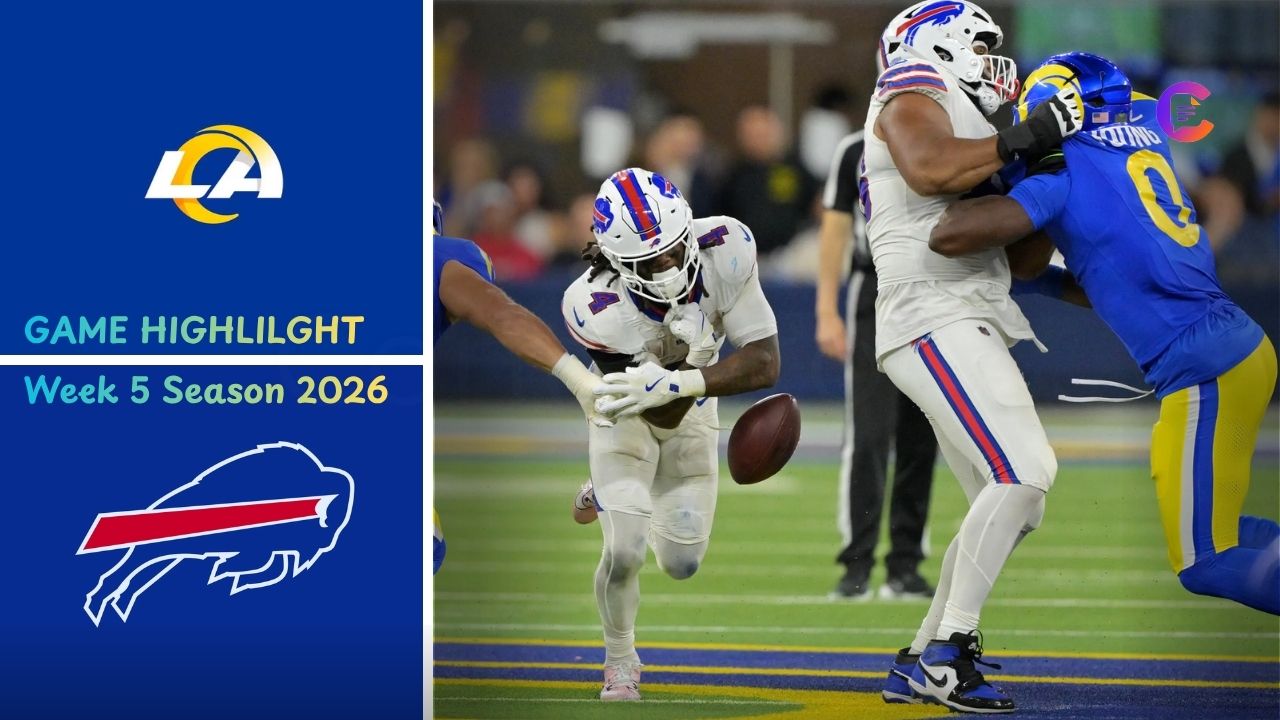
The Buffalo Bills defeated the Los Angeles Rams 37–34 in overtime on October 12, 2026, at SoFi Stadium. The Week 5 matchup delivered a thrilling finish, featuring explosive rushing plays, multiple fourth-quarter touchdowns, and a blocked field goal in overtime. Buffalo quarterback Josh Allen played a major role in the victory with his passing and rushing ability. Tyler Bass ultimately secured the win with a 45-yard field goal, ending one of the most dramatic games of the week.
The Rams produced an impressive offensive performance but could not finish the contest with a victory. Matthew Stafford threw for 383 yards and three touchdowns, while Puka Nacua caught 17 passes for 138 yards and a score. Buffalo relied on Allen’s mobility and James Cook’s two rushing touchdowns to keep pace. After Los Angeles forced overtime with a late touchdown, the Bills capitalized on a crucial defensive play and Bass’s accurate kick to leave California with a valuable road win.
Final Score
| Quarter | Buffalo Bills | Los Angeles Rams |
|---|---|---|
| First quarter | 6 | 0 |
| Second quarter | 7 | 7 |
| Third quarter | 6 | 7 |
| Fourth quarter | 15 | 20 |
| Overtime | 3 | 0 |
| Final score | 37 | 34 |
The Bills started strongly, scoring six points in the opening quarter through two Tyler Bass field goals. Los Angeles answered in the second quarter when Stafford connected with Davante Adams for a touchdown. Cook then scored on a 17-yard run, giving Buffalo a 13–7 halftime advantage after a relatively balanced first half.
The Rams took the lead in the third quarter through Blake Corum’s one-yard rushing touchdown. Buffalo responded with a touchdown pass from Allen to Keon Coleman, although the extra point failed. The fourth quarter became a scoring race, with both teams finding the end zone repeatedly before Kyren Williams tied the game at 34–34 with five seconds remaining.
Josh Allen Player Stats
Josh Allen delivered a powerful all-around performance for Buffalo. He completed 12 of 19 passes for 210 yards, one touchdown, and one interception. His passing numbers were solid, but his running ability proved even more influential. Allen rushed 10 times for 121 yards and a touchdown, repeatedly escaping pressure and creating important first downs.
Allen scored on a one-yard quarterback sneak in the fourth quarter, then converted a two-point attempt with a pass to tight end Dalton Kincaid. His late scrambles also helped Buffalo reach scoring range after the Rams blocked a field goal attempt in overtime. Allen’s combination of strength, speed, and decision-making kept the Bills competitive against a productive Los Angeles offense.
| Josh Allen statistic | Total |
|---|---|
| Pass completions | 12 |
| Pass attempts | 19 |
| Passing yards | 210 |
| Passing touchdowns | 1 |
| Interceptions | 1 |
| Rushing attempts | 10 |
| Rushing yards | 121 |
| Rushing touchdowns | 1 |
James Cook’s Two-Touchdown Performance
James Cook was one of Buffalo’s most important offensive players. He finished with 111 rushing yards on 25 carries and scored two touchdowns. His first touchdown came on a 17-yard run in the second quarter, giving the Bills momentum after Stafford had put Los Angeles ahead. Cook’s second score arrived late in the fourth quarter, helping Buffalo move ahead 34–27.
Cook’s performance highlighted Buffalo’s ability to attack on the ground even when its passing game struggled to find consistency. He combined patience with acceleration, taking advantage of openings created by the offensive line. However, his fumble in overtime briefly gave Los Angeles another opportunity. Buffalo’s defense responded by stopping the Rams’ ensuing field-goal attempt, allowing the Bills to recover and eventually win.
| James Cook statistic | Total |
|---|---|
| Rushing attempts | 25 |
| Rushing yards | 111 |
| Rushing touchdowns | 2 |
| Receptions | 1 |
| Receiving yards | 7 |
| Total touchdowns | 2 |
Matthew Stafford Player Stats
| Matthew Stafford statistic | Total |
|---|---|
| Pass completions | 40 |
| Pass attempts | 54 |
| Passing yards | 383 |
| Passing touchdowns | 3 |
| Interceptions | 0 |
| Sacks taken | 1 |
Matthew Stafford delivered a high-volume passing performance for the Rams. He completed 40 of 54 attempts for 383 yards and three touchdowns without throwing an interception. Stafford repeatedly moved the ball through the air, using short completions and longer throws to keep Los Angeles within reach. His accuracy helped the Rams score 34 points and force overtime.
Stafford connected with Davante Adams for two touchdowns and found Puka Nacua for another score. His passing production placed considerable pressure on Buffalo’s defense, especially during the fourth quarter. Despite the strong numbers, Los Angeles could not convert its final overtime opportunity. Greg Rousseau blocked Harrison Mevis’s field-goal attempt, changing the game’s momentum and giving Allen another chance to lead Buffalo toward victory.
Explore more Denver Broncos vs Los Angeles Chargers Match Player Stats and Full Game Recap
Puka Nacua Leads the Rams Receiving Attack
Puka Nacua was Stafford’s most frequently targeted receiver. He caught 17 passes on 24 targets for 138 yards and one touchdown. His reception total demonstrated how central he was to the Rams’ passing strategy. Nacua consistently found space underneath and helped Los Angeles maintain drives when the offense needed to respond to Buffalo’s scoring.
His touchdown came on a two-yard reception in the fourth quarter, helping the Rams take a 20–19 lead. Nacua’s production also gave Stafford a dependable option during the final drive of regulation. Although the Rams eventually lost, Nacua’s performance stood out as one of the game’s strongest individual displays. His ability to create separation and secure difficult catches kept the Buffalo defense under pressure throughout the night.
| Rams receiver | Receptions | Receiving yards | Touchdowns |
|---|---|---|---|
| Puka Nacua | 17 | 138 | 1 |
| Tyler Higbee | 5 | 83 | 0 |
| Davante Adams | 5 | 51 | 2 |
| Davis Allen | 2 | 24 | 0 |
| Tutu Atwell | 1 | 4 | 0 |
Davante Adams and the Rams’ Touchdown Production
Davante Adams gave Los Angeles a major scoring threat in the red zone. He finished with five receptions for 51 yards and two touchdowns. His first score came on a four-yard pass from Stafford in the second quarter. That reception put the Rams ahead 7–6 and showed their ability to convert a long possession into points.
Adams added his second touchdown on a five-yard reception in the fourth quarter, tying the game at 27–27. His route running helped Stafford find him in tight coverage near the goal line. Adams’ two scores were important to the Rams’ comeback, but the team needed one more defensive stop in overtime to secure the win. Buffalo’s ability to recover from adversity ultimately proved decisive.
Explore A Complete Guide to the 2026 US Elections and Midterms
Keon Coleman and Buffalo’s Receiving Options
Keon Coleman recorded one reception for seven yards, but it produced a crucial touchdown in the third quarter. Allen found Coleman in the end zone, allowing Buffalo to respond after Corum’s rushing score. The failed extra point left the Bills ahead 19–14, making every later possession increasingly important.
Khalil Shakir and Ty Johnson contributed in different ways. Shakir finished with three receptions for 80 yards, including a 57-yard gain in overtime that moved Buffalo deep into Rams territory. Johnson caught four passes for 72 yards, with a 40-yard reception helping establish Buffalo’s offensive rhythm. Ray Davis added 31 receiving yards, giving Allen useful options beyond the team’s leading wide receivers.
Kyren Williams and Blake Corum on the Ground
Kyren Williams played a major role in keeping Los Angeles alive. He rushed 16 times for 49 yards and scored the game-tying touchdown with a one-yard run in the final seconds. Williams also caught six passes for 27 yards, contributing as both a runner and receiver. His late score erased Buffalo’s seven-point lead and sent the game into overtime.
Blake Corum added 19 rushing yards on five carries and scored on a one-yard run in the third quarter. Although neither running back matched Cook’s rushing total, their touchdowns helped the Rams turn sustained drives into points. Los Angeles finished with 77 rushing yards, relying more heavily on Stafford’s passing attack. That imbalance did not prevent the Rams from scoring 34 points, but it left them needing a successful final defensive stand.
Read more Detroit Lions vs Arizona Cardinals Match Player Stats Key Performers
The Overtime Finish and Tyler Bass’s Winning Kick
Overtime began with Buffalo making a major gain through Shakir, whose reception carried the ball 57 yards to the Rams’ 22-yard line. Cook fumbled on the next play, giving Los Angeles another chance to win. The Rams moved into field-goal range, but Harrison Mevis’s 48-yard attempt was blocked by Bills linebacker Greg Rousseau.
Allen then used his legs to move Buffalo back into scoring range. Bass stepped up for a 45-yard field goal with 1:55 remaining in overtime and converted the attempt. The kick gave Buffalo a 37–34 victory and capped a contest full of sudden momentum changes. Rousseau’s block and Bass’s accuracy became the defining moments of the extra period.
Team Statistics and Game Analysis
The Rams finished with 454 total yards, slightly ahead of Buffalo’s 436. Stafford’s 383 passing yards drove much of that production. Buffalo, however, generated 234 rushing yards and found ways to score at critical moments. Allen and Cook combined for 232 rushing yards, creating a ground attack that helped offset the Bills’ less productive passing performance.
Turnovers also shaped the result. Buffalo committed two turnovers, including an interception and Cook’s overtime fumble, while Los Angeles finished without a turnover. The Bills also committed 13 penalties for 112 yards. Despite those mistakes, Buffalo made the decisive plays when the game was on the line. The blocked field goal stopped the Rams from taking the lead, and Bass converted the opportunity that followed.
What the Result Means for Both Teams
The victory improved Buffalo’s record to 4–1, giving the Bills an important result against a competitive NFC opponent. Allen’s rushing production and Cook’s touchdowns demonstrated the offense’s ability to adapt when the passing game faced challenges. The team will still need to address its penalties and ball security, especially after Cook’s overtime fumble nearly changed the outcome.
The loss dropped Los Angeles to 2–3 despite a strong performance from Stafford and the receiving group. The Rams moved the ball effectively and showed resilience by tying the game late. However, the blocked field goal proved costly, and the defense could not prevent Allen from setting up the winning kick. Los Angeles will need to improve its late-game execution to turn similar performances into victories.
Conclusion
The Buffalo Bills vs Los Angeles Rams Match Player Stats show why the 37–34 result became an overtime thriller. Josh Allen recorded 210 passing yards and 121 rushing yards, while James Cook added 111 rushing yards and two touchdowns. Matthew Stafford threw for 383 yards and three scores, and Puka Nacua caught 17 passes for 138 yards. Both offenses delivered under pressure, but Buffalo made the decisive plays in overtime.
Greg Rousseau’s blocked field goal stopped the Rams from taking the lead, and Tyler Bass converted a 45-yard kick to seal the win. The result moved Buffalo to 4–1 and left Los Angeles at 2–3. The game highlighted the importance of quarterback mobility, rushing production, and special-teams execution. For the Bills, it was a hard-earned road victory. For the Rams, it was a painful loss after a late comeback.
Get More Update CONTENTORY