
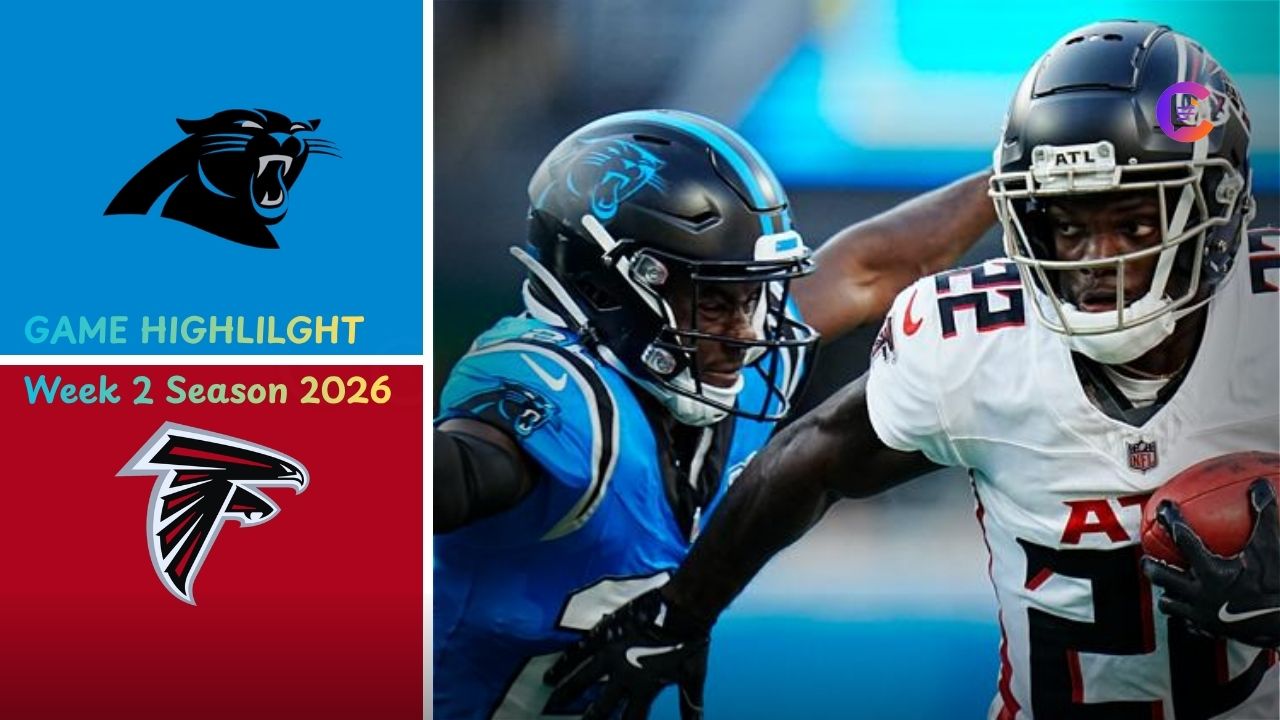
The Carolina Panthers defeated the Atlanta Falcons 34-3 on September 20, 2026, in a Week 2 NFC South matchup at Mercedes-Benz Stadium in Atlanta. Carolina controlled the game from the opening quarter and built a 20-3 halftime advantage before adding 14 more points after the break. Bryce Young led the Panthers’ offense with 287 passing yards and three touchdown passes, while the Carolina defense forced five turnovers. The result moved Carolina to 1-1 while Atlanta dropped to 0-2.
The Panthers also received major contributions from their receiving group and running game. Tetairoa McMillan recorded five receptions for 101 yards, while Jalen Coker added eight catches for 66 yards. Darren Waller caught three passes for 33 yards and scored two touchdowns. Atlanta struggled to generate consistent offense, with Cooper Rush throwing for 86 yards and two interceptions before Jack Strand entered the game. Strand threw one interception and lost a fumble, adding to Atlanta’s turnover problems during the decisive second half.
Final Score Table
| Team | Q1 | Q2 | Q3 | Q4 | Final |
|---|---|---|---|---|---|
| Carolina Panthers | 10 | 10 | 14 | 0 | 34 |
| Atlanta Falcons | 0 | 3 | 0 | 0 | 3 |
Final Score and Game Overview

Carolina established control early with a touchdown pass from Bryce Young to Chuba Hubbard, followed by a Ryan Fitzgerald field goal. The Panthers added another field goal before Atlanta finally got on the scoreboard through a Nick Folk field goal. Carolina then responded with two second-quarter touchdown passes to Darren Waller, allowing the Panthers to enter halftime with a commanding 20-3 lead. The scoring sequence gave Carolina both momentum and a substantial advantage before the Falcons could establish any offensive rhythm.
The Panthers continued extending their advantage in the third quarter. Young connected with Waller again for a 12-yard touchdown, while Devin Lloyd returned an interception for another Carolina touchdown. Atlanta failed to score after halftime, and Carolina finished the afternoon with 34 points. The Panthers generated 340 total yards and limited Atlanta to 286, while the five-turnover difference became one of the clearest statistical factors behind the final result.
Bryce Young’s Strong Passing Performance
Bryce Young delivered one of the Panthers’ most important individual performances. He completed 23 of 36 attempts for 287 yards and three touchdowns without throwing an interception. His passing performance helped Carolina create a consistent scoring threat throughout the first three quarters. Young distributed the ball across multiple targets, allowing the Panthers to produce 340 total yards while maintaining control of the game. His efficiency also helped Carolina avoid the turnover problems that affected Atlanta.
Young’s three touchdown passes went to Chuba Hubbard and Darren Waller, with Waller receiving two of the scoring throws. The quarterback also benefited from explosive plays by his receivers, including Xavier Legette’s 55-yard reception that moved Carolina deep into Atlanta territory late in the second quarter. Three plays later, Young found Waller for a touchdown. That sequence helped Carolina regain momentum immediately before halftime and reinforced the effectiveness of its passing attack.
Bryce Young Passing Stats
| Player | Completions/Attempts | Passing Yards | TD | INT |
|---|---|---|---|---|
| Bryce Young | 23/36 | 287 | 3 | 0 |
Tetairoa McMillan Leads Carolina Receiving
Tetairoa McMillan produced Carolina’s highest receiving yardage total. He finished with five receptions for 101 yards, averaging 20.2 yards per catch. His longest reception covered 28 yards, and his production gave Young a reliable downfield option throughout the matchup. McMillan’s performance helped Carolina stretch Atlanta’s defense and contributed to the Panthers’ ability to generate 340 total yards.
Jalen Coker also played a significant role, catching eight passes for 66 yards. Xavier Legette added two receptions for 64 yards, including a 55-yard reception that helped set up a touchdown shortly before halftime. Darren Waller became particularly important in the red zone, catching three passes for 33 yards and two touchdowns. The distribution showed that Carolina did not depend on a single receiver to produce its offensive output.
Panthers Receiving Leaders
| Player | Receptions | Receiving Yards | TD |
|---|---|---|---|
| Tetairoa McMillan | 5 | 101 | 0 |
| Jalen Coker | 8 | 66 | 0 |
| Xavier Legette | 2 | 64 | 0 |
| Darren Waller | 3 | 33 | 2 |
| Chuba Hubbard | 2 | 11 | 1 |
Darren Waller Makes a Red-Zone Impact
Darren Waller became one of the key scoring players for Carolina during the first half. He caught three passes for 33 yards and scored two touchdowns. His first touchdown came on a seven-yard reception from Young with 24 seconds remaining in the second quarter. That score gave Carolina a 20-3 halftime lead and capped an important late drive for the Panthers.
Waller added another touchdown during the third quarter, catching a 12-yard pass from Young with 9:44 remaining in the period. That score pushed Carolina’s advantage to 27-3 and made an Atlanta comeback increasingly difficult. Although Waller finished with fewer receiving yards than McMillan or Coker, his three receptions produced two touchdowns, making his contribution especially important in the scoring area.
Chuba Hubbard and Carolina’s Rushing Attack
Chuba Hubbard led the Panthers in rushing with 12 carries for 53 yards. He averaged 4.42 yards per attempt and recorded a longest run of 12 yards. Hubbard also caught two passes for 11 yards and scored Carolina’s opening touchdown on a three-yard reception from Young. His contribution provided balance to an offense that finished with 68 rushing yards according to the game statistics.
Jonathon Brooks carried the ball five times for 16 yards, while Young added six rushing yards on one attempt. Carolina did not need an unusually large rushing workload because its passing game produced consistent gains. The Panthers ran 60 offensive plays and averaged 5.7 yards per play. Their ability to mix rushing attempts with Young’s passing helped Carolina maintain control while avoiding turnovers throughout the game.
Panthers Rushing Leaders
| Player | Carries | Rushing Yards | TD |
|---|---|---|---|
| Chuba Hubbard | 12 | 53 | 0 |
| Jonathon Brooks | 5 | 16 | 0 |
| Bryce Young | 1 | 6 | 0 |
Atlanta Falcons Quarterback Struggles
Cooper Rush started at quarterback for Atlanta and completed 10 of 17 passes for 86 yards with two interceptions. His passing production never developed into a sustained scoring attack, and Atlanta entered halftime with only three points. Rush also recorded two rushing attempts for 20 yards, but his passing turnovers placed additional pressure on an offense already struggling to move the football.
Rookie Jack Strand replaced Rush and completed eight of 15 passes for 59 yards with one interception. Strand also lost a fumble late in the fourth quarter after being sacked. The Falcons therefore finished the game with five total turnovers, including three interceptions and two lost fumbles. Carolina capitalized on those mistakes, including a third-quarter interception return for a touchdown by Devin Lloyd.
Falcons Passing Stats
| Player | Completions/Attempts | Passing Yards | TD | INT |
|---|---|---|---|---|
| Cooper Rush | 10/17 | 86 | 0 | 2 |
| Jack Strand | 8/15 | 59 | 0 | 1 |
Bijan Robinson Leads Atlanta’s Rushing
Bijan Robinson remained productive on the ground despite Atlanta’s difficult offensive afternoon. He carried 16 times for 72 yards, averaging 4.5 yards per attempt with a longest run of 11 yards. Robinson also became the first player in Falcons history to reach 4,000 career rushing yards before turning 25, reaching the milestone in his 53rd game. The achievement provided a notable individual moment during an otherwise difficult afternoon for Atlanta.
Brian Robinson Jr. added 51 rushing yards on 11 carries, while Cooper Rush contributed 20 rushing yards on two attempts. Atlanta finished with 32 rushing attempts and 157 rushing yards, according to the team statistics. However, the Falcons’ ground production did not translate into points because turnovers repeatedly ended possessions. Carolina’s defense remained in control, particularly after Atlanta moved away from its starting quarterback.
Falcons Rushing Leaders
| Player | Carries | Rushing Yards | TD |
|---|---|---|---|
| Bijan Robinson | 16 | 72 | 0 |
| Brian Robinson Jr. | 11 | 51 | 0 |
| Cooper Rush | 2 | 20 | 0 |
| Jack Strand | 2 | 16 | 0 |
Drake London and Atlanta Receiving Stats
Drake London led Atlanta’s receiving group with four receptions for 51 yards on five targets. His longest reception covered 17 yards, but the Falcons struggled to consistently move the ball through the passing game. Atlanta’s quarterbacks combined for 145 passing yards, leaving the receiving corps with limited opportunities to influence the scoreboard.
Austin Hooper caught two passes for 20 yards, while Brian Robinson Jr. added two receptions for 16 yards. Kyle Pitts recorded one catch for 15 yards, and several Atlanta drives ended before reaching scoring range. The Falcons’ inability to create sustained passing production became more significant as Carolina built its lead. By halftime, Atlanta trailed 20-3, and the offense could not produce a second-half response.
Falcons Receiving Leaders
| Player | Receptions | Receiving Yards | TD |
|---|---|---|---|
| Drake London | 4 | 51 | 0 |
| Austin Hooper | 2 | 20 | 0 |
| Brian Robinson Jr. | 2 | 16 | 0 |
| Kyle Pitts | 1 | 15 | 0 |
| Zach Branch | 2 | 14 | 0 |
Devin Lloyd Changes the Game
Devin Lloyd delivered one of the biggest defensive plays of the afternoon. The Panthers linebacker intercepted a pass from Jack Strand during the third quarter and returned it for a touchdown. The play extended Carolina’s lead from 27-3 to 33-3 before the extra point. Lloyd also recorded a second interception during the game, making him one of the central figures in Carolina’s defensive performance.
Carolina’s defense forced five Atlanta turnovers overall and kept the Falcons out of the end zone. The Panthers’ ability to convert defensive takeaways into points created a significant difference even though Atlanta ran 67 offensive plays compared with Carolina’s 60. The five-turnover advantage also prevented Atlanta from taking advantage of its 30:29 time of possession. Instead, Carolina repeatedly gained possession after Falcons mistakes and converted those opportunities into points.
Team Statistics Comparison
The overall team statistics show a game that was closer in possession than the final score suggests. Atlanta actually held the ball for 30:29, compared with Carolina’s 29:31. However, Carolina produced 340 total yards compared with Atlanta’s 286 and averaged 5.7 yards per play against Atlanta’s 4.3. The decisive statistical difference came from turnovers, as Carolina finished with none while Atlanta committed five.
Carolina also converted six of 14 third-down attempts and three of six red-zone opportunities. Atlanta converted four of 13 third downs and did not reach the red zone. The Panthers committed nine penalties for 63 yards, while the Falcons had six penalties for 39 yards. These numbers show that Carolina’s victory came primarily through offensive efficiency and defensive takeaways rather than overwhelming possession dominance.
Team Comparison Table
| Statistic | Carolina Panthers | Atlanta Falcons |
|---|---|---|
| Total Yards | 340 | 286 |
| Passing Yards | 272 | 129 |
| Rushing Yards | 68 | 157 |
| Total Plays | 60 | 67 |
| Yards per Play | 5.7 | 4.3 |
| Possession | 29:31 | 30:29 |
| Turnovers | 0 | 5 |
| Penalties | 9 | 6 |
| Penalty Yards | 63 | 39 |
| Third Down | 6/14 | 4/13 |
| Red Zone | 3/6 | 0/0 |
Key Moments That Decided the Game
The late second-quarter sequence was one of the most important stretches. With Carolina leading 13-3, Xavier Legette caught a 55-yard pass that moved the Panthers near the Atlanta goal line. Three plays later, Young found Waller for a seven-yard touchdown with only 24 seconds remaining. The score gave Carolina a 20-3 halftime lead and ensured that Atlanta faced a significant deficit heading into the second half.
The third quarter then removed much of Atlanta’s remaining opportunity to respond. Young connected with Waller for another touchdown before Strand threw an interception that Lloyd returned for a score. Carolina suddenly led 34-3, and the Falcons never recovered. Atlanta’s late offensive possessions also produced another lost fumble, allowing the Panthers to finish the game without surrendering a second-half score.
Read more Detroit Lions vs Buffalo Bills Match Player Stats Full Game Breakdown
Week 2 Records and Series Context
The victory moved Carolina to 1-1 following the opening two games of the 2026 season. The Panthers also extended their winning streak against Atlanta to four consecutive games, according to Carolina’s official postgame statistical review. The team has scored at least 30 points in each of those four victories. Carolina’s 34 points also contributed to a franchise-record 71 points across its first two games of the 2026 season.
Atlanta fell to 0-2 after the defeat and remained without a touchdown through the first two games of the season. The Falcons’ offense has struggled to turn possessions into points, while the Panthers’ defense produced five turnovers in this matchup. The rivalry result therefore had implications beyond the single Week 2 score, especially as both NFC South teams continued establishing their identities early in the 2026 campaign.
Final Match Summary
The Carolina Panthers completed a 34-3 victory over the Atlanta Falcons through a combination of efficient passing, red-zone production, and a disruptive defensive performance. Bryce Young completed 23 of 36 passes for 287 yards and three touchdowns, while Tetairoa McMillan reached 101 receiving yards. Darren Waller scored twice, and Devin Lloyd produced two interceptions, including a touchdown return. Carolina’s defense also held Atlanta without a touchdown while forcing five turnovers.
Atlanta’s individual rushing numbers were respectable, with Bijan Robinson gaining 72 yards and Brian Robinson Jr. adding 51. However, the Falcons could not overcome their five turnovers or limited passing production. Cooper Rush threw two interceptions, Jack Strand threw another and later lost a fumble. Carolina’s 340 total yards were only moderately higher than Atlanta’s 286, but the turnover differential and scoring efficiency created the decisive separation in the 34-3 final score.
Get More Update CONTENTORY