

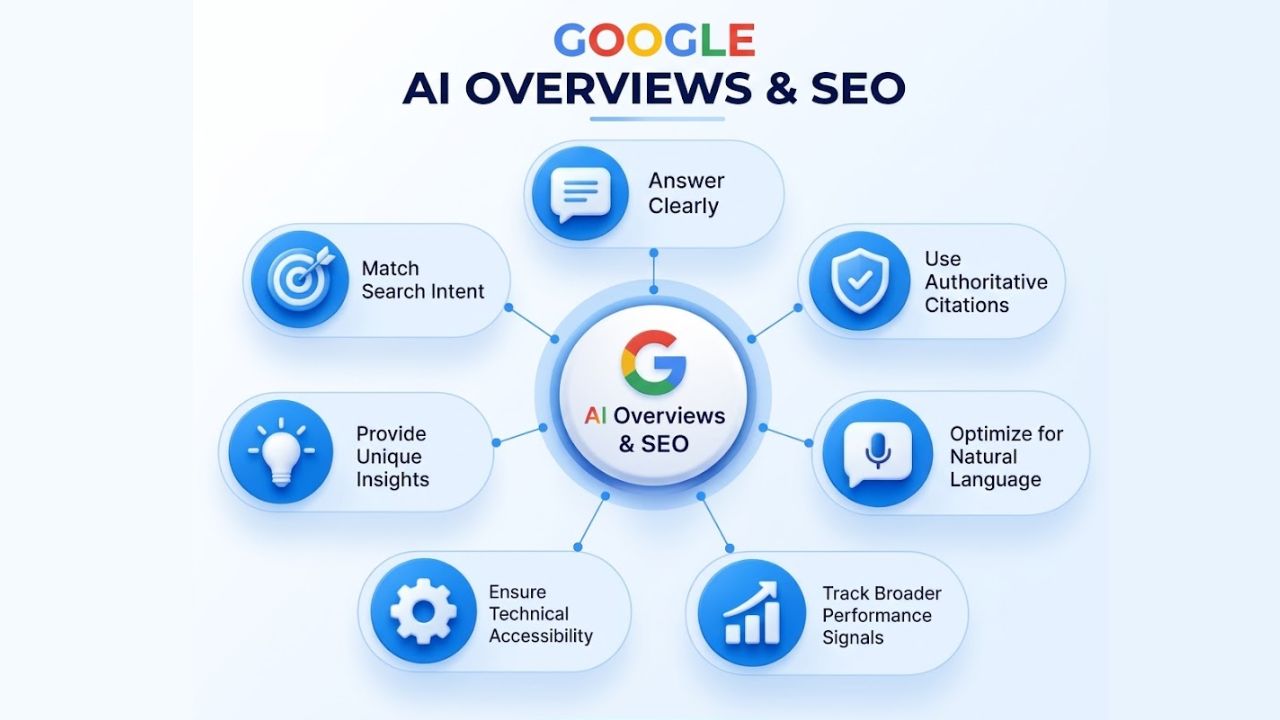
Google Search is changing how people discover information online. Instead of displaying only traditional links, Google AI Overviews can summarize a topic and provide links to websites that help users explore it further. This shift creates new opportunities for publishers, bloggers, businesses, and content creators. However, appearing in an AI-generated summary requires more than inserting keywords or adding a few technical changes to an existing page.
Google AI Overviews SEO best practices focus on the same core principles that support effective search engine optimization: useful content, reliable information, accessible web pages, and a satisfying user experience. Google’s official guidance confirms that website owners do not need special AI markup or separate optimization tricks to become eligible for AI Overviews. The practical goal is to create content that deserves to be discovered, referenced, and visited. Google Search Central’s AI features guidance explains these principles in detail.
Understanding Google AI Overviews and Their Impact on SEO
Google AI Overviews provide AI-generated summaries for selected searches. They help users understand complicated questions, explore related topics, and discover relevant websites through supporting links. Google does not display an AI Overview for every query. Its systems determine when an AI-generated response can add value to the search experience.
For website owners, this means search visibility involves more than traditional rankings alone. A page may attract visitors through a conventional result, a link within an AI Overview, or another search feature. These opportunities depend on the query, the content available, and Google’s systems. Publishers should therefore maintain their existing SEO strategy while improving the usefulness and originality of their content.
Create Helpful, Original Content That Adds Real Value
Originality is one of the most important principles for websites seeking sustainable visibility. Articles that repeat information already available across dozens of websites offer limited reasons for readers to visit. Instead, publishers should contribute meaningful explanations, firsthand experience, original reporting, expert insights, examples, or useful analysis.
For example, a technology website reviewing a new smartphone can go beyond listing its specifications. It can explain real-world battery performance, compare camera results, identify practical limitations, and discuss who would benefit from buying it. These details provide value that a basic specification summary cannot match. Google’s helpful, reliable, people-first content guidance encourages publishers to prioritize information that genuinely satisfies readers.
Structure Articles Around Real User Questions
Readers often search using complete questions rather than short keywords. They may want to understand a concept, compare two products, troubleshoot a problem, or decide whether a service suits their needs. Content that addresses these specific goals can make information easier to find and understand.
Start with the main question behind a page, then organize the article into logical sections. Use descriptive headings, concise explanations, examples, and supporting details. Answer the central question early instead of forcing readers to navigate several introductory paragraphs before reaching the useful information. Add related questions only when they help readers understand the topic more completely. This approach improves readability without requiring a rigid formula for AI-generated search visibility.
Follow Technical SEO Fundamentals
Even excellent content needs to be accessible to search engines. Google states that pages must be indexed and eligible to appear with a search snippet to qualify as supporting links in AI Overviews. Meeting these requirements does not guarantee that Google will index or display a page, but technical problems can limit its visibility.
Website owners should review several essential areas:
- Crawlability: Make sure important pages are not unintentionally blocked by robots.txt or other access restrictions.
- Indexing: Use Google Search Console to check indexing status and investigate unexpected exclusions.
- Internal linking: Connect related articles through descriptive links so readers and search engines can discover important pages.
- Mobile usability: Ensure content works properly on smartphones, tablets, and desktop devices.
- Page experience: Reduce unnecessary delays, intrusive interruptions, and confusing layouts.
- JavaScript accessibility: Check that important content remains available for Google to process.
Google’s SEO Starter Guide offers further guidance on building search-friendly websites.
Demonstrate Experience, Expertise, and Trustworthiness
Trust matters when readers rely on content to make decisions. Publishers should make it easy for visitors to understand who created an article, where important information came from, and whether the publisher has relevant experience.
Include clear author biographies, an informative About page, and editorial contact details where appropriate. Link to official documentation, original studies, public records, or other reliable sources when they support the article’s claims. Correct errors promptly and distinguish confirmed facts from estimates or speculation.
These practices are particularly important for health, finance, legal matters, and other topics where inaccurate information may cause harm. They also help technology and news publishers establish credibility. Trust signals are not a guaranteed shortcut into AI Overviews; they are part of building a useful, dependable website.
Use Structured Data Correctly
Structured data helps search engines understand certain information on a page. Depending on the content, eligible implementations may support specific search features, such as product details or other supported rich results.
However, publishers should not assume that adding schema automatically improves their chances of appearing in AI Overviews. Google says there is no special schema.org markup required for AI Overviews or AI Mode. If you use structured data, ensure it accurately represents the content visitors can see on the page and follows the relevant feature guidelines.
For example, a product page should not include ratings, prices, or availability details that contradict its visible information. Validate supported markup and fix errors through the appropriate testing tools. Accurate structured data supports clear communication with search engines, but it does not guarantee enhanced search placement.
Make Content Easy to Read and Navigate
Well-organized pages help readers find the information they need without unnecessary effort. Use a clear title, a focused introduction, descriptive subheadings, and paragraphs that develop one main idea at a time. Lists and tables can help readers compare options or follow instructions, but they should serve a genuine purpose rather than decorate every page.
Visual content can also improve an article when it adds information. Original screenshots, product photographs, diagrams, and explanatory videos may help readers understand a topic more effectively than text alone. Provide useful alternative text for meaningful images and ensure that important information is not available only inside an image or video.
Publishers should also avoid hiding essential content behind unnecessary interactions. Keep the main explanation accessible and make navigation intuitive. The objective is not to make every article follow an identical template. It is to make each page easy to understand and useful for its intended audience.
Avoid AI SEO Myths and Manipulative Shortcuts
As interest in AI-powered search grows, some services promise special techniques for getting content cited by AI systems. Such claims deserve careful scrutiny. Google’s current guidance says publishers do not need special AI files, dedicated AI markup, or a separate set of ranking tricks to appear in AI Overviews.
Other questionable tactics include creating large numbers of near-identical articles, adding repetitive keyword variations, and publishing superficial content solely to capture search traffic. Using generative AI to assist research or drafting is not automatically a problem. However, producing pages at scale without meaningful originality or user value can violate Google’s spam policies.
Use automation where it improves efficiency, but maintain editorial oversight. Check facts, add original insights, correct errors, and remove material that does not serve the reader. Review Google’s guidance on generative AI content before adopting automated publishing workflows.
Measure Performance and Improve Existing Content
SEO improvements should rely on evidence rather than assumptions. Google Search Console helps website owners understand how pages perform in Google Search, identify indexing problems, and investigate changes in impressions and clicks.
Google has also introduced reporting for generative AI search performance, giving website owners more insight into how their content appears across AI search experiences. Check the available reporting in your Search Console property and review the documentation for the metrics and features currently supported.
Use these insights to identify pages that need better explanations, stronger sourcing, updated information, or improved internal links. Compare performance over meaningful periods and account for seasonal changes, search demand, and changes in Google’s results. Do not assume every traffic decline comes from AI Overviews. Investigate the evidence before changing a successful content strategy.
Best Practices for Websites and Publishers: A Practical Checklist
A focused review can help teams turn these recommendations into everyday publishing habits.
- Create original content that answers a clear reader need.
- Use accurate titles and descriptive headings.
- Verify factual claims and cite trustworthy sources where appropriate.
- Keep important pages crawlable and eligible for indexing.
- Add relevant internal links to related resources.
- Ensure mobile users can read and navigate the site comfortably.
- Use structured data only when it fits the content and supported search features.
- Update articles when facts, products, policies, or recommendations change.
- Review authorship, editorial standards, and correction procedures.
- Monitor Search Console data and investigate performance changes.
- Avoid promises of guaranteed AI Overview placement.
These steps are useful for independent bloggers, newsrooms, e-commerce businesses, and large publishing teams. The priorities may differ by website, but the underlying principle remains consistent: build pages that deserve attention because they provide useful information.
Conclusion
Google AI Overviews SEO best practices are rooted in strong, established SEO fundamentals. Publishers should focus on original content, clear explanations, trustworthy sourcing, accessible technical structures, and a positive reading experience. No special markup or guaranteed ranking formula can ensure that a page appears in an AI-generated summary.
The most sustainable approach is to help readers accomplish their goals while making content easy for Google to discover and understand. Review technical performance, improve articles with meaningful information, and use available search data to guide decisions. As AI-powered search continues to evolve, websites that consistently deliver distinctive value will be better prepared to compete for visibility across changing search experiences.
Frequently Asked Questions
What is Google AI Overviews SEO?
Google AI Overviews SEO refers to applying established SEO practices to improve a website’s eligibility and overall visibility in Google’s AI-generated search summaries. It emphasizes useful content, technical accessibility, accuracy, and strong user experiences.
How can a website appear in Google AI Overviews?
Make sure your pages are accessible to Google, eligible for indexing, and compliant with Search policies. Publish helpful, original content that answers relevant questions. These steps support eligibility, but Google does not guarantee placement in an AI Overview.
Does Google require special schema markup for AI Overviews?
No. Google’s published guidance says there is no special schema.org markup required for AI Overviews or AI Mode. Use appropriate structured data for supported search features and ensure it matches the visible page content.
Does AI-generated content hurt SEO?
Not automatically. Google evaluates content based on its usefulness, quality, relevance, and compliance with its policies rather than simply whether AI helped create it. Publishing large amounts of low-value, unoriginal content may violate Google’s scaled content abuse policy.
Get More Update CONTENTORY