

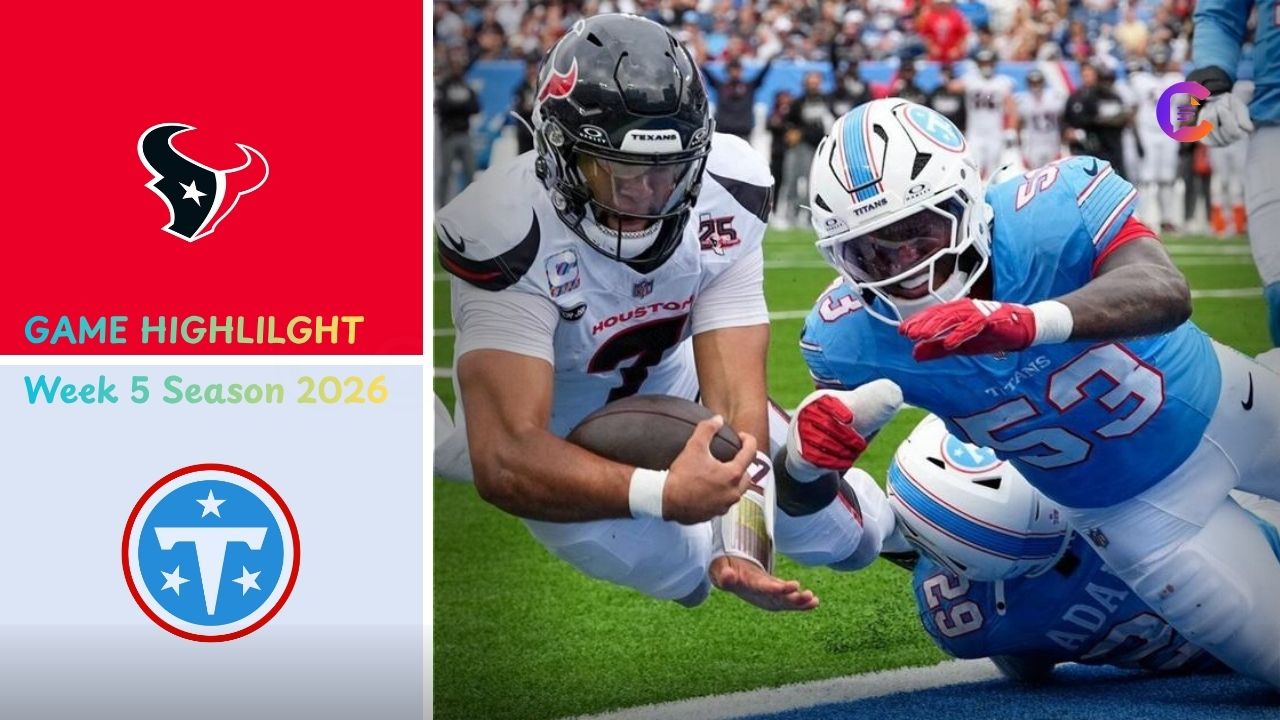
The Houston Texans earned their first win of the 2026 NFL season with a convincing 26–3 victory over the Tennessee Titans on Sunday, October 11. The AFC South rivals entered Week 5 searching for momentum after difficult starts. Houston delivered a strong response through balanced offensive production, reliable kicking, and an aggressive defensive performance. The Texans controlled the contest after Tennessee’s opening field goal and prevented the home team from scoring again for the remainder of the game.
C.J. Stroud led Houston with 261 passing yards, one passing touchdown, and one rushing touchdown. Kicker Ka’imi Fairbairn added four field goals, while the Texans’ defense repeatedly pressured quarterback Cam Ward. Tennessee finished with only 187 total yards and failed to reach the end zone. The result moved Houston to 1–4 and dropped Tennessee to 0–5. These player statistics reveal how Houston turned a close opening quarter into a decisive road victory.
Houston Texans vs Tennessee Titans Final Score
Houston won every quarter after the opening period, building its advantage through field goals before adding two touchdowns in the second half. Tennessee managed only three points, all from Joey Slye’s first-quarter field goal. Houston’s offense produced 329 total yards, compared with Tennessee’s 187, and held the ball for more than nine additional minutes.
| Team | Q1 | Q2 | Q3 | Q4 | Final |
|---|---|---|---|---|---|
| Houston Texans | 3 | 9 | 7 | 7 | 26 |
| Tennessee Titans | 3 | 0 | 0 | 0 | 3 |
Houston’s 23-point winning margin reflected its advantage in offensive efficiency and defensive pressure. The Texans converted four field goals before and during their touchdown drives, giving their defense room to attack. Tennessee could not establish a consistent scoring response after its first possession. Houston’s ability to turn promising drives into points proved especially important in the first half.
C.J. Stroud’s Passing Performance
Stroud completed 26 of 34 passes for 261 yards and one touchdown. He threw no interceptions and recorded a passer rating of 107.6. His completion rate exceeded 76%, helping Houston sustain drives and maintain control of the game. Tennessee’s defense recorded two sacks against him, but Stroud still found ways to move the offense forward.
| Passing stat | C.J. Stroud |
|---|---|
| Completions/Attempts | 26/34 |
| Passing yards | 261 |
| Completion rate | 76.5% |
| Passing touchdowns | 1 |
| Interceptions | 0 |
| Sacks taken | 2 |
| Passer rating | 107.6 |
Stroud’s performance mattered beyond his passing totals. He also scored on a two-yard rushing attempt in the third quarter, giving Houston another way to finish a drive. His composure helped the Texans avoid costly turnovers and capitalize on scoring opportunities. The combination of accurate passing and a rushing touchdown made him one of the game’s most influential performers.
Read Cleveland Browns vs New York Jets Match Player Stats and Final Score
Cam Ward and the Titans’ Passing Game
Cam Ward completed 23 of 36 passes for 170 yards. He threw one interception, did not record a passing touchdown, and took four sacks for a loss of 40 yards. His longest completion went for 23 yards, but Tennessee struggled to generate explosive plays consistently. Houston’s pressure disrupted the timing of the passing game and forced the Titans into difficult situations.
| Passing stat | Cam Ward |
|---|---|
| Completions/Attempts | 23/36 |
| Passing yards | 170 |
| Completion rate | 63.9% |
| Passing touchdowns | 0 |
| Interceptions | 1 |
| Sacks taken | 4 |
| Passer rating | 63.4 |
Ward found several receivers throughout the afternoon, yet those completions rarely translated into scoring chances. Tennessee’s offense managed only one field goal and could not answer Houston’s second-half touchdowns. The sacks also reduced the value of the Titans’ passing gains. Ward’s numbers illustrate the difficulty of sustaining an offense against a defense that controlled the line of scrimmage.
Houston Texans Rushing Statistics
Houston recorded 79 net rushing yards on 27 attempts. Woody Marks led the team with 62 yards on 15 carries, providing the Texans with their most productive ground contribution. David Montgomery added 11 yards on five attempts before leaving the game with a groin injury. Stroud contributed five rushing yards and scored Houston’s first touchdown of the second half.
| Player | Carries | Rushing yards | Touchdowns |
|---|---|---|---|
| Woody Marks | 15 | 62 | 0 |
| David Montgomery | 5 | 11 | 0 |
| C.J. Stroud | 6 | 5 | 1 |
| Jaylin Noel | 1 | 1 | 0 |
Marks helped Houston keep its offense balanced after Montgomery exited. Although the Texans averaged fewer than three yards per rushing attempt, their ground game contributed to sustained possessions and helped manage the clock. Stroud’s touchdown run was particularly valuable because it turned Houston’s growing lead into a two-score advantage. The Texans did not need a huge rushing total because their passing game and defense handled the other key tasks.
Tennessee Titans Rushing Statistics
Tennessee finished with 57 net rushing yards on 18 attempts. Tony Pollard led the Titans with 52 yards on 14 carries, accounting for most of the team’s ground production. Kalel Mullings added three yards, while Ward recorded two rushing yards. Tyjae Spears had two carries but finished without a positive net rushing total.
| Player | Carries | Rushing yards | Touchdowns |
|---|---|---|---|
| Tony Pollard | 14 | 52 | 0 |
| Kalel Mullings | 1 | 3 | 0 |
| Cam Ward | 1 | 2 | 0 |
| Tyjae Spears | 2 | 0 | 0 |
Pollard produced the Titans’ strongest rushing performance, but Tennessee could not build a consistent attack around him. The team averaged approximately 3.2 yards per rushing attempt and never scored a rushing touchdown. Houston’s defense limited the Titans’ options on early downs, making the passing game increasingly important. With Ward under pressure and the offense trailing, Tennessee struggled to find a reliable path back into the contest.
Houston Texans Receiving Leaders
Houston spread the ball across several targets, with Xavier Hutchinson leading the team in receiving yards. Hutchinson caught four passes for 65 yards, while Nico Collins recorded five receptions for 56 yards. Jaylin Noel caught five passes for 41 yards and scored the Texans’ fourth-quarter touchdown. Dalton Schultz, Kayshon Boutte, and Woody Marks also contributed to the passing attack.
| Receiver | Receptions | Receiving yards | Touchdowns |
|---|---|---|---|
| Xavier Hutchinson | 4 | 65 | 0 |
| Nico Collins | 5 | 56 | 0 |
| Jaylin Noel | 5 | 41 | 1 |
| Kayshon Boutte | 3 | 38 | 0 |
| Dalton Schultz | 3 | 30 | 0 |
| Woody Marks | 4 | 23 | 0 |
| Foster Moreau | 2 | 8 | 0 |
Noel delivered the game’s final touchdown on a nine-yard pass from Stroud in the fourth quarter. Collins provided a dependable option, while Hutchinson’s yardage helped stretch the field. The distribution showed how Houston could move the ball without relying on a single receiver. That variety made the offense harder to contain and helped Stroud complete more than three-quarters of his passes.
Tennessee Titans Receiving Leaders
Wan’Dale Robinson led Tennessee with six receptions for 53 yards. Calvin Ridley added two catches for 33 yards, including the team’s longest reception of 23 yards. Tyjae Spears caught nine passes for 28 yards, giving Ward a frequent short-range option. Chimere Dike added three receptions for 28 yards, while Elic Ayomanor, Carnell Tate, and Daniel Bellinger recorded smaller contributions.
| Receiver | Receptions | Receiving yards | Touchdowns |
|---|---|---|---|
| Wan’Dale Robinson | 6 | 53 | 0 |
| Calvin Ridley | 2 | 33 | 0 |
| Tyjae Spears | 9 | 28 | 0 |
| Chimere Dike | 3 | 28 | 0 |
| Elic Ayomanor | 1 | 17 | 0 |
| Carnell Tate | 1 | 6 | 0 |
| Daniel Bellinger | 1 | 5 | 0 |
Robinson led the Titans in receiving yards, while Spears caught the most passes among the listed receivers. However, Tennessee struggled to turn short completions into significant gains. The team recorded no receiving touchdowns, and its limited explosive production kept Houston’s defense in control. The Titans needed more downfield success and better protection to create a realistic scoring threat.
Defensive Highlights: Will Anderson Jr. Leads Houston
Houston’s defense played a central role in the victory. Will Anderson Jr. recorded three sacks, putting sustained pressure on Ward and helping disrupt Tennessee’s offensive rhythm. Danielle Hunter also registered a sack. The Texans finished with four team sacks and held the Titans to 187 total yards, preventing them from scoring after the opening field goal.
Jake Hansen added an interception, giving Houston another key defensive play. The Texans also limited Tennessee’s rushing production and forced the offense into challenging passing situations. Their pressure became particularly effective as the game progressed, with Anderson making several major plays late. The performance offered Houston a strong defensive foundation after its difficult start to the season.
Explore Cincinnati Bengals vs Miami Dolphins Match Player Stats and Game Highlights
Ka’imi Fairbairn’s Four Field Goals
Fairbairn supplied 12 points through four successful field goals. He converted attempts from 45, 35, 26, and 53 yards, helping Houston establish control before its touchdowns arrived. His longest kick came from 53 yards in the second quarter. Every successful attempt increased the pressure on Tennessee to produce an answer.
Joey Slye scored Tennessee’s only points with a 30-yard field goal in the first quarter. After that opening score, the Titans failed to add anything to the scoreboard. Fairbairn’s reliability ensured Houston made the most of its scoring opportunities, even when drives ended before reaching the end zone. His performance was an important part of the Texans’ comfortable final margin.
Quarter-by-Quarter Game Breakdown
The Titans opened the scoring with Slye’s 30-yard field goal. Houston answered with Fairbairn’s 45-yard kick, leaving the teams tied at 3–3 after the first quarter. The Texans took command in the second quarter, adding three field goals from 35, 26, and 53 yards. That sequence gave Houston a 12–3 halftime lead.
Stroud extended the advantage in the third quarter with a two-yard rushing touchdown, pushing the score to 19–3. Tennessee could not respond with a scoring drive, leaving Houston firmly in control entering the final period. Stroud then connected with Noel for a nine-yard touchdown in the fourth quarter. Fairbairn’s extra point completed the 26–3 result and sealed Houston’s first win of the season.
Team Statistics and Key Differences
The team numbers highlight Houston’s advantage in possession, yardage, and scoring efficiency. The Texans recorded 20 first downs compared with Tennessee’s 15. Houston gained 329 total yards, while the Titans managed 187. The Texans also held possession for 34 minutes and 39 seconds, giving their offense more time to work and their defense more opportunities to pressure Ward.
| Team statistic | Houston | Tennessee |
|---|---|---|
| First downs | 20 | 15 |
| Total net yards | 329 | 187 |
| Net rushing yards | 79 | 57 |
| Net passing yards | 250 | 130 |
| Third-down efficiency | 6/12 | 4/11 |
| Sacks taken | 2 | 4 |
| Interceptions thrown | 0 | 1 |
| Time of possession | 34:39 | 25:21 |
| Field goals made | 4 | 1 |
| Total points | 26 | 3 |
Houston’s passing production, defensive pressure, and longer possessions created the clearest statistical separation. Tennessee also committed a turnover and struggled to convert third downs. The Texans had 11 penalties for 95 yards, so discipline remained an area for improvement despite the victory. Even with those penalties, Houston controlled the important categories and finished with a decisive win.
What the Result Means for Both Teams
For Houston, the victory ended its winless start and offered evidence that its defense could influence a game from beginning to end. Stroud’s efficient passing, his rushing touchdown, and Fairbairn’s perfect field-goal performance gave the offense several ways to score. The defensive line’s pressure was equally important. Houston will look to build on this performance and carry the same intensity into its next matchup.
Tennessee faced a different outlook after falling to 0–5. The Titans showed some early promise with their opening field goal, but their offense produced no further points. Ward needs stronger protection and more explosive plays, while the team must find better ways to sustain drives. The loss also highlighted how quickly a game can get away when a defense cannot stop the opponent’s scoring rhythm.
Conclusion
The Houston Texans vs Tennessee Titans matchup ended with a 26–3 Houston victory, driven by efficient quarterback play, reliable kicking, and a dominant defensive effort. Stroud finished with 261 passing yards and two total touchdowns, while Fairbairn converted all four of his field-goal attempts. Anderson’s three sacks helped restrict Tennessee’s offense to 187 total yards and just one scoring drive.
The final score reflected Houston’s control after the opening quarter. The Texans turned field goals into a halftime lead, added touchdowns in both halves, and shut Tennessee out after its first possession. For Houston, the win provided a much-needed breakthrough in Week 5. For Tennessee, the result exposed offensive issues that must be addressed before the team can reverse its season.
Get More Update CONTENTORY