

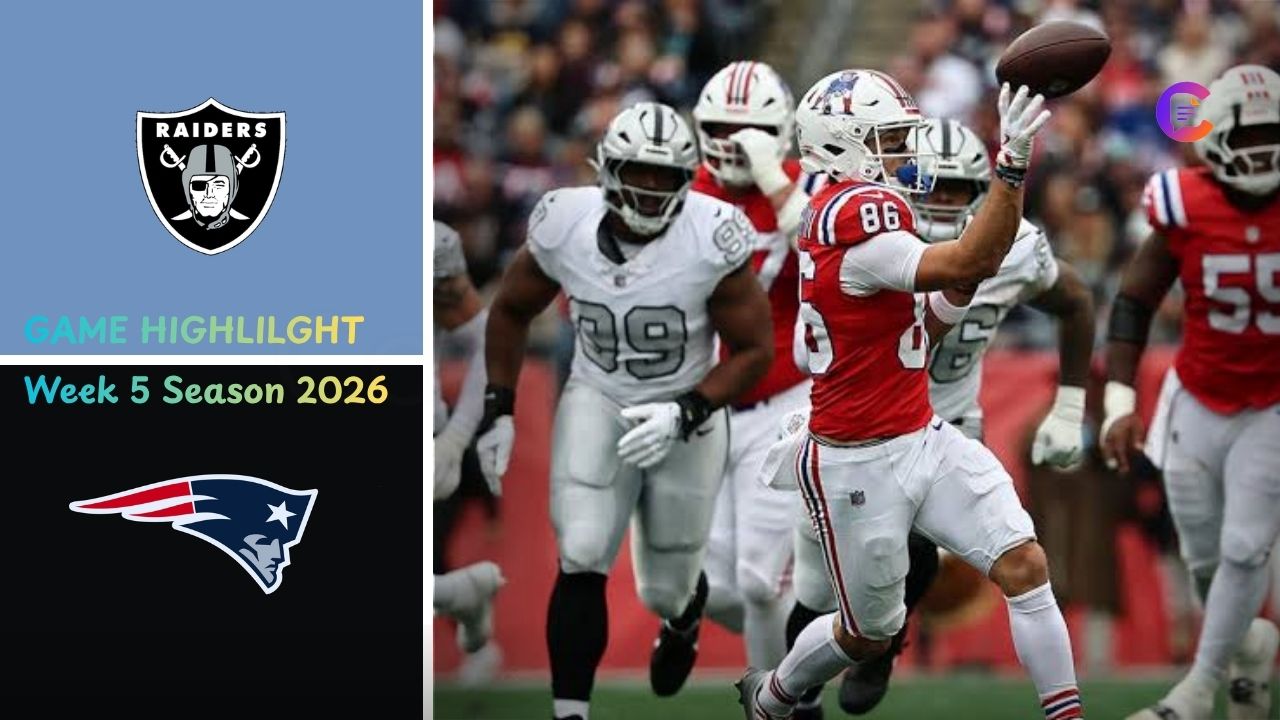
The New England Patriots delivered an impressive performance against the Las Vegas Raiders on October 11, 2026, earning a commanding 45–17 victory at Gillette Stadium. The Week 5 matchup showcased New England’s offensive firepower, efficient quarterback play, and ability to capitalize on scoring opportunities. Drake Maye led the attack with 374 passing yards and five total touchdowns. The Patriots combined explosive passing plays with an effective running game to secure their third win of the season.
Las Vegas produced some promising individual performances but struggled to match New England’s scoring pace. Quarterback Kirk Cousins threw for 243 yards and a touchdown, while tight end Brock Bowers recorded 110 receiving yards and a score. However, the Raiders allowed 536 total yards and failed to maintain defensive pressure throughout the contest. New England’s balanced offense and timely defensive stops created a decisive gap, leaving the Raiders searching for answers after a difficult road defeat.
Final Score and Quarter-by-Quarter Results
| Team | Q1 | Q2 | Q3 | Q4 | Final |
|---|---|---|---|---|---|
| Las Vegas Raiders | 7 | 0 | 3 | 7 | 17 |
| New England Patriots | 14 | 7 | 14 | 10 | 45 |
The Patriots scored 14 points in the opening quarter and continued building their advantage throughout the game. New England led 21–7 at halftime before adding another 14 points in the third quarter. The Raiders scored a touchdown in both the first and fourth quarters, but their third-quarter field goal could not keep pace with the Patriots’ repeated scoring drives.
New England’s fast start gave Maye and the offense room to operate. The Patriots stretched the field with long touchdown passes and added points through their running game. Las Vegas briefly threatened to remain competitive, but the Raiders could not produce enough defensive stops. The 28-point margin reflected New England’s superiority in total yardage, offensive efficiency, and touchdown production.
Drake Maye’s Outstanding Passing Performance
Drake Maye delivered one of his strongest performances of the season. He completed 26 of 34 passes for 374 yards and four touchdowns without throwing an interception. Maye also scored a rushing touchdown, giving him five total touchdowns. His ability to attack downfield created repeated problems for the Raiders’ secondary and helped New England generate its highest-scoring performance of his starting tenure.
| Passing statistic | Drake Maye |
|---|---|
| Completions/Attempts | 26/34 |
| Passing yards | 374 |
| Completion percentage | 76.5% |
| Passing touchdowns | 4 |
| Interceptions | 0 |
| Rushing touchdowns | 1 |
| Total touchdowns | 5 |
Maye connected with several receivers, including DeMario Douglas, Kyle Williams, and Hunter Henry. His downfield accuracy helped New England turn open receivers into major gains and touchdowns. He also avoided turnovers, allowing the Patriots to maintain possession and continue applying pressure. Maye’s performance was the central reason New England controlled the matchup from the opening quarter.
Kirk Cousins Leads the Raiders’ Passing Attack
Kirk Cousins completed 19 of 28 passes for 243 yards and one touchdown. He did not throw an interception, giving Las Vegas a reasonably efficient passing performance despite the heavy defeat. Fernando Mendoza also appeared in the passing game, completing six of eight attempts for 48 yards. However, the Raiders could not match Maye’s scoring output or generate enough sustained drives to challenge New England.
| Passing statistic | Kirk Cousins | Fernando Mendoza |
|---|---|---|
| Completions/Attempts | 19/28 | 6/8 |
| Passing yards | 243 | 48 |
| Passing touchdowns | 1 | 0 |
| Interceptions | 0 | 0 |
Cousins found Bowers for a touchdown and helped Las Vegas reach 306 total yards. Still, the offense fell well short of New England’s 536 yards. The Raiders also struggled to maintain possession, holding the ball for only 25 minutes and 33 seconds. Their passing game produced yardage, but it did not deliver enough touchdowns to keep the contest close.
Explore Houston Texans vs Tennessee Titans Match Player Stats Full Game Breakdown
Brock Bowers Leads Las Vegas Receivers
Brock Bowers was the Raiders’ leading receiving threat. He caught eight passes for 110 yards and one touchdown, giving Cousins a dependable target throughout the game. Bowers’ production showed that Las Vegas could move the ball through the air, particularly when the offense used him to exploit openings across the middle and downfield.
| Raiders receiver | Receptions | Receiving yards | Touchdowns |
|---|---|---|---|
| Brock Bowers | 8 | 110 | 1 |
| Ashton Jeanty | 3 | 50 | 0 |
| C. White | 2 | 44 | 0 |
| Tre Tucker | 4 | 41 | 0 |
| Dylan Laube | 3 | 16 | 0 |
| Ian Thomas | 1 | 9 | 0 |
| D. Thompkins | 1 | 8 | 0 |
| Michael Benson | 1 | 6 | 0 |
| Malik Washington | 1 | 5 | 0 |
| Michael Mayer | 1 | 2 | 0 |
Ashton Jeanty added 50 receiving yards, while C. White contributed 44. Tre Tucker also caught four passes for 41 yards. The Raiders spread the ball among several targets, but Bowers remained their most productive option. His touchdown helped the offense get on the scoreboard, although New England’s defense prevented Las Vegas from maintaining a consistent scoring rhythm.
New England’s Receiving Leaders
The Patriots’ receiving group made the most of Maye’s accurate passing. Kyle Williams led the team with 91 yards on three catches and scored a touchdown. DeMario Douglas added 65 yards and two touchdown receptions, while Efton Chism III recorded five catches for 57 yards. Hunter Henry contributed 44 yards and a touchdown, giving New England several scoring threats.
| Patriots receiver | Receptions | Receiving yards | Touchdowns |
|---|---|---|---|
| Kyle Williams | 3 | 91 | 1 |
| DeMario Douglas | 4 | 65 | 2 |
| Efton Chism III | 5 | 57 | 0 |
| E. Raridon | 5 | 57 | 0 |
| Hunter Henry | 3 | 44 | 1 |
| Rhamondre Stevenson | 3 | 21 | 0 |
| Romeo Doubs | 1 | 16 | 0 |
| TreVeyon Henderson | 1 | 16 | 0 |
| C. Kiner | 1 | 7 | 0 |
Douglas scored on a 35-yard reception, while Williams added a 34-yard touchdown catch. Henry also found the end zone, helping the Patriots maintain their advantage. This distribution made New England difficult to defend because the Raiders could not focus on a single receiver. Maye’s ability to find different targets helped the Patriots turn passing opportunities into points.
Rushing Statistics: Rhamondre Stevenson Leads New England
Rhamondre Stevenson led New England’s rushing attack with 64 yards on 13 carries and scored a touchdown. C. Kiner added 52 yards on six attempts, giving the Patriots another productive runner. Maye contributed 25 rushing yards and a touchdown, while TreVeyon Henderson recorded 22 yards before leaving the game with an injury.
| Patriots rusher | Carries | Rushing yards | Touchdowns |
|---|---|---|---|
| Rhamondre Stevenson | 13 | 64 | 1 |
| C. Kiner | 6 | 52 | 0 |
| Drake Maye | 7 | 25 | 1 |
| TreVeyon Henderson | 4 | 22 | 0 |
| Efton Chism III | 1 | 2 | 0 |
The Patriots’ rushing production complemented Maye’s passing success. Stevenson’s touchdown helped New England score in the red zone, while Kiner’s gains provided useful support. Maye’s rushing score added another dimension to the offense and forced the Raiders to defend both the quarterback and the running backs. New England did not depend entirely on passing plays to create its scoring advantage.
Explore Indianapolis Colts vs Pittsburgh Steelers Match Player Stats Key Performers
Raiders Rushing Statistics and Dylan Laube’s Touchdown
Las Vegas struggled to establish a consistent rushing attack. Ashton Jeanty carried the ball 10 times for 27 yards, while Dylan Laube recorded four carries for nine yards and a touchdown. Malik Washington gained five yards on one attempt, and Cousins and Mendoza also contributed small rushing totals. The team’s limited ground production made it harder to control the clock or reduce New England’s offensive opportunities.
| Raiders rusher | Carries | Rushing yards | Touchdowns |
|---|---|---|---|
| Ashton Jeanty | 10 | 27 | 0 |
| Dylan Laube | 4 | 9 | 1 |
| Malik Washington | 1 | 5 | 0 |
| Fernando Mendoza | 1 | 3 | 0 |
| Tre Tucker | 2 | -6 | 0 |
Laube’s touchdown gave the Raiders a positive moment late in the game, but it came after New England had established a substantial lead. Jeanty’s 27 rushing yards were modest, and the offense could not consistently create favorable second- and third-down situations. Las Vegas needed more production on the ground to complement Cousins’ passing and keep the Patriots’ defense from focusing on the aerial attack.
Team Statistics and Overall Comparison
The team statistics show why New England controlled the game. The Patriots recorded 536 total net yards and 29 first downs, compared with 306 yards and substantially fewer scoring opportunities for Las Vegas. New England also held the ball for 34 minutes and 27 seconds. The Raiders managed just 25 minutes and 33 seconds of possession, giving Maye and the Patriots more opportunities to build their lead.
| Team statistic | Las Vegas Raiders | New England Patriots |
|---|---|---|
| Final score | 17 | 45 |
| Total net yards | 306 | 536 |
| Passing yards | 291 | 374 |
| Rushing yards | 15 | 162 |
| Time of possession | 25:33 | 34:27 |
| Penalties | 8 | 12 |
| Penalty yards | 101 | 116 |
New England’s advantage came from both passing and rushing production. The Patriots combined deep throws with an effective ground attack, while the Raiders struggled to produce consistent rushing gains. Although New England committed more penalties and lost more penalty yards, its offensive output outweighed those mistakes. The Patriots’ ability to score touchdowns rather than settle for field goals proved especially important.
Defensive Analysis and Key Turning Points
New England’s defense helped protect the lead by limiting the Raiders’ ability to answer the Patriots’ scoring drives. Las Vegas produced 306 total yards, but it could not maintain the same offensive efficiency as its opponent. The Patriots’ defense forced the Raiders to work for their points and prevented them from turning every promising possession into a touchdown.
The game’s key turning point was New England’s explosive start. Maye’s touchdown passes to Douglas and Williams helped create separation, while the Patriots continued scoring after halftime. Las Vegas needed a defensive stop and a quick offensive response to stay within reach. Instead, New England added another 14 points in the third quarter and kept extending the lead. The Patriots’ combination of downfield passing, rushing touchdowns, and possession control settled the contest.
What the Result Means for Both Teams
The victory improved New England’s record to 3–2 and marked its second consecutive win. Maye’s five total touchdowns offered a strong sign of offensive progress, while the receiving group showed depth despite injuries affecting the roster. The Patriots produced 45 points and 536 yards, demonstrating how effectively their passing and rushing attacks worked together. Maintaining that balance will be important as the schedule continues.
Las Vegas also moved to 3–2 despite the loss, but the result exposed concerns on defense and in the running game. Bowers had an excellent receiving performance, and Cousins avoided interceptions, yet the Raiders could not keep pace with New England. Improving defensive coverage and generating more rushing production will be essential. The Raiders must also find ways to limit explosive touchdowns when facing high-powered offenses.
Conclusion
The Las Vegas Raiders vs New England Patriots matchup ended in a convincing 45–17 victory for New England. Drake Maye was the standout performer with 374 passing yards, four passing touchdowns, and one rushing touchdown. DeMario Douglas caught two touchdown passes, Kyle Williams delivered a long scoring reception, and Rhamondre Stevenson contributed a rushing touchdown. Together, those performances helped the Patriots generate 536 total yards.
The Raiders had notable individual contributions from Kirk Cousins and Brock Bowers, but their offense could not match New England’s scoring pace. Bowers finished with 110 receiving yards and a touchdown, while Dylan Laube added a rushing score. However, Las Vegas struggled to establish its ground game and prevent explosive passing plays. New England’s superior offensive production and more effective scoring drives ultimately decided the Week 5 contest.
Get More Update CONTENTORY